Kelli tagged the blogosphere on this one:
"A few questions to share my Thanksgiving day with you..."
1. Which do you like better: hosting Thanksgiving at your home, or going elsewhere?
Someday, we'll host. Until then, I'll bring the turnips. And sometimes Brussels sprouts.
2. Do you buy a fresh or frozen turkey? Organic? Free-range? Tofurkey?
In college, my friend Nick used Tofurkey as an escalated swear word (Tofu --> Tofutti--> Tofurkey). I agree.
3. Do you make stuffing or dressing? What kind?
My MIL makes the sausage stuffing, one wet one dry. I eat it. Good deal for me.
4. Sweet potato pie or Pumpkin pie?
Can't get sweet potato often enough to prefer it, but it's good when I get it.
5. Are leftovers a blessing or a curse?
This isn't even a real question. They're a delight of the first order.
6. What side dishes are a must-have in your family?
Mashed turnip, stuffed mushrooms, 3+ others. I make the turnip for me. That my wife eats some is the truest evidence of her love for me.
7. What do you wish you had that might make Thanksgiving easier?
A La-Z-Boy to facilitate footballnapping.
8. If/when you go to someone else’s house for the holiday, do you usually bring a dish? If so, what is it?
The above-mentioned turnip. If it's really only for me, I should prepare it, no?
9. What is your favorite after-Thanksgiving activity?
Board games until at least one of us erodes into irrepressible giggling. Doesn't usually take long.
10. Share one Thanksgiving tradition.
My daughter preparing a blessing.
11. Share one Thanksgiving memory.
During after-dinner gaming one year, playing Uno Attack ("Uno Spitto" to her friends), my Mother managed to cause a playing card to helicopter the length of the table and land in her coffee. Nothing but net. Took ten minutes and 14 tissues for us to recover from that gigglefit.
12. Name five things you’re thankful for.
1. My delightful loving supportive family -- every circle of it, every day.
2. A job that lets me have a small hand in improving people's lives.
3. The geographic accident that placed me in the NJ Poetry Community; living at a time when my poetry community includes friends in 10 states, some of whom I've only "met" through the window of this little spot on the WWWeb.
4. Good health in those nearest me who have it, good care for those nearest me that need it.
5. Having great people in my life - at work, at home, in art, and at the bowling alley - who have the skill to teach me, the will to teach me, and the time to teach me.
Learn something every day: That's the way I practice my gratitude.
Thanks for the impetus, Kelli, and Happy Thanksgiving to all!
Thursday, November 26, 2009


Wednesday, November 18, 2009
Where the month has gone (a play in 3 excuses)
Wow. You blink and it's two weeks later. How does THAT happen? Anyway, here's what's been going on.
Well, work's been busy, but I know that none of you, my six loyal readers, are here to read about that.
* * *
Last week I presented a lunchtime poetry seminar to the Seniors group at my church. I had read about LifeVerse and proposed a talk to the group a few months ago, but right up to the night before, I wasn't entirely sure I was going to do. I learned that the idea of a writing workshop wasn't going to be appealing the group, so I set out to assemble a short program on the theme of "What Poetry Can Deliver": an assortment of unusual metaphors, a love poem someone who doesn't live with poetry might be surprised to by, and since it was a church group, at least one prayer poem. Aside from a few of my own poems, here's what I wound up presenting:
"November", Billy Collins (timely)
"Not Rose Petals", BJ Ward (a love poem with an unusual metaphor)
"Nonsense Song", W.H. Auden (a little fun in the form of a love poem)
"Fork", Charles Simic (poems can be about anything)
"Prayer", Joe Weil (prayer poem)
"Joy is the Grace we Say to God", Ray Bradbury (prayer poem)
I did go in expecting that there wouldn't be many poetry fans in the audience, and I debated presenting more classic work, but opted in the end to present work I loved and trust that my enthusiasm and the quality of the work would carry the day. Turned out to be a good call.
Should I have been surprised at the reaction? At one lady approaching me at the end for a copy of Joe Weil's poem? Or someone asking for copies of my own work? Or someone asking where she could find more of BJ Ward's work? I suppose not. And yet I was.
* * *
This week, despite a case of pink eye that's been wandering my house trying to catch me, I was able to slip out to attend a professional society meeting (always refreshing) and to sit in on a great reading by John Trause, part of a new series hosted by Rick Mullin at Tasty Coco in Caldwell. John is equal parts poet, entertainer, and historian (or is that redundant?), and you can get a good feel for the event over at Rick's place.
Would have been enough just to hear John, but it was also a terrific open, my own effort a kindergarten contribution to a grad school seminar. Great stuff.
* * *
So that's the last couple. Next up is finding a new recipe for Brussels sprouts for Thanksgiving and getting ready to mash the annual turnip.
And other things, maybe.
Tuesday, November 03, 2009
Debrief on de Koninck
We had a nice crowd at Sunday's Spoken Word Series event - 15 people counting the late arrivals and early departures, about half invited directly by featured reader Jessica de Koninck. Jessica read mostly new poems, commenting early on that many people find her work unhappy; that's certainly true of her firs book Repairs, which is advertised as a meditation on loss (I find it more a coupling of the ordinary details of keeping on with the extraordinary feelings of absence and familiarity that accompany the passing (or leaving) of someone close.
The poems that Jessica read - about her children, about cooking her Grandmother's traditional dishes - were exactly what I find most compelling in the poems I like: The discovery of something extraordinary in an otherwise ordinary observation. Jessica's are poems written from a grounding tradition without being "traditional" poems - they don't celebrate tradition explicitly so much as they find the pointer in the tradition that directs us back to ourselves.
Jessica does less embellishing between poems than many readers, but still was comfortable when one of our regular called out for an encore (fairly common in our events...). All in all, whether the poems had a bit of darkness in them or not, it was an entertaining afternoon. Jessica's been busy with appearances around NJ lately; catch her when she visits your area!
Sunday, November 01, 2009
Jack Wiler 1951-2009
Looking for God in Downtown Jersey City
The soul tonight is a shopping bag
Plastic
Floating lightly above a rusted gate.
I found it on my kitchen counter weighted down with
mustard and toilet paper.
I emptied out the garbage and when my back was turned
the soul fled
lifted up on the wind and out over fourth street
through the streets of Jersey City
people look up cross themselves
their eyes bright for an instant
The soul reflecting back pure white.
Dogs and children see it and laugh for a moment
we are all of us full and clean and
pure in the reflected glory of the plastic soul
we have glimpsed for just a moment.
Then it's gone.
A child steps back for a chance at a second look
At something else
white and plastic and high above us
that we can admire as not of our bodies.
(from I Have No Clue, Long Shot Productions, 1996)
Got the news today of Jack Wiler's passing last month. Jack read for us in Hoboken in 2004. Jessica de Koninck, our featured reader today, paid tribute to Jack by reading his excellent "Belief Systems" at Symposia bookstore, in the same room he'd presented it five years ago. It's a poem that has inspired with grateful attribution several other poems -- at least one of which has also been heard in Hoboken.
I didn't know Jack all that well, other than through his work and the praise that it and he received whenever his name came up among NJ poets.
Jack's book Fun Being Me ends with these words:
But it's God's world and it's His noise and it never stops.
It would be sweet if all of God's names were names we know.
It would be sweet.
Tuesday, October 27, 2009
Jessica de Koninck this Sunday in Hoboken!
Jessica G. de Koninck
October’s Spoken Word Artist
For Immediate Release: October 20, 2009
Performance Date: November 1, 2009, at 3 p.m., with open microphone following
Location: Symposia Bookstore, 510 Washington St., Hoboken, NJ (Accessible by PATH & Light Rail), www.symposia.us
Admission: FREE, with $3 suggested donation
Information: www.debaun.org/SpokenWordSeries.html or 201-216-8933
Hoboken, NJ: For the third installment of the 2009–2010 Spoken Word Series, DeBaun Center for Performing Arts and curator David Vincenti have chosen a well-published artist to be featured on Sunday, November 1, 2009, at 3 p.m.—Jessica G. de Koninck. The Spoken Word Series, co-hosted by Siobhan Barry-Bratcher and David Vincenti, is presented monthly at Symposia Bookstore, 510 Washington St., Hoboken, NJ.
Jessica G. de Koninck’s first collection Repairs, a series of poems about loss, was published by Finishling Line Press. Among numerous journals and anthologies, her poems appear in print in The Ledge, Bridges, the Paterson Literary Review, the Edison Literary Review and US 1 Worksheets and on-line in The Valparaiso Poetry Review and elsewhere. She has been nominated for a Pushcart Prize. A former Councilwoman and resident of Montclair, New Jersey, she is pursuing an MFA at Stonecoast. Also an attorney, Jessica is counsel to the South Orange and Maplewood Public Schools.
Jessica will read from her works and then the microphone will be open to the public to share their work. Although it is not necessary to pre-register to attend the event, those interested in sharing their work during the open mic are asked to sign up at 2:45 p.m. Open mic participants are asked to limit their work to five minutes per person.
The Spoken Word Series takes place at Symposia Bookstore, 510 Washington St., Hoboken, NJ. Symposia is the only used bookstore in Hoboken and has great prices for used books, wireless Internet access and many events every week. This is the sixth year DeBaun Center for the Performing Arts and Symposia Bookstore have teamed up to co-produce the Series. With each reading, more and more people are introduced to this wonderful bookshop and the work of many superb artists.
For more information, please visit www.debaun.org/SpokenWordSeries.html, email Center@debaun.org or call 201-216-8933.
The next Spoken Word event will be on December 6, 2009, at 3 p.m. with Linda Radice.
Saturday, October 24, 2009
The Dragon and the Bomb
Today's Literary Quote the Day at iGoogle is from W. H. Auden: "A poet can write about a man slaying a dragon, but not about a man pushing a button that releases a bomb."
Boy, I hate to disagree with a genius, but......
Seems to me that a more accurate (though admittedly less pithy) thought would be "It's easier for a poet to write a good poem about a man slaying a dragon than a good poem about a man pushing a button that releases a bomb." And stated this way, the justification is simple: distance.
It's easier (for most) to attain emotional distance from the romantic medieval fiction than from the difficult modern fact. And because of that, the bomber poems can fall much more easily into triteness or worse: political prose attempting to hide in a poem. For many of us who call ourselves "poets", attention to craft does down when we have "something important" to say. Billy Collins once noted that his poetry improved when he "realized he had nothing to say", his point being that many grand subjects had been written about before, often by the literary giants who preceded us, and to write something meaningful on those subjects meant to exceed their greatness.
Of course, the problem with many of us who all ourselves "poets" is a deplorable interest in our own history, a lack of awareness of those greats and an accompanying inflated sense of our own efforts. But that's another post.
What this means to me is that if you can find a way into the bombardier's seat that isn't a simplistic description of the ensuing horror or the pat discussion of conflict in his year, you can write that poem about the man dropping a bomb. If you can take what's going on in that instant and apply the filter of form or language to open it up to different interpretations, that subject should be wide open to you. It's just much harder to do it well.
It's this kind of logic that causes me to gravitate to my pet subjects, areas which for one reason or another are less crowded or lend themselves to reinterpretation or repurposing in verse.
Of course, this doesn't even begin to address the subject of the respective target audiences in Auden's original quote and the implications understanding them might have for the poem. Who do you think would be more open, less critical: dragonstory fans or devotees of the military and political?
Friday, October 23, 2009
A Few, Little, Tired Bits
Oh, my. You know the place writing has in your life when the hobbies hits the fan, so to speak. Let me set the tap to "drip, drip, drivel" and see if I have anything interesting to say.
***
It's been a phenomenal month on the New Jersey poetry scene. If you're already in Peter Murphy's PoetryNJ Yahoo Group, or a regular visitor to Anthony Buccino's NJ Poets and Poetry, or a subscriber to the Delaware Valley Poets list, or connected to one of the other terrific sources of information in our wonderful Garden State poetry community, you should get there.
How good is this month? Check out these events scheduled opposite each other next week:
ERIC HOFFMAN, BURT KIMMELMAN & MADELINE TIGER in Monclair
Thursday, October 29, 7:30 PM Watchung Booksellers http://www.watchungbooksellers.com/
DIANE LOCKWARD & DAVID TUCKER in Middletown
Thursday, October 29 @ 7:00 PM Middletown Public Library.
Also, I'm really late to add congrats, but Diane Lockward and Kelli Agodon recently announced upcoming books. And Meg Kearney's new book (announced some time ago) is now available at Amazon.
***
After 30+ years in musical theater (give or take a month), I performed my first solo in front of an audience tonight. Don't get me wrong, I've been singing in public forever, but no one has ever mistaken my very blendworthy bass for a less-powerful version Howard Keel. I kinda liked it.
Better, though, was getting a chance for my whole family to be part of the finale in our musical revue. All of us were in front of or around the footlights. I liked that a lot.
Incidentally, you have one more chance to see us.
***
I had forgotten, by the way, how all-consuming the final weeks of staging a production could be. It's not even that our individual bits require all that energy (though anyone who tells you maintaining your character, even for just a song or two, 4 or 5 nights in a row isn't work has never trod the boards) - it's just as much the active listening when you're not in character, the being present during other scenes to know how yours contributes to the whole...
And I'd forgotten how much fun it could be, too.
***
I'd like to thank the New Jersey Jets (you heard me) for not dragging things out until week 15 this year. That makes Sundays a bit easier. Frees me up to watch the bowling with a clear conscience.
***
I've just about got the hang of that Facebook thingy. My Artist's Page is slowly becoming both informational and entertaining. If you're looking for status updates, I'm not your man, but if you're looking for reminders of selected Jersey events, links to interesting arts articles or (perish the thought!) the chance to see me perform live, I think it's serving its purpose there. Easier to update than this (though that's a personal bias - if I'm in this space, I take a bit more care in the writing. Not always in the spelling, but in the writing).
***
Only 60 shopping days until Christmas. Feels like I'm behind already. Thinking about my annual Christmas poem. I'm leaning in a Peanutsy direction, if I can pull it off. Hard to tap the energy of the masterpiece. 'course I haven't made much time for the pencil.
Which means maybe I should end this post and grab my notebook. You think?
***
It's been a phenomenal month on the New Jersey poetry scene. If you're already in Peter Murphy's PoetryNJ Yahoo Group, or a regular visitor to Anthony Buccino's NJ Poets and Poetry, or a subscriber to the Delaware Valley Poets list, or connected to one of the other terrific sources of information in our wonderful Garden State poetry community, you should get there.
How good is this month? Check out these events scheduled opposite each other next week:
ERIC HOFFMAN, BURT KIMMELMAN & MADELINE TIGER in Monclair
Thursday, October 29, 7:30 PM Watchung Booksellers http://www.watchungbooksellers.com/
DIANE LOCKWARD & DAVID TUCKER in Middletown
Thursday, October 29 @ 7:00 PM Middletown Public Library.
Also, I'm really late to add congrats, but Diane Lockward and Kelli Agodon recently announced upcoming books. And Meg Kearney's new book (announced some time ago) is now available at Amazon.
***
After 30+ years in musical theater (give or take a month), I performed my first solo in front of an audience tonight. Don't get me wrong, I've been singing in public forever, but no one has ever mistaken my very blendworthy bass for a less-powerful version Howard Keel. I kinda liked it.
Better, though, was getting a chance for my whole family to be part of the finale in our musical revue. All of us were in front of or around the footlights. I liked that a lot.
Incidentally, you have one more chance to see us.
***
I had forgotten, by the way, how all-consuming the final weeks of staging a production could be. It's not even that our individual bits require all that energy (though anyone who tells you maintaining your character, even for just a song or two, 4 or 5 nights in a row isn't work has never trod the boards) - it's just as much the active listening when you're not in character, the being present during other scenes to know how yours contributes to the whole...
And I'd forgotten how much fun it could be, too.
***
I'd like to thank the New Jersey Jets (you heard me) for not dragging things out until week 15 this year. That makes Sundays a bit easier. Frees me up to watch the bowling with a clear conscience.
***
I've just about got the hang of that Facebook thingy. My Artist's Page is slowly becoming both informational and entertaining. If you're looking for status updates, I'm not your man, but if you're looking for reminders of selected Jersey events, links to interesting arts articles or (perish the thought!) the chance to see me perform live, I think it's serving its purpose there. Easier to update than this (though that's a personal bias - if I'm in this space, I take a bit more care in the writing. Not always in the spelling, but in the writing).
***
Only 60 shopping days until Christmas. Feels like I'm behind already. Thinking about my annual Christmas poem. I'm leaning in a Peanutsy direction, if I can pull it off. Hard to tap the energy of the masterpiece. 'course I haven't made much time for the pencil.
Which means maybe I should end this post and grab my notebook. You think?
Monday, October 05, 2009
Monday Musings on Poetry Friday
I'm so far behind in the poetry orbit that I'm in danger of being lapped by Pluto, but I did happen to catch Khalil Murrell's Poetry Friday entry over at the Dodge Blog. I've enjoyed what the Dodge folks have done with that space, and Murrell's essay is interesting and well written, but there are couple of inconsistencies I'm struggling with.
When he says early on that "completing your MFA is like finishing med school or an MBA (except with less money-making potential, but similar debt).", I'm OK with it, though the difference between medical school and an MBA is huge -in both effort and application. In the sense that each area of expertise has a logical education terminus, I agree.
Next, in considering what to do with the thesis inside that terminal degree, Murrell asserts that "Naturally, capitalism offers an easy answer to these questions: morph it into manuscript, shop it around and publish! publish! publish!". Starting to lose me here. Having already asserted that there's no money in poetry and kept the work "professional" in quotes, it's misleading to call the drive to publish a capitalistic exercise, no matter what that implies.
"But in many ways life as a writer becomes more complicated once you drop the pen and certainly as you mature as an artist.". Hmm. Certainly no one can argue that maturation implies an acceptance of complexity, bit I don't understand how seeking publication equates to "drop(ping) the pen". This seems dramatic, and inappropriately so for someone familiar with the process. Going on to add "And believe it or not, I even miss the time when I foolishly wrote bad love poems (but good to me at the time) before the word “workshop” ever invaded my vocabulary." again speaks to nostalgia for a less complex, more youthful time, but doesn't speak to an older self who isn't writing.
Again speaking of publishing exclusive of or in preference to writing, Murrell notes that his writing buddies "are very disciplined about getting their work out there. In fact, one friend created an Excel document to track her submissions. Another keeps some type of document on his iPhone." This moves from nostalgia into naivete. Is it really such a surprise to track submissions? to navigate a spreadsheet program? To have such information handy?
Closing up his approach to completing his degree, Murrell notes "I’m satisfied with making sure I leave my program with an authentic—rather than workshop—voice, with trying to create something beautiful out of bewilderment or sadness." I've written about and empathize very much with pursuit of genuine voice. But the naivete is even louder here. Unless the point here is advocacy of college for college's sake - a strange sentiment for graduate school in this century - this implies that there is no connection between the conscious decision to pursue advanced education the desire to advance in one's field. Now, I don't think that Murrell's really saying this; I think he's just frustrated with the priority that publication has in some people's minds. However, when he adds that "I realize this may sound overly romantic if not inauthentic .... (b)ut a little romanticism has done very little to hurt the masses.", think frustration really clouds his position. I suspect many poets with a certain level of talent and accomplishment find the "romantic" opinion of the amateur - the "Hey, I've written a poem! Everyone needs to read it!" - more frustrating than the publish or perish attitude of the jaded professional.
Perhaps I'm picking nits here. And (Disclaimer Alert!) I'm not an MFA candidate and not likely to become one anytime soon. But I think most professionals like me, who went to graduate school specifically to learn and apply particular skills for the purpose of being and being recognized as someone more accomplished in a given field, I think Murrell's argument is (admittedly) romantic, but also deliberately incomplete.
Which may actually specifically make it poetic, now that I think a little. Maybe I'm way off after all.
Saturday, September 26, 2009
Fred McBagonluri at DeBaun
Here's this week's press release from the Spoken Word Series. Beats me why it never occurred to me to post there here before.
===========================================================
Fred McBagonluri
October’s Spoken Word Artist
For Immediate Release
October’s Spoken Word Artist
For Immediate Release
Performance Date: October 4, 2009, at 3 p.m., with open microphone following
Location: Symposia Bookstore, 510 Washington St., Hoboken, NJ (Accessible by PATH & Light Rail), www.symposia.us
Admission: FREE, with $3 suggested donation
Information: www.debaun.org/SpokenWordSeries.html or 201-216-8933
Hoboken, NJ: For the second installment of the 2009–2010 Spoken Word Series, DeBaun Center for Performing Arts and curator David Vincenti have chosen a wonderful artist to be featured on Sunday, October 4, 2009, at 3 p.m.—Fred McBagonluri. The Spoken Word Series, co-hosted by Siobhan Barry-Bratcher and David Vincenti, is presented monthly at Symposia Bookstore, 510 Washington St., Hoboken, NJ.
Fred McBagonluri is a Director of R&D at BD Medical. Fred graduated from Central State University, Wilberforce, OH with a BS in Manufacturing Engineering (summa cum laude) in 1996. He holds MS and PhD from Virginia Tech (1998) and University of Dayton (2005), respectively. He has published extensively in technical journals, conference proceedings and book chapters and has over 26 US and European patent applications in the areas of advanced imaging technologies and hearing instruments design. Fred is the 2008 recipient of the Black Engineer of the Year: Most Promising Scientist, 2008 NJBiz Healthcare Innovator Hero Awards and 2009 Astronaut Candidate Finalist. He is the author of three novels: (A) Woman to Marry, Dusk Recitals and When Tears Stand Still. He is married to Diana McBagonluri, also an author and they have two daughters, Putiaha and Puyen.
Fred will read from his works and then the microphone will be open to the public to share their work. Although it is not necessary to pre-register to attend the event, those interested in sharing their work during the open mic are asked to sign up at 2:45 p.m. Open mic participants are asked to limit their work to five minutes per person.
The Spoken Word Series takes place at Symposia Bookstore, 510 Washington St., Hoboken, NJ. Symposia is the only used bookstore in Hoboken and has great prices for used books, wireless Internet access and many events every week. This is the sixth year DeBaun Center for the Performing Arts and Symposia Bookstore have teamed up to co-produce the Series. With each reading, more and more people are introduced to this wonderful bookshop and the work of many superb artists.
For more information, please visit www.debaun.org/SpokenWordSeries.html, email Center@debaun.org or call 201-216-8933.
The next Spoken Word event will be on November 1, 2009, at 3 p.m. with Jessica de Koninck.
Thursday, September 17, 2009
One Poem, My Beamish Boy!
The Poetry Out Loud blog posts the following question: If you could choose only ONE poem to teach to your students, what would it be, and why? POL is about high school, which is a venue I've only dipped a toe into, but I can answer without hesitation for the age groups I've worked with (3rd-8th).
Jabberwocky.
Think about it. It's a classic but it's fun. It permits the teaching of rhyme and meter. It permits both performance and interperations. It many elements of sound and how it affects tone (hard sounds are darker...), etc.
And here's one more huge thing for me: it teaches not to be hung up on the words as individuals when the idea is to experience the poem. There will be time to worry about the words and their placement, and all that; a first experience with poetry is not that time).
One of the biggest hurdles I find in getting kids to write poems is to permit their imagination to come with them into a poem. To let their natural desire to tell great stories, unencumbered by truth, control the pen. What better vehicle to get past that than a great action story in which you provide the meaning for every single noun.
And as kids get older, you can add to the lesson that the poem is capable of taking on a life of its own irrespective of what was in the poet's head when he or she wrote it - another reason to trade meaning for momentum in the poem. Almost always the right thing to do.
What poems were meaningful to you as kids? What was it about them that stayed with you:?
What is this man trying to say?

Actually, I'm teaching some project managers some simple tools to better understand scope management. Wasn't that obvious?
Notes: Photo was borrowed from here. Visit the Symposium Page for more on my talk.
Tuesday, September 15, 2009
Poetry Weekends in New Jersey!
Oh, to be in New Jersey, now that verse is here....
***
If you weren't in Hoboken last weekend, you missed Deborah Ager's visit, and hearing her read from Midnight Voices. Deborah and her family braved both sides of the Hudson and got to spend some quality time at the Hoboken Italian Festival (zeppoles in lieu of payment? I'll bite).
Thanks, Deborah for the visit! I hope the southbound traffic treated you well on the way home (but I know it probably didn't...)
***
My oh my, if you have already made plans for this Sunday, you need to cancel them now and get your DVR ready to save the end of the Jets' 23-13 victory for you. That's right. I said it.
Here are three events that should ought to give the NFL a run for its TV money. Unfortunately, they're all happening at the same time!
First, in Red Bank, you have Peter Murphy and Chris McIntyre reading at Dublin House.
If that's too far south for you, stop in to see Nancy Scott and BJ Ward at Poets in the Garden in Morristown.
And finally, if you have an aversion to BOTH the Parkway and 287, join Diane Lockward for a Poetry Party on the theme "When Arts Collide" at the Huddle Inn.
***
And NEXT weekend, we have the Warren County Poetry Festival! More on that as it approaches. I need to focus on Sunday!
***
If you weren't in Hoboken last weekend, you missed Deborah Ager's visit, and hearing her read from Midnight Voices. Deborah and her family braved both sides of the Hudson and got to spend some quality time at the Hoboken Italian Festival (zeppoles in lieu of payment? I'll bite).
Thanks, Deborah for the visit! I hope the southbound traffic treated you well on the way home (but I know it probably didn't...)
***
My oh my, if you have already made plans for this Sunday, you need to cancel them now and get your DVR ready to save the end of the Jets' 23-13 victory for you. That's right. I said it.
Here are three events that should ought to give the NFL a run for its TV money. Unfortunately, they're all happening at the same time!
First, in Red Bank, you have Peter Murphy and Chris McIntyre reading at Dublin House.
If that's too far south for you, stop in to see Nancy Scott and BJ Ward at Poets in the Garden in Morristown.
And finally, if you have an aversion to BOTH the Parkway and 287, join Diane Lockward for a Poetry Party on the theme "When Arts Collide" at the Huddle Inn.
***
And NEXT weekend, we have the Warren County Poetry Festival! More on that as it approaches. I need to focus on Sunday!
Saturday, September 12, 2009
Another few reasons you should come to Hoboken tomorrow...
From my perch, I regard your room
as insipid. I receive your whispers
daily. You, in return, push all
my buttons.
...
from "Lament of the Telephone", by Deborah Ager, from Midnight Voices.
It promises to be a mostly sunny day in The Boken, and you may even be able to grab a few zeppoles on the way in or out of the reading. The Jets are starting a rookie and won't be watchable until week 5, the Giants don't kick off until 4:15. There are no excuses not to be in your seat at Symposia Bookstore (510 Washington Street) by 3PM.
None.
Zero.
See you there.
Friday, September 11, 2009
Remember. Read. Renew.
Home By Now
by Meg Kearney
New Hampshire air curls my hair like a child's
hand curls around a finger. "Children?" No,
we tell the realtor, but maybe a dog or two.
They'll bark at the mail car (Margaret's
Chevy Supreme) and chase the occasional
moose here in this place where doors are left
unlocked and it's Code Green from sun-up,
meaning go ahead and feel relieved—
the terrorists are back where you left them
on East 20th Street and Avenue C. In New York
we stocked our emergency packs with whistles
and duct tape. In New England, precautions take
a milder hue: don't say "pig" on a lobster boat
or paint the hull blue. Your friends in the city
say they'll miss you but don't blame you—they
still cringe each time a plane's overhead,
one ear cocked for the other shoe.
==================
Meg read for DeBaun Series in January, 2002. Although we'd "started" the series a few months earlier, I consider Meg's reading our first real event for a number of reasons, but mostly because the cumulative audience for the preceding 4 "events" was "zero". When she read for DeBaun, she started by reciting the poem of a teenage boy, which I unfortunately don't remember, which basically said if the two sides in a war could see each other clearly, as if through a window, they'd just stop fighting. I think Meg recited that poem to open all her readings in 2002, as a small gesture toward restored sanity in the world.
==================
Well, we've been trying to live up to the spirit Meg's reading baptized us with, and you'll see that spirit in action this weekend if you can stop by Symposia Bookstore at 3PM Sunday, when poet and editor Deborah Ager will join us. Read her poems, then make your plans to join us. You TiVo the games.
Monday, September 07, 2009
Deborah Ager at DeBaun
Even now I dream of this -- ice-glossed asphalt,
the car in circiles, then at rest in the median.
For miles, nothing but snow coating Osceola,
Iowa like a curse, winter crimping the final berries.
(from "Black Ice", Midnight Voices, Cherry Grove Collections)
Deborah Ager will be the featured reader at the initial event of the Spoken Word Series this coming Sunday; all the usual details apply.
Hope to see you there!
Sunday, September 06, 2009
SePOETember
You could get whiplash entering the New Jersey Poetry Scene in September, I'm thinking. Our season starts up in 7 days (more on that tomorrow), but here's an event you might want to be making time that might not show up on your usual poetry calendars:
Premiere Stages mounts a production of "Any Other Name", George Brant's play inspired by the experiences of poet John Clare, through September 20. Read more about it, and if you're ordering tickets, use the discount code "ROSE" when you call the box office (908-737-SHOW) to announce your love of poetry and save 5 bucks in the process.
Saturday, August 29, 2009
The END of the "Experiment"
I'm done with the phrase "experimental poetry".
Starting with the literal, let's combine the definitions of experimental and experiment to define the term (all definitions from the Random House dictionary via Dictionary.com):
"pertaining to, derived from, or founded on a test, trial, or tentative procedure"
No. Poetry isn't tentative. More on test and trial in a minute.
"pertaining to, derived from, or founded on an act or operation for the purpose of discovering something unknown or of testing a principle, supposition, etc."
Tempting, because we do write to discover what's on our mind, but to term this experimental would be in ignorance of the difference between experimentation and exploration. When no response is measured ("If I do this, what will this thing do?"), discovery is an act of exploration - a documentation of what's already there (though perhaps unknown to you). Excepting acts of improvisation with a live audience, there is nothing to measure in response to the act of putting words on the page or screen.
"pertaining to, derived from, or founded on a chemical experiment OR a teaching experiment OR an experiment in living."
You might pass muster applying this definition IF the rubric or theme of the poem fits one of these definitions. However, there's nothing chemical and nothing you can live in when you're presenting a poem. Surely you can create poem as a teaching example, but that's no more an experiment than the varnished plates of food outside the Greek restaurant in the Food Court at the Mall.
"of the nature of an experiment; tentative, as in "the new program is still in an experimental stage".
Boo on tentative, but the rest has potential. However, it falls short when you realize that this means "having the potential to fail" - if the program tanks and is abandoned, it was a failed experiment - OK. But if a poem fails and is abandoned, we have a word for that: a "draft". I contend that nothing that reaches your personal definition of complete can be termed experimental.
"based on or derived from experience; empirical"
This covers everything you'll ever write.
A quick word on test and trial: a test is an action you take or a situation you create for the purpose of seeing what will happen. But it's not an experiment until set it leaves your control for the trial whose results you will observe objectively. If the piece of art you create is never outside your control, it can never pass this definition. This leaves in play the performance elements of some poetic presentations, but unless reactions are noted and changes to the poem considered, this too fails the definition.
Am I being deliberately too literal to make my point? Let's consider what turns up on the first page of a Google search for "experimental poetry":
Text Etc. discusses many different elements of poetry. About "experimental poetry", into which bucket it collects VizPo, Concrete, Conceptualism, and Code as Text, it says: "Experimental poetry can be intriguing and pleasing, but it is not poetry as commonly understood by the term, and has therefore to be judged on different grounds, most commonly those of the visual arts, which it increasingly resembles.". OK, no argument here. But if it's "not poetry", then why try to make it so - let it be a new art form, not a "poem". This is how science and engineering operate, isn't it; when the experiments begin to produce a new and unique set of rules about the systems they define, they get classed out as a new discipline with the old as its root. For further consideration, Goef Huth, who wrote on visual poetry in Poetry last year, starts his bio with "Geof Huth is a poet and visual poet..."; why do we need for the distinction if one is merely a special case of the other? Bottom line: we don't*.
In her essay at CORNER, Laura López Fernández notes that "Contemporary experimental poetry, in its various forms of manifestation -- visual poetry, phonetic poetry, sound poetry, performance poetry, non-object poetry or action art, video poetry, cyber poetry, computer holopoetry, mail-art, etc. is an integrative and interactive art that requires a "reader" willing to participate in a new configuration of semiotic codes." OK, if you know that semiotics is "the study of signs and symbols as elements of communicative behavior", and you are deeply enough integrated with contemporary poetry to accept poetry without symbols (metaphors, allegory, etc.) isn't poetry at all, what is experimental here? It's just the integration of technology or performance. These are neither new nor non-obvious extensions of poetry. BUT... if it really does require a new science, then it's a new discipline and a new art. See above.
Nothing else on the front page of the Google search attempts to define the term, though Selby's List provides many paths to explore it. There's one very silly definition that actually lists a dozen or so forms to apply if you want to create an "experimental" poem. This is the most egregious misapplication of the term and does disservice to the serious definition attempts above. Make a note: if a template exists, you're not conducting an experiment.
Let me now air the biggest flaw in this discussion: I've turned to Google, which returns results based on popularity, which isn't fair to any art form clearly operating on an extreme edge of its accepted definition and therefore not likely to be popular. I get that. But point me at a credible source that more completely explores the test-and-response definition essential to experimentation, and we can talk about the rest.
This is another area where being a career technologist disposes me to a particular interpretation - and one that in its own way, is a "fringe" opinion for someone who studies the art of poetry. I get that, too. Teach me where I'm wrong.
A final disclaimer: Don't take this to mean I don't enjoy some of the work currently showing up as "experimental". I'm really just becoming confident enough in my understanding to begin seriously tackling the copy of Poetry for the Millennium I got as a gift years ago, but I'm not ignorant of of the works of Silliman, Armantrout, Rothenberg, etc. That's not the point of this at all. The point is this:
Don't marginalize forms or create barriers that prevent new audiences from encountering poetry by branding it with a scary and inappropriate term. Just make it, and just take it in.
*BTW, You should go spend an hour on Geof's website; just because I disagree with the term doesn't mean it's not well worth your time.
Thursday, August 27, 2009
Bloggabits
Ted says it the best I've seen it said: "The artist ... concentrates on the work, working as though outside history, creating through some compulsion and irrational belief that the deferred import of the work will be delivered to an audience someday, somehow. " The artist creates because the artist must create AND with the implicit expectation of an audience.
Diane, discussing ways technology is enabling aural encounter with far-flung poets, remarks: "... historically, poetry is an oral art form. How hard do we work to get music into our lines? And yet, most often we encounter poetry only on the page". As someone with "engineering" and "technology" in the titles of my degrees, I love this observation; is the augmentation of the human experience through deployment of technology. And yet a return to the root of the art also. Perfect.
Matt has Batman taking himself a little too seriously. I've been toying with writing about superheroes, but whenever I do I think of Lucille Clifton's Clark Kent Poems and Jeannine Gailey's poems and wonder what I can add. I think Matt's got the angle that is unique to those of us who were never quite far enough out there to dress up as Iron Man but who kept thinking you know, this guy is really interesting. Hmm.
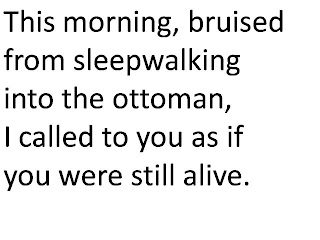
Robert asks for "mistake poems". Mine's here:
The Dodge Blog suggests Twelve Great Spots in NJ, and their choices are all fine, but I wish there were a way to add hearing BJ Ward read his "New Jersey" or Joe Weil and his "Morning at the Elizabeth Arch". Ideally, we'd do this over Italian hot dogs and a nice tomato and mozzarella.
And now off to the kitchen...
Diane, discussing ways technology is enabling aural encounter with far-flung poets, remarks: "... historically, poetry is an oral art form. How hard do we work to get music into our lines? And yet, most often we encounter poetry only on the page". As someone with "engineering" and "technology" in the titles of my degrees, I love this observation; is the augmentation of the human experience through deployment of technology. And yet a return to the root of the art also. Perfect.
Matt has Batman taking himself a little too seriously. I've been toying with writing about superheroes, but whenever I do I think of Lucille Clifton's Clark Kent Poems and Jeannine Gailey's poems and wonder what I can add. I think Matt's got the angle that is unique to those of us who were never quite far enough out there to dress up as Iron Man but who kept thinking you know, this guy is really interesting. Hmm.
Robert asks for "mistake poems". Mine's here:
The Dodge Blog suggests Twelve Great Spots in NJ, and their choices are all fine, but I wish there were a way to add hearing BJ Ward read his "New Jersey" or Joe Weil and his "Morning at the Elizabeth Arch". Ideally, we'd do this over Italian hot dogs and a nice tomato and mozzarella.
And now off to the kitchen...
Sunday, August 23, 2009
August in New Jersey
It's August in New Jersey. Local's thoughts are turning to tomatoes (even TWA is feeling the sway with a produce poem from Barbara Crooker, a writer with links to The Garden State), and poetry series are starting to resprout around the landscape. Here are links to just a few:
The Spoken Word Series (Hoboken)
The Carriage House Poetry Series (Fanwood)
The Distinguished Poets Series (Paterson)
Delaware Valley Poets (Princeton)
Second Wednesdays poetry readings (Rutherford)
PoetsWednesday (Woodbridge)
And that ain't all. Anthony Buccino keeps a much more complete list of events than I (click NJ Poets and Poetry at your right). If live near the intersection of two numbered highways and can't find a way to participate in poetry this fall, it's all on you.
***
Did you hear that the Dodge has been resuscitated? Somehow I missed that in the busyness of the past few weeks. I vote Montclair, if that matters to anyone. I don't think any of them will be as easy to get to as Waterloo, though; and no urban center will have the same magic. Dovie Thomason's stories and Coleman Barks reading Rumi were almost spiritual experiences when encountered from within a dewy sunrise.
***
Got a bit of minor grief over the euphemisms for salty language in my last post. Listen, I'm not really that prissy when it comes to language (Die Hard is one of my favorite movies, after all), but I am a firm believer in applying language appropriately to the situation, and that as students and lovers of language, we should be able to describe something that is exceptionally good without expletives or the word "awesome". And that awareness of the audience requires adaptation of our word selection; my daughters and my mother stop by here occasionally, after all.
***
iGoogle's Literary Quote for today: "Humor is an affirmation of dignity, a declaration of man's superiority to all that befalls him." - Romain Gary
Amen. And on that note, I'm off to a First Birthday Party.
Thursday, August 20, 2009
Latesummerbits
Summer is careening to an end, and if your house is anything like mine, you're cramming in all the goofing off you've been meaning to do* but have been too busy to get to. Ah, life!
***
Linguistic thought from two days at the local Six Flags: Am I the last person who thinks that not all s-words are interchangeable with the word "stuff"? Corollary: am I the only adult who looks at the prominent "No Profanity" signs around the park and doesn't think "What the bleep do they mean by 'profanity'"? Essay question: Does "public place" equate to "freedom to drop the f-bomb"?
***
I picked up John Updike's last book of poems at the library tonight, thumbed through it for about 4 minutes, concluded I'd derived all the value I was likely to derive from it, put it back where I found it, and moved on. How haughty is that for an amateur?
***
In a fortunate act, I happened to grab Bias and Do You Speak American during a single library visit last week. You can agree with disagree with Goldberg (I'm about 70/30 agreed with a touch of "All right, already!"), but when you consider the idea that subtleties of word choice and sentence construction are are least as influential as blatant acts of opinion-pushing alongside the truism that language is influenced by evolutions in opinion and societal norms, you have a terribly interesting future to consider as linguaphile. And as a consumer of news media, but you're not going to find any chatter on that subject within these walls.
***
Catching up on August bloggings, I was happy to scroll past the recognizable presence of Joel Lewis on Silliman's Blog. Lewis was an early participant in the Spoken Word Series, generous not only just in being there, but in advice and in bringing wine and traditional treats for the audience. He's got a gift that is rare even among the artists I follow, in that he's equally compelling talking about baseball or about mythology. Or the mythology of baseball.
***
Back on swearing at Six Flags, after receiving a minor earful from a young lady (19? 20?) for suggesting that some colloquialisms are inappropriate in line for a water slide with the under-10 crowd, I naturally ran into said young lady throughout the day. And here's the thing: she was perfectly pleasant and friendly the whole time. She just didn't care much for me objecting to her expletives. And when I moved through the pain of being though a fuddy-duddy (though this I surely am), all I could think was that there had to be better words than the ones she was deploying repeatedly (though certainly with versatility).
***
Which leads me back to a comment from a non-poet and infrequent reader of poetry, upon hearing me read a Frank Steele poem: "That doesn't sound like poetry." What does poetry sound like, anyway? Like language unfettered by any rules at all? Like the prosey observations of Updike? Like text with new words invented for new and perfect purposes? Like Joel Lewis' "I bought my language/at a flea market/and the small talk here//on Paterson Plank Road/is a conception vessel/for native inertia".
***
Hmm...
* - yes, I know that's a line from Calvin and Hobbes. But thanks for asking!
***
Linguistic thought from two days at the local Six Flags: Am I the last person who thinks that not all s-words are interchangeable with the word "stuff"? Corollary: am I the only adult who looks at the prominent "No Profanity" signs around the park and doesn't think "What the bleep do they mean by 'profanity'"? Essay question: Does "public place" equate to "freedom to drop the f-bomb"?
***
I picked up John Updike's last book of poems at the library tonight, thumbed through it for about 4 minutes, concluded I'd derived all the value I was likely to derive from it, put it back where I found it, and moved on. How haughty is that for an amateur?
***
In a fortunate act, I happened to grab Bias and Do You Speak American during a single library visit last week. You can agree with disagree with Goldberg (I'm about 70/30 agreed with a touch of "All right, already!"), but when you consider the idea that subtleties of word choice and sentence construction are are least as influential as blatant acts of opinion-pushing alongside the truism that language is influenced by evolutions in opinion and societal norms, you have a terribly interesting future to consider as linguaphile. And as a consumer of news media, but you're not going to find any chatter on that subject within these walls.
***
Catching up on August bloggings, I was happy to scroll past the recognizable presence of Joel Lewis on Silliman's Blog. Lewis was an early participant in the Spoken Word Series, generous not only just in being there, but in advice and in bringing wine and traditional treats for the audience. He's got a gift that is rare even among the artists I follow, in that he's equally compelling talking about baseball or about mythology. Or the mythology of baseball.
***
Back on swearing at Six Flags, after receiving a minor earful from a young lady (19? 20?) for suggesting that some colloquialisms are inappropriate in line for a water slide with the under-10 crowd, I naturally ran into said young lady throughout the day. And here's the thing: she was perfectly pleasant and friendly the whole time. She just didn't care much for me objecting to her expletives. And when I moved through the pain of being though a fuddy-duddy (though this I surely am), all I could think was that there had to be better words than the ones she was deploying repeatedly (though certainly with versatility).
***
Which leads me back to a comment from a non-poet and infrequent reader of poetry, upon hearing me read a Frank Steele poem: "That doesn't sound like poetry." What does poetry sound like, anyway? Like language unfettered by any rules at all? Like the prosey observations of Updike? Like text with new words invented for new and perfect purposes? Like Joel Lewis' "I bought my language/at a flea market/and the small talk here//on Paterson Plank Road/is a conception vessel/for native inertia".
***
Hmm...
* - yes, I know that's a line from Calvin and Hobbes. But thanks for asking!
Subscribe to:
Posts (Atom)