Today's Literary Quote the Day at iGoogle is from W. H. Auden: "A poet can write about a man slaying a dragon, but not about a man pushing a button that releases a bomb."
Boy, I hate to disagree with a genius, but......
Seems to me that a more accurate (though admittedly less pithy) thought would be "It's easier for a poet to write a good poem about a man slaying a dragon than a good poem about a man pushing a button that releases a bomb." And stated this way, the justification is simple: distance.
It's easier (for most) to attain emotional distance from the romantic medieval fiction than from the difficult modern fact. And because of that, the bomber poems can fall much more easily into triteness or worse: political prose attempting to hide in a poem. For many of us who call ourselves "poets", attention to craft does down when we have "something important" to say. Billy Collins once noted that his poetry improved when he "realized he had nothing to say", his point being that many grand subjects had been written about before, often by the literary giants who preceded us, and to write something meaningful on those subjects meant to exceed their greatness.
Of course, the problem with many of us who all ourselves "poets" is a deplorable interest in our own history, a lack of awareness of those greats and an accompanying inflated sense of our own efforts. But that's another post.
What this means to me is that if you can find a way into the bombardier's seat that isn't a simplistic description of the ensuing horror or the pat discussion of conflict in his year, you can write that poem about the man dropping a bomb. If you can take what's going on in that instant and apply the filter of form or language to open it up to different interpretations, that subject should be wide open to you. It's just much harder to do it well.
It's this kind of logic that causes me to gravitate to my pet subjects, areas which for one reason or another are less crowded or lend themselves to reinterpretation or repurposing in verse.
Of course, this doesn't even begin to address the subject of the respective target audiences in Auden's original quote and the implications understanding them might have for the poem. Who do you think would be more open, less critical: dragonstory fans or devotees of the military and political?
Saturday, October 24, 2009


Friday, October 23, 2009
A Few, Little, Tired Bits
Oh, my. You know the place writing has in your life when the hobbies hits the fan, so to speak. Let me set the tap to "drip, drip, drivel" and see if I have anything interesting to say.
***
It's been a phenomenal month on the New Jersey poetry scene. If you're already in Peter Murphy's PoetryNJ Yahoo Group, or a regular visitor to Anthony Buccino's NJ Poets and Poetry, or a subscriber to the Delaware Valley Poets list, or connected to one of the other terrific sources of information in our wonderful Garden State poetry community, you should get there.
How good is this month? Check out these events scheduled opposite each other next week:
ERIC HOFFMAN, BURT KIMMELMAN & MADELINE TIGER in Monclair
Thursday, October 29, 7:30 PM Watchung Booksellers http://www.watchungbooksellers.com/
DIANE LOCKWARD & DAVID TUCKER in Middletown
Thursday, October 29 @ 7:00 PM Middletown Public Library.
Also, I'm really late to add congrats, but Diane Lockward and Kelli Agodon recently announced upcoming books. And Meg Kearney's new book (announced some time ago) is now available at Amazon.
***
After 30+ years in musical theater (give or take a month), I performed my first solo in front of an audience tonight. Don't get me wrong, I've been singing in public forever, but no one has ever mistaken my very blendworthy bass for a less-powerful version Howard Keel. I kinda liked it.
Better, though, was getting a chance for my whole family to be part of the finale in our musical revue. All of us were in front of or around the footlights. I liked that a lot.
Incidentally, you have one more chance to see us.
***
I had forgotten, by the way, how all-consuming the final weeks of staging a production could be. It's not even that our individual bits require all that energy (though anyone who tells you maintaining your character, even for just a song or two, 4 or 5 nights in a row isn't work has never trod the boards) - it's just as much the active listening when you're not in character, the being present during other scenes to know how yours contributes to the whole...
And I'd forgotten how much fun it could be, too.
***
I'd like to thank the New Jersey Jets (you heard me) for not dragging things out until week 15 this year. That makes Sundays a bit easier. Frees me up to watch the bowling with a clear conscience.
***
I've just about got the hang of that Facebook thingy. My Artist's Page is slowly becoming both informational and entertaining. If you're looking for status updates, I'm not your man, but if you're looking for reminders of selected Jersey events, links to interesting arts articles or (perish the thought!) the chance to see me perform live, I think it's serving its purpose there. Easier to update than this (though that's a personal bias - if I'm in this space, I take a bit more care in the writing. Not always in the spelling, but in the writing).
***
Only 60 shopping days until Christmas. Feels like I'm behind already. Thinking about my annual Christmas poem. I'm leaning in a Peanutsy direction, if I can pull it off. Hard to tap the energy of the masterpiece. 'course I haven't made much time for the pencil.
Which means maybe I should end this post and grab my notebook. You think?
***
It's been a phenomenal month on the New Jersey poetry scene. If you're already in Peter Murphy's PoetryNJ Yahoo Group, or a regular visitor to Anthony Buccino's NJ Poets and Poetry, or a subscriber to the Delaware Valley Poets list, or connected to one of the other terrific sources of information in our wonderful Garden State poetry community, you should get there.
How good is this month? Check out these events scheduled opposite each other next week:
ERIC HOFFMAN, BURT KIMMELMAN & MADELINE TIGER in Monclair
Thursday, October 29, 7:30 PM Watchung Booksellers http://www.watchungbooksellers.com/
DIANE LOCKWARD & DAVID TUCKER in Middletown
Thursday, October 29 @ 7:00 PM Middletown Public Library.
Also, I'm really late to add congrats, but Diane Lockward and Kelli Agodon recently announced upcoming books. And Meg Kearney's new book (announced some time ago) is now available at Amazon.
***
After 30+ years in musical theater (give or take a month), I performed my first solo in front of an audience tonight. Don't get me wrong, I've been singing in public forever, but no one has ever mistaken my very blendworthy bass for a less-powerful version Howard Keel. I kinda liked it.
Better, though, was getting a chance for my whole family to be part of the finale in our musical revue. All of us were in front of or around the footlights. I liked that a lot.
Incidentally, you have one more chance to see us.
***
I had forgotten, by the way, how all-consuming the final weeks of staging a production could be. It's not even that our individual bits require all that energy (though anyone who tells you maintaining your character, even for just a song or two, 4 or 5 nights in a row isn't work has never trod the boards) - it's just as much the active listening when you're not in character, the being present during other scenes to know how yours contributes to the whole...
And I'd forgotten how much fun it could be, too.
***
I'd like to thank the New Jersey Jets (you heard me) for not dragging things out until week 15 this year. That makes Sundays a bit easier. Frees me up to watch the bowling with a clear conscience.
***
I've just about got the hang of that Facebook thingy. My Artist's Page is slowly becoming both informational and entertaining. If you're looking for status updates, I'm not your man, but if you're looking for reminders of selected Jersey events, links to interesting arts articles or (perish the thought!) the chance to see me perform live, I think it's serving its purpose there. Easier to update than this (though that's a personal bias - if I'm in this space, I take a bit more care in the writing. Not always in the spelling, but in the writing).
***
Only 60 shopping days until Christmas. Feels like I'm behind already. Thinking about my annual Christmas poem. I'm leaning in a Peanutsy direction, if I can pull it off. Hard to tap the energy of the masterpiece. 'course I haven't made much time for the pencil.
Which means maybe I should end this post and grab my notebook. You think?
Monday, October 05, 2009
Monday Musings on Poetry Friday
I'm so far behind in the poetry orbit that I'm in danger of being lapped by Pluto, but I did happen to catch Khalil Murrell's Poetry Friday entry over at the Dodge Blog. I've enjoyed what the Dodge folks have done with that space, and Murrell's essay is interesting and well written, but there are couple of inconsistencies I'm struggling with.
When he says early on that "completing your MFA is like finishing med school or an MBA (except with less money-making potential, but similar debt).", I'm OK with it, though the difference between medical school and an MBA is huge -in both effort and application. In the sense that each area of expertise has a logical education terminus, I agree.
Next, in considering what to do with the thesis inside that terminal degree, Murrell asserts that "Naturally, capitalism offers an easy answer to these questions: morph it into manuscript, shop it around and publish! publish! publish!". Starting to lose me here. Having already asserted that there's no money in poetry and kept the work "professional" in quotes, it's misleading to call the drive to publish a capitalistic exercise, no matter what that implies.
"But in many ways life as a writer becomes more complicated once you drop the pen and certainly as you mature as an artist.". Hmm. Certainly no one can argue that maturation implies an acceptance of complexity, bit I don't understand how seeking publication equates to "drop(ping) the pen". This seems dramatic, and inappropriately so for someone familiar with the process. Going on to add "And believe it or not, I even miss the time when I foolishly wrote bad love poems (but good to me at the time) before the word “workshop” ever invaded my vocabulary." again speaks to nostalgia for a less complex, more youthful time, but doesn't speak to an older self who isn't writing.
Again speaking of publishing exclusive of or in preference to writing, Murrell notes that his writing buddies "are very disciplined about getting their work out there. In fact, one friend created an Excel document to track her submissions. Another keeps some type of document on his iPhone." This moves from nostalgia into naivete. Is it really such a surprise to track submissions? to navigate a spreadsheet program? To have such information handy?
Closing up his approach to completing his degree, Murrell notes "I’m satisfied with making sure I leave my program with an authentic—rather than workshop—voice, with trying to create something beautiful out of bewilderment or sadness." I've written about and empathize very much with pursuit of genuine voice. But the naivete is even louder here. Unless the point here is advocacy of college for college's sake - a strange sentiment for graduate school in this century - this implies that there is no connection between the conscious decision to pursue advanced education the desire to advance in one's field. Now, I don't think that Murrell's really saying this; I think he's just frustrated with the priority that publication has in some people's minds. However, when he adds that "I realize this may sound overly romantic if not inauthentic .... (b)ut a little romanticism has done very little to hurt the masses.", think frustration really clouds his position. I suspect many poets with a certain level of talent and accomplishment find the "romantic" opinion of the amateur - the "Hey, I've written a poem! Everyone needs to read it!" - more frustrating than the publish or perish attitude of the jaded professional.
Perhaps I'm picking nits here. And (Disclaimer Alert!) I'm not an MFA candidate and not likely to become one anytime soon. But I think most professionals like me, who went to graduate school specifically to learn and apply particular skills for the purpose of being and being recognized as someone more accomplished in a given field, I think Murrell's argument is (admittedly) romantic, but also deliberately incomplete.
Which may actually specifically make it poetic, now that I think a little. Maybe I'm way off after all.
When he says early on that "completing your MFA is like finishing med school or an MBA (except with less money-making potential, but similar debt).", I'm OK with it, though the difference between medical school and an MBA is huge -in both effort and application. In the sense that each area of expertise has a logical education terminus, I agree.
Next, in considering what to do with the thesis inside that terminal degree, Murrell asserts that "Naturally, capitalism offers an easy answer to these questions: morph it into manuscript, shop it around and publish! publish! publish!". Starting to lose me here. Having already asserted that there's no money in poetry and kept the work "professional" in quotes, it's misleading to call the drive to publish a capitalistic exercise, no matter what that implies.
"But in many ways life as a writer becomes more complicated once you drop the pen and certainly as you mature as an artist.". Hmm. Certainly no one can argue that maturation implies an acceptance of complexity, bit I don't understand how seeking publication equates to "drop(ping) the pen". This seems dramatic, and inappropriately so for someone familiar with the process. Going on to add "And believe it or not, I even miss the time when I foolishly wrote bad love poems (but good to me at the time) before the word “workshop” ever invaded my vocabulary." again speaks to nostalgia for a less complex, more youthful time, but doesn't speak to an older self who isn't writing.
Again speaking of publishing exclusive of or in preference to writing, Murrell notes that his writing buddies "are very disciplined about getting their work out there. In fact, one friend created an Excel document to track her submissions. Another keeps some type of document on his iPhone." This moves from nostalgia into naivete. Is it really such a surprise to track submissions? to navigate a spreadsheet program? To have such information handy?
Closing up his approach to completing his degree, Murrell notes "I’m satisfied with making sure I leave my program with an authentic—rather than workshop—voice, with trying to create something beautiful out of bewilderment or sadness." I've written about and empathize very much with pursuit of genuine voice. But the naivete is even louder here. Unless the point here is advocacy of college for college's sake - a strange sentiment for graduate school in this century - this implies that there is no connection between the conscious decision to pursue advanced education the desire to advance in one's field. Now, I don't think that Murrell's really saying this; I think he's just frustrated with the priority that publication has in some people's minds. However, when he adds that "I realize this may sound overly romantic if not inauthentic .... (b)ut a little romanticism has done very little to hurt the masses.", think frustration really clouds his position. I suspect many poets with a certain level of talent and accomplishment find the "romantic" opinion of the amateur - the "Hey, I've written a poem! Everyone needs to read it!" - more frustrating than the publish or perish attitude of the jaded professional.
Perhaps I'm picking nits here. And (Disclaimer Alert!) I'm not an MFA candidate and not likely to become one anytime soon. But I think most professionals like me, who went to graduate school specifically to learn and apply particular skills for the purpose of being and being recognized as someone more accomplished in a given field, I think Murrell's argument is (admittedly) romantic, but also deliberately incomplete.
Which may actually specifically make it poetic, now that I think a little. Maybe I'm way off after all.
Saturday, September 26, 2009
Fred McBagonluri at DeBaun
Here's this week's press release from the Spoken Word Series. Beats me why it never occurred to me to post there here before.
===========================================================
Fred McBagonluri
October’s Spoken Word Artist
For Immediate Release
October’s Spoken Word Artist
For Immediate Release
Performance Date: October 4, 2009, at 3 p.m., with open microphone following
Location: Symposia Bookstore, 510 Washington St., Hoboken, NJ (Accessible by PATH & Light Rail), www.symposia.us
Admission: FREE, with $3 suggested donation
Information: www.debaun.org/SpokenWordSeries.html or 201-216-8933
Hoboken, NJ: For the second installment of the 2009–2010 Spoken Word Series, DeBaun Center for Performing Arts and curator David Vincenti have chosen a wonderful artist to be featured on Sunday, October 4, 2009, at 3 p.m.—Fred McBagonluri. The Spoken Word Series, co-hosted by Siobhan Barry-Bratcher and David Vincenti, is presented monthly at Symposia Bookstore, 510 Washington St., Hoboken, NJ.
Fred McBagonluri is a Director of R&D at BD Medical. Fred graduated from Central State University, Wilberforce, OH with a BS in Manufacturing Engineering (summa cum laude) in 1996. He holds MS and PhD from Virginia Tech (1998) and University of Dayton (2005), respectively. He has published extensively in technical journals, conference proceedings and book chapters and has over 26 US and European patent applications in the areas of advanced imaging technologies and hearing instruments design. Fred is the 2008 recipient of the Black Engineer of the Year: Most Promising Scientist, 2008 NJBiz Healthcare Innovator Hero Awards and 2009 Astronaut Candidate Finalist. He is the author of three novels: (A) Woman to Marry, Dusk Recitals and When Tears Stand Still. He is married to Diana McBagonluri, also an author and they have two daughters, Putiaha and Puyen.
Fred will read from his works and then the microphone will be open to the public to share their work. Although it is not necessary to pre-register to attend the event, those interested in sharing their work during the open mic are asked to sign up at 2:45 p.m. Open mic participants are asked to limit their work to five minutes per person.
The Spoken Word Series takes place at Symposia Bookstore, 510 Washington St., Hoboken, NJ. Symposia is the only used bookstore in Hoboken and has great prices for used books, wireless Internet access and many events every week. This is the sixth year DeBaun Center for the Performing Arts and Symposia Bookstore have teamed up to co-produce the Series. With each reading, more and more people are introduced to this wonderful bookshop and the work of many superb artists.
For more information, please visit www.debaun.org/SpokenWordSeries.html, email Center@debaun.org or call 201-216-8933.
The next Spoken Word event will be on November 1, 2009, at 3 p.m. with Jessica de Koninck.
Thursday, September 17, 2009
One Poem, My Beamish Boy!
The Poetry Out Loud blog posts the following question: If you could choose only ONE poem to teach to your students, what would it be, and why? POL is about high school, which is a venue I've only dipped a toe into, but I can answer without hesitation for the age groups I've worked with (3rd-8th).
Jabberwocky.
Think about it. It's a classic but it's fun. It permits the teaching of rhyme and meter. It permits both performance and interperations. It many elements of sound and how it affects tone (hard sounds are darker...), etc.
And here's one more huge thing for me: it teaches not to be hung up on the words as individuals when the idea is to experience the poem. There will be time to worry about the words and their placement, and all that; a first experience with poetry is not that time).
One of the biggest hurdles I find in getting kids to write poems is to permit their imagination to come with them into a poem. To let their natural desire to tell great stories, unencumbered by truth, control the pen. What better vehicle to get past that than a great action story in which you provide the meaning for every single noun.
And as kids get older, you can add to the lesson that the poem is capable of taking on a life of its own irrespective of what was in the poet's head when he or she wrote it - another reason to trade meaning for momentum in the poem. Almost always the right thing to do.
What poems were meaningful to you as kids? What was it about them that stayed with you:?
Jabberwocky.
Think about it. It's a classic but it's fun. It permits the teaching of rhyme and meter. It permits both performance and interperations. It many elements of sound and how it affects tone (hard sounds are darker...), etc.
And here's one more huge thing for me: it teaches not to be hung up on the words as individuals when the idea is to experience the poem. There will be time to worry about the words and their placement, and all that; a first experience with poetry is not that time).
One of the biggest hurdles I find in getting kids to write poems is to permit their imagination to come with them into a poem. To let their natural desire to tell great stories, unencumbered by truth, control the pen. What better vehicle to get past that than a great action story in which you provide the meaning for every single noun.
And as kids get older, you can add to the lesson that the poem is capable of taking on a life of its own irrespective of what was in the poet's head when he or she wrote it - another reason to trade meaning for momentum in the poem. Almost always the right thing to do.
What poems were meaningful to you as kids? What was it about them that stayed with you:?
What is this man trying to say?

Actually, I'm teaching some project managers some simple tools to better understand scope management. Wasn't that obvious?
Notes: Photo was borrowed from here. Visit the Symposium Page for more on my talk.
Tuesday, September 15, 2009
Poetry Weekends in New Jersey!
Oh, to be in New Jersey, now that verse is here....
***
If you weren't in Hoboken last weekend, you missed Deborah Ager's visit, and hearing her read from Midnight Voices. Deborah and her family braved both sides of the Hudson and got to spend some quality time at the Hoboken Italian Festival (zeppoles in lieu of payment? I'll bite).
Thanks, Deborah for the visit! I hope the southbound traffic treated you well on the way home (but I know it probably didn't...)
***
My oh my, if you have already made plans for this Sunday, you need to cancel them now and get your DVR ready to save the end of the Jets' 23-13 victory for you. That's right. I said it.
Here are three events that should ought to give the NFL a run for its TV money. Unfortunately, they're all happening at the same time!
First, in Red Bank, you have Peter Murphy and Chris McIntyre reading at Dublin House.
If that's too far south for you, stop in to see Nancy Scott and BJ Ward at Poets in the Garden in Morristown.
And finally, if you have an aversion to BOTH the Parkway and 287, join Diane Lockward for a Poetry Party on the theme "When Arts Collide" at the Huddle Inn.
***
And NEXT weekend, we have the Warren County Poetry Festival! More on that as it approaches. I need to focus on Sunday!
***
If you weren't in Hoboken last weekend, you missed Deborah Ager's visit, and hearing her read from Midnight Voices. Deborah and her family braved both sides of the Hudson and got to spend some quality time at the Hoboken Italian Festival (zeppoles in lieu of payment? I'll bite).
Thanks, Deborah for the visit! I hope the southbound traffic treated you well on the way home (but I know it probably didn't...)
***
My oh my, if you have already made plans for this Sunday, you need to cancel them now and get your DVR ready to save the end of the Jets' 23-13 victory for you. That's right. I said it.
Here are three events that should ought to give the NFL a run for its TV money. Unfortunately, they're all happening at the same time!
First, in Red Bank, you have Peter Murphy and Chris McIntyre reading at Dublin House.
If that's too far south for you, stop in to see Nancy Scott and BJ Ward at Poets in the Garden in Morristown.
And finally, if you have an aversion to BOTH the Parkway and 287, join Diane Lockward for a Poetry Party on the theme "When Arts Collide" at the Huddle Inn.
***
And NEXT weekend, we have the Warren County Poetry Festival! More on that as it approaches. I need to focus on Sunday!
Saturday, September 12, 2009
Another few reasons you should come to Hoboken tomorrow...
From my perch, I regard your room
as insipid. I receive your whispers
daily. You, in return, push all
my buttons.
...
from "Lament of the Telephone", by Deborah Ager, from Midnight Voices.
It promises to be a mostly sunny day in The Boken, and you may even be able to grab a few zeppoles on the way in or out of the reading. The Jets are starting a rookie and won't be watchable until week 5, the Giants don't kick off until 4:15. There are no excuses not to be in your seat at Symposia Bookstore (510 Washington Street) by 3PM.
None.
Zero.
See you there.
as insipid. I receive your whispers
daily. You, in return, push all
my buttons.
...
from "Lament of the Telephone", by Deborah Ager, from Midnight Voices.
It promises to be a mostly sunny day in The Boken, and you may even be able to grab a few zeppoles on the way in or out of the reading. The Jets are starting a rookie and won't be watchable until week 5, the Giants don't kick off until 4:15. There are no excuses not to be in your seat at Symposia Bookstore (510 Washington Street) by 3PM.
None.
Zero.
See you there.
Friday, September 11, 2009
Remember. Read. Renew.
Home By Now
by Meg Kearney
New Hampshire air curls my hair like a child's
hand curls around a finger. "Children?" No,
we tell the realtor, but maybe a dog or two.
They'll bark at the mail car (Margaret's
Chevy Supreme) and chase the occasional
moose here in this place where doors are left
unlocked and it's Code Green from sun-up,
meaning go ahead and feel relieved—
the terrorists are back where you left them
on East 20th Street and Avenue C. In New York
we stocked our emergency packs with whistles
and duct tape. In New England, precautions take
a milder hue: don't say "pig" on a lobster boat
or paint the hull blue. Your friends in the city
say they'll miss you but don't blame you—they
still cringe each time a plane's overhead,
one ear cocked for the other shoe.
==================
Meg read for DeBaun Series in January, 2002. Although we'd "started" the series a few months earlier, I consider Meg's reading our first real event for a number of reasons, but mostly because the cumulative audience for the preceding 4 "events" was "zero". When she read for DeBaun, she started by reciting the poem of a teenage boy, which I unfortunately don't remember, which basically said if the two sides in a war could see each other clearly, as if through a window, they'd just stop fighting. I think Meg recited that poem to open all her readings in 2002, as a small gesture toward restored sanity in the world.
==================
Well, we've been trying to live up to the spirit Meg's reading baptized us with, and you'll see that spirit in action this weekend if you can stop by Symposia Bookstore at 3PM Sunday, when poet and editor Deborah Ager will join us. Read her poems, then make your plans to join us. You TiVo the games.
by Meg Kearney
New Hampshire air curls my hair like a child's
hand curls around a finger. "Children?" No,
we tell the realtor, but maybe a dog or two.
They'll bark at the mail car (Margaret's
Chevy Supreme) and chase the occasional
moose here in this place where doors are left
unlocked and it's Code Green from sun-up,
meaning go ahead and feel relieved—
the terrorists are back where you left them
on East 20th Street and Avenue C. In New York
we stocked our emergency packs with whistles
and duct tape. In New England, precautions take
a milder hue: don't say "pig" on a lobster boat
or paint the hull blue. Your friends in the city
say they'll miss you but don't blame you—they
still cringe each time a plane's overhead,
one ear cocked for the other shoe.
==================
Meg read for DeBaun Series in January, 2002. Although we'd "started" the series a few months earlier, I consider Meg's reading our first real event for a number of reasons, but mostly because the cumulative audience for the preceding 4 "events" was "zero". When she read for DeBaun, she started by reciting the poem of a teenage boy, which I unfortunately don't remember, which basically said if the two sides in a war could see each other clearly, as if through a window, they'd just stop fighting. I think Meg recited that poem to open all her readings in 2002, as a small gesture toward restored sanity in the world.
==================
Well, we've been trying to live up to the spirit Meg's reading baptized us with, and you'll see that spirit in action this weekend if you can stop by Symposia Bookstore at 3PM Sunday, when poet and editor Deborah Ager will join us. Read her poems, then make your plans to join us. You TiVo the games.
Monday, September 07, 2009
Deborah Ager at DeBaun
Even now I dream of this -- ice-glossed asphalt,
the car in circiles, then at rest in the median.
For miles, nothing but snow coating Osceola,
Iowa like a curse, winter crimping the final berries.
(from "Black Ice", Midnight Voices, Cherry Grove Collections)
Deborah Ager will be the featured reader at the initial event of the Spoken Word Series this coming Sunday; all the usual details apply.
Hope to see you there!
the car in circiles, then at rest in the median.
For miles, nothing but snow coating Osceola,
Iowa like a curse, winter crimping the final berries.
(from "Black Ice", Midnight Voices, Cherry Grove Collections)
Deborah Ager will be the featured reader at the initial event of the Spoken Word Series this coming Sunday; all the usual details apply.
Hope to see you there!
Sunday, September 06, 2009
SePOETember
You could get whiplash entering the New Jersey Poetry Scene in September, I'm thinking. Our season starts up in 7 days (more on that tomorrow), but here's an event you might want to be making time that might not show up on your usual poetry calendars:
Premiere Stages mounts a production of "Any Other Name", George Brant's play inspired by the experiences of poet John Clare, through September 20. Read more about it, and if you're ordering tickets, use the discount code "ROSE" when you call the box office (908-737-SHOW) to announce your love of poetry and save 5 bucks in the process.
Saturday, August 29, 2009
The END of the "Experiment"
I'm done with the phrase "experimental poetry".
Starting with the literal, let's combine the definitions of experimental and experiment to define the term (all definitions from the Random House dictionary via Dictionary.com):
"pertaining to, derived from, or founded on a test, trial, or tentative procedure"
No. Poetry isn't tentative. More on test and trial in a minute.
"pertaining to, derived from, or founded on an act or operation for the purpose of discovering something unknown or of testing a principle, supposition, etc."
Tempting, because we do write to discover what's on our mind, but to term this experimental would be in ignorance of the difference between experimentation and exploration. When no response is measured ("If I do this, what will this thing do?"), discovery is an act of exploration - a documentation of what's already there (though perhaps unknown to you). Excepting acts of improvisation with a live audience, there is nothing to measure in response to the act of putting words on the page or screen.
"pertaining to, derived from, or founded on a chemical experiment OR a teaching experiment OR an experiment in living."
You might pass muster applying this definition IF the rubric or theme of the poem fits one of these definitions. However, there's nothing chemical and nothing you can live in when you're presenting a poem. Surely you can create poem as a teaching example, but that's no more an experiment than the varnished plates of food outside the Greek restaurant in the Food Court at the Mall.
"of the nature of an experiment; tentative, as in "the new program is still in an experimental stage".
Boo on tentative, but the rest has potential. However, it falls short when you realize that this means "having the potential to fail" - if the program tanks and is abandoned, it was a failed experiment - OK. But if a poem fails and is abandoned, we have a word for that: a "draft". I contend that nothing that reaches your personal definition of complete can be termed experimental.
"based on or derived from experience; empirical"
This covers everything you'll ever write.
A quick word on test and trial: a test is an action you take or a situation you create for the purpose of seeing what will happen. But it's not an experiment until set it leaves your control for the trial whose results you will observe objectively. If the piece of art you create is never outside your control, it can never pass this definition. This leaves in play the performance elements of some poetic presentations, but unless reactions are noted and changes to the poem considered, this too fails the definition.
Am I being deliberately too literal to make my point? Let's consider what turns up on the first page of a Google search for "experimental poetry":
Text Etc. discusses many different elements of poetry. About "experimental poetry", into which bucket it collects VizPo, Concrete, Conceptualism, and Code as Text, it says: "Experimental poetry can be intriguing and pleasing, but it is not poetry as commonly understood by the term, and has therefore to be judged on different grounds, most commonly those of the visual arts, which it increasingly resembles.". OK, no argument here. But if it's "not poetry", then why try to make it so - let it be a new art form, not a "poem". This is how science and engineering operate, isn't it; when the experiments begin to produce a new and unique set of rules about the systems they define, they get classed out as a new discipline with the old as its root. For further consideration, Goef Huth, who wrote on visual poetry in Poetry last year, starts his bio with "Geof Huth is a poet and visual poet..."; why do we need for the distinction if one is merely a special case of the other? Bottom line: we don't*.
In her essay at CORNER, Laura López Fernández notes that "Contemporary experimental poetry, in its various forms of manifestation -- visual poetry, phonetic poetry, sound poetry, performance poetry, non-object poetry or action art, video poetry, cyber poetry, computer holopoetry, mail-art, etc. is an integrative and interactive art that requires a "reader" willing to participate in a new configuration of semiotic codes." OK, if you know that semiotics is "the study of signs and symbols as elements of communicative behavior", and you are deeply enough integrated with contemporary poetry to accept poetry without symbols (metaphors, allegory, etc.) isn't poetry at all, what is experimental here? It's just the integration of technology or performance. These are neither new nor non-obvious extensions of poetry. BUT... if it really does require a new science, then it's a new discipline and a new art. See above.
Nothing else on the front page of the Google search attempts to define the term, though Selby's List provides many paths to explore it. There's one very silly definition that actually lists a dozen or so forms to apply if you want to create an "experimental" poem. This is the most egregious misapplication of the term and does disservice to the serious definition attempts above. Make a note: if a template exists, you're not conducting an experiment.
Let me now air the biggest flaw in this discussion: I've turned to Google, which returns results based on popularity, which isn't fair to any art form clearly operating on an extreme edge of its accepted definition and therefore not likely to be popular. I get that. But point me at a credible source that more completely explores the test-and-response definition essential to experimentation, and we can talk about the rest.
This is another area where being a career technologist disposes me to a particular interpretation - and one that in its own way, is a "fringe" opinion for someone who studies the art of poetry. I get that, too. Teach me where I'm wrong.
A final disclaimer: Don't take this to mean I don't enjoy some of the work currently showing up as "experimental". I'm really just becoming confident enough in my understanding to begin seriously tackling the copy of Poetry for the Millennium I got as a gift years ago, but I'm not ignorant of of the works of Silliman, Armantrout, Rothenberg, etc. That's not the point of this at all. The point is this:
Don't marginalize forms or create barriers that prevent new audiences from encountering poetry by branding it with a scary and inappropriate term. Just make it, and just take it in.
*BTW, You should go spend an hour on Geof's website; just because I disagree with the term doesn't mean it's not well worth your time.
Starting with the literal, let's combine the definitions of experimental and experiment to define the term (all definitions from the Random House dictionary via Dictionary.com):
"pertaining to, derived from, or founded on a test, trial, or tentative procedure"
No. Poetry isn't tentative. More on test and trial in a minute.
"pertaining to, derived from, or founded on an act or operation for the purpose of discovering something unknown or of testing a principle, supposition, etc."
Tempting, because we do write to discover what's on our mind, but to term this experimental would be in ignorance of the difference between experimentation and exploration. When no response is measured ("If I do this, what will this thing do?"), discovery is an act of exploration - a documentation of what's already there (though perhaps unknown to you). Excepting acts of improvisation with a live audience, there is nothing to measure in response to the act of putting words on the page or screen.
"pertaining to, derived from, or founded on a chemical experiment OR a teaching experiment OR an experiment in living."
You might pass muster applying this definition IF the rubric or theme of the poem fits one of these definitions. However, there's nothing chemical and nothing you can live in when you're presenting a poem. Surely you can create poem as a teaching example, but that's no more an experiment than the varnished plates of food outside the Greek restaurant in the Food Court at the Mall.
"of the nature of an experiment; tentative, as in "the new program is still in an experimental stage".
Boo on tentative, but the rest has potential. However, it falls short when you realize that this means "having the potential to fail" - if the program tanks and is abandoned, it was a failed experiment - OK. But if a poem fails and is abandoned, we have a word for that: a "draft". I contend that nothing that reaches your personal definition of complete can be termed experimental.
"based on or derived from experience; empirical"
This covers everything you'll ever write.
A quick word on test and trial: a test is an action you take or a situation you create for the purpose of seeing what will happen. But it's not an experiment until set it leaves your control for the trial whose results you will observe objectively. If the piece of art you create is never outside your control, it can never pass this definition. This leaves in play the performance elements of some poetic presentations, but unless reactions are noted and changes to the poem considered, this too fails the definition.
Am I being deliberately too literal to make my point? Let's consider what turns up on the first page of a Google search for "experimental poetry":
Text Etc. discusses many different elements of poetry. About "experimental poetry", into which bucket it collects VizPo, Concrete, Conceptualism, and Code as Text, it says: "Experimental poetry can be intriguing and pleasing, but it is not poetry as commonly understood by the term, and has therefore to be judged on different grounds, most commonly those of the visual arts, which it increasingly resembles.". OK, no argument here. But if it's "not poetry", then why try to make it so - let it be a new art form, not a "poem". This is how science and engineering operate, isn't it; when the experiments begin to produce a new and unique set of rules about the systems they define, they get classed out as a new discipline with the old as its root. For further consideration, Goef Huth, who wrote on visual poetry in Poetry last year, starts his bio with "Geof Huth is a poet and visual poet..."; why do we need for the distinction if one is merely a special case of the other? Bottom line: we don't*.
In her essay at CORNER, Laura López Fernández notes that "Contemporary experimental poetry, in its various forms of manifestation -- visual poetry, phonetic poetry, sound poetry, performance poetry, non-object poetry or action art, video poetry, cyber poetry, computer holopoetry, mail-art, etc. is an integrative and interactive art that requires a "reader" willing to participate in a new configuration of semiotic codes." OK, if you know that semiotics is "the study of signs and symbols as elements of communicative behavior", and you are deeply enough integrated with contemporary poetry to accept poetry without symbols (metaphors, allegory, etc.) isn't poetry at all, what is experimental here? It's just the integration of technology or performance. These are neither new nor non-obvious extensions of poetry. BUT... if it really does require a new science, then it's a new discipline and a new art. See above.
Nothing else on the front page of the Google search attempts to define the term, though Selby's List provides many paths to explore it. There's one very silly definition that actually lists a dozen or so forms to apply if you want to create an "experimental" poem. This is the most egregious misapplication of the term and does disservice to the serious definition attempts above. Make a note: if a template exists, you're not conducting an experiment.
Let me now air the biggest flaw in this discussion: I've turned to Google, which returns results based on popularity, which isn't fair to any art form clearly operating on an extreme edge of its accepted definition and therefore not likely to be popular. I get that. But point me at a credible source that more completely explores the test-and-response definition essential to experimentation, and we can talk about the rest.
This is another area where being a career technologist disposes me to a particular interpretation - and one that in its own way, is a "fringe" opinion for someone who studies the art of poetry. I get that, too. Teach me where I'm wrong.
A final disclaimer: Don't take this to mean I don't enjoy some of the work currently showing up as "experimental". I'm really just becoming confident enough in my understanding to begin seriously tackling the copy of Poetry for the Millennium I got as a gift years ago, but I'm not ignorant of of the works of Silliman, Armantrout, Rothenberg, etc. That's not the point of this at all. The point is this:
Don't marginalize forms or create barriers that prevent new audiences from encountering poetry by branding it with a scary and inappropriate term. Just make it, and just take it in.
*BTW, You should go spend an hour on Geof's website; just because I disagree with the term doesn't mean it's not well worth your time.
Thursday, August 27, 2009
Bloggabits
Ted says it the best I've seen it said: "The artist ... concentrates on the work, working as though outside history, creating through some compulsion and irrational belief that the deferred import of the work will be delivered to an audience someday, somehow. " The artist creates because the artist must create AND with the implicit expectation of an audience.
Diane, discussing ways technology is enabling aural encounter with far-flung poets, remarks: "... historically, poetry is an oral art form. How hard do we work to get music into our lines? And yet, most often we encounter poetry only on the page". As someone with "engineering" and "technology" in the titles of my degrees, I love this observation; is the augmentation of the human experience through deployment of technology. And yet a return to the root of the art also. Perfect.
Matt has Batman taking himself a little too seriously. I've been toying with writing about superheroes, but whenever I do I think of Lucille Clifton's Clark Kent Poems and Jeannine Gailey's poems and wonder what I can add. I think Matt's got the angle that is unique to those of us who were never quite far enough out there to dress up as Iron Man but who kept thinking you know, this guy is really interesting. Hmm.
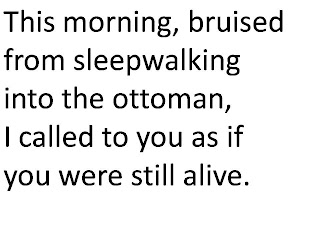
Robert asks for "mistake poems". Mine's here:
The Dodge Blog suggests Twelve Great Spots in NJ, and their choices are all fine, but I wish there were a way to add hearing BJ Ward read his "New Jersey" or Joe Weil and his "Morning at the Elizabeth Arch". Ideally, we'd do this over Italian hot dogs and a nice tomato and mozzarella.
And now off to the kitchen...
Diane, discussing ways technology is enabling aural encounter with far-flung poets, remarks: "... historically, poetry is an oral art form. How hard do we work to get music into our lines? And yet, most often we encounter poetry only on the page". As someone with "engineering" and "technology" in the titles of my degrees, I love this observation; is the augmentation of the human experience through deployment of technology. And yet a return to the root of the art also. Perfect.
Matt has Batman taking himself a little too seriously. I've been toying with writing about superheroes, but whenever I do I think of Lucille Clifton's Clark Kent Poems and Jeannine Gailey's poems and wonder what I can add. I think Matt's got the angle that is unique to those of us who were never quite far enough out there to dress up as Iron Man but who kept thinking you know, this guy is really interesting. Hmm.
Robert asks for "mistake poems". Mine's here:
The Dodge Blog suggests Twelve Great Spots in NJ, and their choices are all fine, but I wish there were a way to add hearing BJ Ward read his "New Jersey" or Joe Weil and his "Morning at the Elizabeth Arch". Ideally, we'd do this over Italian hot dogs and a nice tomato and mozzarella.
And now off to the kitchen...
Sunday, August 23, 2009
August in New Jersey
It's August in New Jersey. Local's thoughts are turning to tomatoes (even TWA is feeling the sway with a produce poem from Barbara Crooker, a writer with links to The Garden State), and poetry series are starting to resprout around the landscape. Here are links to just a few:
The Spoken Word Series (Hoboken)
The Carriage House Poetry Series (Fanwood)
The Distinguished Poets Series (Paterson)
Delaware Valley Poets (Princeton)
Second Wednesdays poetry readings (Rutherford)
PoetsWednesday (Woodbridge)
And that ain't all. Anthony Buccino keeps a much more complete list of events than I (click NJ Poets and Poetry at your right). If live near the intersection of two numbered highways and can't find a way to participate in poetry this fall, it's all on you.
***
Did you hear that the Dodge has been resuscitated? Somehow I missed that in the busyness of the past few weeks. I vote Montclair, if that matters to anyone. I don't think any of them will be as easy to get to as Waterloo, though; and no urban center will have the same magic. Dovie Thomason's stories and Coleman Barks reading Rumi were almost spiritual experiences when encountered from within a dewy sunrise.
***
Got a bit of minor grief over the euphemisms for salty language in my last post. Listen, I'm not really that prissy when it comes to language (Die Hard is one of my favorite movies, after all), but I am a firm believer in applying language appropriately to the situation, and that as students and lovers of language, we should be able to describe something that is exceptionally good without expletives or the word "awesome". And that awareness of the audience requires adaptation of our word selection; my daughters and my mother stop by here occasionally, after all.
***
iGoogle's Literary Quote for today: "Humor is an affirmation of dignity, a declaration of man's superiority to all that befalls him." - Romain Gary
Amen. And on that note, I'm off to a First Birthday Party.
The Spoken Word Series (Hoboken)
The Carriage House Poetry Series (Fanwood)
The Distinguished Poets Series (Paterson)
Delaware Valley Poets (Princeton)
Second Wednesdays poetry readings (Rutherford)
PoetsWednesday (Woodbridge)
And that ain't all. Anthony Buccino keeps a much more complete list of events than I (click NJ Poets and Poetry at your right). If live near the intersection of two numbered highways and can't find a way to participate in poetry this fall, it's all on you.
***
Did you hear that the Dodge has been resuscitated? Somehow I missed that in the busyness of the past few weeks. I vote Montclair, if that matters to anyone. I don't think any of them will be as easy to get to as Waterloo, though; and no urban center will have the same magic. Dovie Thomason's stories and Coleman Barks reading Rumi were almost spiritual experiences when encountered from within a dewy sunrise.
***
Got a bit of minor grief over the euphemisms for salty language in my last post. Listen, I'm not really that prissy when it comes to language (Die Hard is one of my favorite movies, after all), but I am a firm believer in applying language appropriately to the situation, and that as students and lovers of language, we should be able to describe something that is exceptionally good without expletives or the word "awesome". And that awareness of the audience requires adaptation of our word selection; my daughters and my mother stop by here occasionally, after all.
***
iGoogle's Literary Quote for today: "Humor is an affirmation of dignity, a declaration of man's superiority to all that befalls him." - Romain Gary
Amen. And on that note, I'm off to a First Birthday Party.
Thursday, August 20, 2009
Latesummerbits
Summer is careening to an end, and if your house is anything like mine, you're cramming in all the goofing off you've been meaning to do* but have been too busy to get to. Ah, life!
***
Linguistic thought from two days at the local Six Flags: Am I the last person who thinks that not all s-words are interchangeable with the word "stuff"? Corollary: am I the only adult who looks at the prominent "No Profanity" signs around the park and doesn't think "What the bleep do they mean by 'profanity'"? Essay question: Does "public place" equate to "freedom to drop the f-bomb"?
***
I picked up John Updike's last book of poems at the library tonight, thumbed through it for about 4 minutes, concluded I'd derived all the value I was likely to derive from it, put it back where I found it, and moved on. How haughty is that for an amateur?
***
In a fortunate act, I happened to grab Bias and Do You Speak American during a single library visit last week. You can agree with disagree with Goldberg (I'm about 70/30 agreed with a touch of "All right, already!"), but when you consider the idea that subtleties of word choice and sentence construction are are least as influential as blatant acts of opinion-pushing alongside the truism that language is influenced by evolutions in opinion and societal norms, you have a terribly interesting future to consider as linguaphile. And as a consumer of news media, but you're not going to find any chatter on that subject within these walls.
***
Catching up on August bloggings, I was happy to scroll past the recognizable presence of Joel Lewis on Silliman's Blog. Lewis was an early participant in the Spoken Word Series, generous not only just in being there, but in advice and in bringing wine and traditional treats for the audience. He's got a gift that is rare even among the artists I follow, in that he's equally compelling talking about baseball or about mythology. Or the mythology of baseball.
***
Back on swearing at Six Flags, after receiving a minor earful from a young lady (19? 20?) for suggesting that some colloquialisms are inappropriate in line for a water slide with the under-10 crowd, I naturally ran into said young lady throughout the day. And here's the thing: she was perfectly pleasant and friendly the whole time. She just didn't care much for me objecting to her expletives. And when I moved through the pain of being though a fuddy-duddy (though this I surely am), all I could think was that there had to be better words than the ones she was deploying repeatedly (though certainly with versatility).
***
Which leads me back to a comment from a non-poet and infrequent reader of poetry, upon hearing me read a Frank Steele poem: "That doesn't sound like poetry." What does poetry sound like, anyway? Like language unfettered by any rules at all? Like the prosey observations of Updike? Like text with new words invented for new and perfect purposes? Like Joel Lewis' "I bought my language/at a flea market/and the small talk here//on Paterson Plank Road/is a conception vessel/for native inertia".
***
Hmm...
* - yes, I know that's a line from Calvin and Hobbes. But thanks for asking!
***
Linguistic thought from two days at the local Six Flags: Am I the last person who thinks that not all s-words are interchangeable with the word "stuff"? Corollary: am I the only adult who looks at the prominent "No Profanity" signs around the park and doesn't think "What the bleep do they mean by 'profanity'"? Essay question: Does "public place" equate to "freedom to drop the f-bomb"?
***
I picked up John Updike's last book of poems at the library tonight, thumbed through it for about 4 minutes, concluded I'd derived all the value I was likely to derive from it, put it back where I found it, and moved on. How haughty is that for an amateur?
***
In a fortunate act, I happened to grab Bias and Do You Speak American during a single library visit last week. You can agree with disagree with Goldberg (I'm about 70/30 agreed with a touch of "All right, already!"), but when you consider the idea that subtleties of word choice and sentence construction are are least as influential as blatant acts of opinion-pushing alongside the truism that language is influenced by evolutions in opinion and societal norms, you have a terribly interesting future to consider as linguaphile. And as a consumer of news media, but you're not going to find any chatter on that subject within these walls.
***
Catching up on August bloggings, I was happy to scroll past the recognizable presence of Joel Lewis on Silliman's Blog. Lewis was an early participant in the Spoken Word Series, generous not only just in being there, but in advice and in bringing wine and traditional treats for the audience. He's got a gift that is rare even among the artists I follow, in that he's equally compelling talking about baseball or about mythology. Or the mythology of baseball.
***
Back on swearing at Six Flags, after receiving a minor earful from a young lady (19? 20?) for suggesting that some colloquialisms are inappropriate in line for a water slide with the under-10 crowd, I naturally ran into said young lady throughout the day. And here's the thing: she was perfectly pleasant and friendly the whole time. She just didn't care much for me objecting to her expletives. And when I moved through the pain of being though a fuddy-duddy (though this I surely am), all I could think was that there had to be better words than the ones she was deploying repeatedly (though certainly with versatility).
***
Which leads me back to a comment from a non-poet and infrequent reader of poetry, upon hearing me read a Frank Steele poem: "That doesn't sound like poetry." What does poetry sound like, anyway? Like language unfettered by any rules at all? Like the prosey observations of Updike? Like text with new words invented for new and perfect purposes? Like Joel Lewis' "I bought my language/at a flea market/and the small talk here//on Paterson Plank Road/is a conception vessel/for native inertia".
***
Hmm...
* - yes, I know that's a line from Calvin and Hobbes. But thanks for asking!
Saturday, August 08, 2009
In Which Poetry's Obituary Appears Someplace New
I read Parade Magazine. All right? We past that now? OK, then.
From this weekend's edition:
Q Why are my tax dollars going to pay a poet laureate when nobody reads poetry?
A “It is difficult/to get the news from poems/yet men die miserably every day/for lack/of what is found there,” wrote the great American poet William Carlos Williams. (We hope you’ll look him up!) While it’s true that not many people read poetry, they’d probably get a lot out of it if they gave it a try. The current U.S. Poet Laureate, Californian Kay Ryan, earns all of $35,000. But fret not: Her stipend is funded from a private endowment, not tax revenues.
Don't know which I find more ridiculous, the question itself or that Parade magazine was perceived to be the appropriate reference. But in any event, let the record show that not only is poetry not dead, but no fewer than three coworkers have approached me in the past two months when they found out I was active in the poetry community to - get this - talk about poetry. We have a little book club in the office which this week has selected an anthology and asked that each attendee read aloud a poem from the book and explain why they like or dislike it. 'Nuff said.
I grow weary of people who don't know where to look for poetry telling me they can't find it. It makes me want to link to the quote that goes something like "It is better to remain silent and be thought a fool, than to open your mouth and remove all doubt", but I can't locate a trustworthy attribution anywhere.
But please: that I can't find it in a 3-minute search doesn't mean it can't be found.
And it doesn't mean it's wrong.
From this weekend's edition:
Q Why are my tax dollars going to pay a poet laureate when nobody reads poetry?
A “It is difficult/to get the news from poems/yet men die miserably every day/for lack/of what is found there,” wrote the great American poet William Carlos Williams. (We hope you’ll look him up!) While it’s true that not many people read poetry, they’d probably get a lot out of it if they gave it a try. The current U.S. Poet Laureate, Californian Kay Ryan, earns all of $35,000. But fret not: Her stipend is funded from a private endowment, not tax revenues.
Don't know which I find more ridiculous, the question itself or that Parade magazine was perceived to be the appropriate reference. But in any event, let the record show that not only is poetry not dead, but no fewer than three coworkers have approached me in the past two months when they found out I was active in the poetry community to - get this - talk about poetry. We have a little book club in the office which this week has selected an anthology and asked that each attendee read aloud a poem from the book and explain why they like or dislike it. 'Nuff said.
I grow weary of people who don't know where to look for poetry telling me they can't find it. It makes me want to link to the quote that goes something like "It is better to remain silent and be thought a fool, than to open your mouth and remove all doubt", but I can't locate a trustworthy attribution anywhere.
But please: that I can't find it in a 3-minute search doesn't mean it can't be found.
And it doesn't mean it's wrong.
Sunday, August 02, 2009
What Makes it Poetry (part 2)?
Continuing the thought....
Ron Silliman adds: "What I find most appalling about William Shatner’s presentation of Sarah Palin Verbatim is not the implicit satire of poetry that it is, but rather that it is so much better than the poetry, say, we find on Prairie Home Companion. The inchoate argle-bargle of Alaska’s former governor, simply as found language, is more open-ended – and at times more evocative – than the very best “Good Poems” Lake Woebegon has to offer."
Diane Lockward reports that at her recent Rotary Club talk, "Someone else asked me for a definition of poetry. A trick question! I used Stafford's definition: an artistic arrangement of words on the page. Music came in again. And some of the special techniques of poetry. Line breaks. Stanzas instead of paragraphs." (Stafford said "A poem is anything said in such a way or put on the page in such a way as to invite the hearer or reader a certain kind of attention. The kind of attention that is invited will appear—sort of—in what follows."
Ted Burke's opinion is that "Poetry is what ever gets you to the next page", that "part of what makes poetry interesting is not just the actual verse interesting (and less interesting) poets produce, but also their rationale as to why they concern themselves with making words do oddly rhythmic things."
A few minute with iGoogle reveal hundreds of other thoughts. A few of these I find easily rejectable (the worst offender being to first define "poet", then any art the "poet" produces is a poem - complete nonsense). Irrespective of whether one likes or dislikes a poem, there are a couple of things (and to my mind, only a couple) that require something to be considered a poem:
- Awareness of language. I don't care what they are, but there need to signs of be conscious of word choice, or if narrative is not germane to the piece, signs of awareness of language in the linguistic choices made, whether for the page, the ear or the eye.
- Awareness of form. Whether you follow or challenge, conform or avoid, you have to know the rules to break them. The way the poem appears in its fixed form has to reflect an awareness that position of every letter or word or sign is important.
- Presence of metaphor (or simile). If you're reporting the news, that's prose. If you're extrapolating the news from a dropped nickel or looking through the footage of the explosion to see a mantis on the sill, that's poetry.
Most notable omission comparing my list to others? "Significance of content" is purely a multiplier in my mind. Writing about an important subject no more ensures poetry than does the importance of selecting a life partner make every date a proposal.
Obviously much more on this subject than I can produce in this small space. But thinking about this has got me questioning my own work, too. Maybe that's where I take this next...
Friday, July 31, 2009
What makes it poetry?
From Bob and Margery:
Sarah Palin was a source of found poetry during her Vice Presidential campaign. Now, her farewell speech as she stepped down from the office of Alaska Governor on Sunday has been dubbed a poem by Conan O’Brien and read in Beat fashion, with bass and bongo backup, by William Shatner on the Tonight Show.
The question arises: Where does the poetry come from? Is it in Palin’s writing or Shatner’s reading? As a humorist, O’Brien recognized the natural images, wandering line, moments of obscurity and slightly skewed word usages in Palin’s speech as indicators that “it’s a poem, it was always meant to be a poem.” And Shatner’s hammy, Beatific performance pours her words into an ironic jazz poetry mold that makes it seem as if that was her intent. But who, really, makes this a poem, good or bad? Palin, who wrote the words? O’Brien, who called it a poem? Shatner, who performed it as a poem? Or your Poetry Guide, who transcribed Shatner’s reading with line breaks that make it look like a poem?
Interesting question. I don't accept intent as sufficient for a poem, and I find delivery to be an exciting but nonessential part of the poetry experience - the wasabi to poesushi, as it were. I always come back to the same thing: The conscious selection and informed deployment of poetic device.
But now that I see it in writing, I think I need an hour or two to work out exactly what I mean by that. Again. But one hint: there's actually no poetry here. Parody, perhaps. Some G-O-Peeved people, maybe. Funny as banana slippers, no doubt. But no poetry.
Let me ruminate. See you later.
Sarah Palin was a source of found poetry during her Vice Presidential campaign. Now, her farewell speech as she stepped down from the office of Alaska Governor on Sunday has been dubbed a poem by Conan O’Brien and read in Beat fashion, with bass and bongo backup, by William Shatner on the Tonight Show.
The question arises: Where does the poetry come from? Is it in Palin’s writing or Shatner’s reading? As a humorist, O’Brien recognized the natural images, wandering line, moments of obscurity and slightly skewed word usages in Palin’s speech as indicators that “it’s a poem, it was always meant to be a poem.” And Shatner’s hammy, Beatific performance pours her words into an ironic jazz poetry mold that makes it seem as if that was her intent. But who, really, makes this a poem, good or bad? Palin, who wrote the words? O’Brien, who called it a poem? Shatner, who performed it as a poem? Or your Poetry Guide, who transcribed Shatner’s reading with line breaks that make it look like a poem?
Interesting question. I don't accept intent as sufficient for a poem, and I find delivery to be an exciting but nonessential part of the poetry experience - the wasabi to poesushi, as it were. I always come back to the same thing: The conscious selection and informed deployment of poetic device.
But now that I see it in writing, I think I need an hour or two to work out exactly what I mean by that. Again. But one hint: there's actually no poetry here. Parody, perhaps. Some G-O-Peeved people, maybe. Funny as banana slippers, no doubt. But no poetry.
Let me ruminate. See you later.
Saturday, July 25, 2009
Good folks, folk music?
Though it's been less barren this year, summer is traditionally a desert in the plenty of NJ poetry, but always a great time for music - you can catch a free show by a quality artist just about every night - it's even easier if you like amateur Sinatra impersonators.
We're long-time Tom Chapin fans in our house, and had the chance to catch him recently at the Gazebo in Florham Park, where my wife made a gift to me of a Chapin's latest album, an adult music collection (he seems to alternate between children's and grownup recordings, though his bigger accomplishments seem to be on the kids' end). I noticed on the new disc a poem of Edward Arlington Robinson's newly set to music. First of all, how great is it that the works of a good American poet are still alive enough to find some music (recall that Robinson died in 1935). And another pleasing note is that the album's title is "Let the Bad Times Roll"; could there be a better place for a Robinson poem to live?
I wonder if there's a natural affinity between gloomy poems and folk performers? Certainly folk music tends toward the darkness in life, as does the poetry that comes to many people's mind when they think of poetry. But is thematic alignment enough? Clearly not, or we'd all be tralala-ing along with the words of Charles Bukowski. In the case of "The Sheaves" (the poem on Chapin's new album), there's the traditional musicality of long iambic lines which support the migration to folk performance.
So if there's a structural element to a poem that makes it suitable for setting to music, is there a difference between a poem and a lyric? I remember perusing mimeographs of Billy Joel lyrics in 8th grade English in an attempt to answer that question, but for me, it's an easy distinction: a lyric, even a rambly folk lyric, contains a repeated chorus a poem's not likely to have (which is why I consider Joel a talented writer, not a poet. Sorry, Mr. Conley). In Chapin's version of The Sheaves, he doesn't create that kind of repetition, so I'll keep thinking about it as a poem set to music. I like it, and I'll request it at his concerts, but it's not "a song" as such.
I also find interesting that the folk-music-is-gloomy theme seems to run counter to the attitude of the performers; Tom Chapin and his band are some of the most genuinely funny and friendly people I've ever met from the stage. Poets, on the other hand, seem to bring their gloominess into audience interactions more frequently. But you knew that already, I'm guessing.
Anyway, this discovery has made me curious to dust off my Robinson (and not just to relive the time my ability to quote "Richard Cory" won my boss at the time a bet). More on that later, maybe. Depending on how gloomy I feel.
Meanwhile, go take in the next concert in your town's park. That's the stuff of summer. No gloominess permitted.
We're long-time Tom Chapin fans in our house, and had the chance to catch him recently at the Gazebo in Florham Park, where my wife made a gift to me of a Chapin's latest album, an adult music collection (he seems to alternate between children's and grownup recordings, though his bigger accomplishments seem to be on the kids' end). I noticed on the new disc a poem of Edward Arlington Robinson's newly set to music. First of all, how great is it that the works of a good American poet are still alive enough to find some music (recall that Robinson died in 1935). And another pleasing note is that the album's title is "Let the Bad Times Roll"; could there be a better place for a Robinson poem to live?
I wonder if there's a natural affinity between gloomy poems and folk performers? Certainly folk music tends toward the darkness in life, as does the poetry that comes to many people's mind when they think of poetry. But is thematic alignment enough? Clearly not, or we'd all be tralala-ing along with the words of Charles Bukowski. In the case of "The Sheaves" (the poem on Chapin's new album), there's the traditional musicality of long iambic lines which support the migration to folk performance.
So if there's a structural element to a poem that makes it suitable for setting to music, is there a difference between a poem and a lyric? I remember perusing mimeographs of Billy Joel lyrics in 8th grade English in an attempt to answer that question, but for me, it's an easy distinction: a lyric, even a rambly folk lyric, contains a repeated chorus a poem's not likely to have (which is why I consider Joel a talented writer, not a poet. Sorry, Mr. Conley). In Chapin's version of The Sheaves, he doesn't create that kind of repetition, so I'll keep thinking about it as a poem set to music. I like it, and I'll request it at his concerts, but it's not "a song" as such.
I also find interesting that the folk-music-is-gloomy theme seems to run counter to the attitude of the performers; Tom Chapin and his band are some of the most genuinely funny and friendly people I've ever met from the stage. Poets, on the other hand, seem to bring their gloominess into audience interactions more frequently. But you knew that already, I'm guessing.
Anyway, this discovery has made me curious to dust off my Robinson (and not just to relive the time my ability to quote "Richard Cory" won my boss at the time a bet). More on that later, maybe. Depending on how gloomy I feel.
Meanwhile, go take in the next concert in your town's park. That's the stuff of summer. No gloominess permitted.
Friday, July 17, 2009
Busy Week Bits
Ugh. Busy week. Lots of goodness. Here's a little of it:
- FIOS has added a local NJ channel, which I didn't think much of until I flipped to it tonight and saw the 2009 Poetry Out Loud NJ finals (which beat the heck out of watching the Mets lose again). I expected performance quality, since that's the direction young poets lean, but I was also impressed with the variety of their selections. When it was happening, I somehow missed that Maria Gillan was one of the judges; where was my head? The proceedings were dedicated to Bill Higginson (1938-2008).
- Been reading Dusk Recitals - The Growing Years, Fred McBagonluri's novel set in Ghana in the 1980s. Been such a busy year, I'd forgotten how important it is to let your readings take you completely out of yourself to permit room for new words to grow. It had been weeks and weeks since I completed a draft; thank goodness THAT drought's over.
- According to the Poets Market emailing list, I might be interested in Horticulture Magazine, because "We know that you're passionate about poetry. But if you're like many of us you have more than one interest." Umm, no. I'm sure it's a fine magazine. Not gonna find one in my house.
- My department held a community service day today; about 40 of us spent five hours at the Community Food Bank of NJ - marvelous place with great people doing the work of the angels, and they let us help for a little while.
New season at DeBaun and a couple other personal events are in the planning horizon. More soonish!
Sunday, July 12, 2009
Sometimes, you just want a cheeseburger
I am an extremely adventurous eater. When I travelled in Japan, I frequently didn't know what I had eaten until I asked my host at the end of the meal. I frequently make menu selections by looking for things I've never had in that particular combination before. My mother-in-law has remarked more than once that she loves cooking for me because she can experiment and she knows I'll eat it. With that in mind, please know that there are days when what I want more than anything is a McDonald's cheeseburger. And here's the thing: When that's what I want, a perfect teriyaki salmon over field greens doesn't appeal to me at all.
On another note, Megan Fox recently had this to say about the new Transformers movie: "People are well aware that this is not a movie about acting. And once you realize that, it becomes almost fun because you can be in the moment and go 'All right, I know that when he calls Action!, I'm either going to be running, or screaming, or both."
What do these things have to do with each other? Put these notions together with the last post's ideas of a "range" of poetry: The ideas is that there is room in any artistic field for output that has selective, or opportunistic appeal, and if you know that's what you're after, there's nothing wrong with that - provided you're aware where you are in the range. Two of my favorite movies are Singin' in the Rain and Twelve Angry Men. I don't fool myself that they are equivalent artistic achievements, but when I want "Make 'em Laugh", "I want another vote" won't do.
Norman Mclean similarly observed in an NPR interview that as a teacher, he always taught Shakespeare every year to make sure that he stayed calibrated (my word); it was OK to teach a "second- or third- or fourth-rater" as long as you knew that's what you were teaching, and teaching Shakespeare kept that in perspective.
The concept of accessibility as a scale of expected audience effort seems to me to apply easily to food and movies, as well. And it doesn't mean any of them are just bad (aside from Howard the Duck). But as it applies to poetry, I think it continues to mean that it's OK to be Eve Merriam as long as you don't think you're Louis Zukofsky.
Or to be yourself, whoever that is, in verse, as long as you know who that is, and who it is that is interested in what you have to say.
On another note, Megan Fox recently had this to say about the new Transformers movie: "People are well aware that this is not a movie about acting. And once you realize that, it becomes almost fun because you can be in the moment and go 'All right, I know that when he calls Action!, I'm either going to be running, or screaming, or both."
What do these things have to do with each other? Put these notions together with the last post's ideas of a "range" of poetry: The ideas is that there is room in any artistic field for output that has selective, or opportunistic appeal, and if you know that's what you're after, there's nothing wrong with that - provided you're aware where you are in the range. Two of my favorite movies are Singin' in the Rain and Twelve Angry Men. I don't fool myself that they are equivalent artistic achievements, but when I want "Make 'em Laugh", "I want another vote" won't do.
Norman Mclean similarly observed in an NPR interview that as a teacher, he always taught Shakespeare every year to make sure that he stayed calibrated (my word); it was OK to teach a "second- or third- or fourth-rater" as long as you knew that's what you were teaching, and teaching Shakespeare kept that in perspective.
The concept of accessibility as a scale of expected audience effort seems to me to apply easily to food and movies, as well. And it doesn't mean any of them are just bad (aside from Howard the Duck). But as it applies to poetry, I think it continues to mean that it's OK to be Eve Merriam as long as you don't think you're Louis Zukofsky.
Or to be yourself, whoever that is, in verse, as long as you know who that is, and who it is that is interested in what you have to say.
Friday, July 10, 2009
The Surface Roughness of Poetry
Before I went on vacation, I was working with my teammates at work on finalizing a paper for the upcoming Materials and Processes for Medical Devices conference sponsored by ASM International. It has since occurred to me, perhaps as side-effect of eight days of brain purge plus a rapid reimmersion into the business of engineering, that a technical conference is not a bad analog for understanding the idea of "accessibility" in poetry (and the powerful opinions people have about it. Stay with me for a bit.
The argument for accessibility is captured most famously, I think, in Billy Collins' introduction to the Best America Poetry 2006 (which is discussed at some length in this post at Silliman's Blog). There are many arguments made in that post and its comments, but Ron's premise is twofold: "Accessibility" is really just an oversimplification of "understanding in context", and any selection of poems claiming to be representative of American Poetry which only includes poems whose Accessibility Quotient* (thesis complexity x rereading loops**) is toward the low end exclude a great deal of people who otherwise should fit under that title. It focuses on an audience less likely to choose to invest the time in understanding more than the topmost of any number of layers of understanding.
But here's the deal: that applies to any writer in any field.
Here's why this occurred to me now, in the context of writing a technical paper: Without giving too much away before the conference, I can say that one of the core ideas of my team's paper can be described in at least two ways: "changing the texture of a plastic part" and "selecting and validating a means for imparting a surface of controlled and reliable roughness and designing a method for characterizing that surface." You can read the abstract for more details, but trust me, both statements are accurate. You ask: who cares?
Well, one statement is understandable immediately without and need of deep understanding of surface engineering. The other doesn't necessarily say a lot more, but what it says it says with precision and a level of insight that is more meaningful to one skilled in the practice of surface engineering or interested enough to want to acquire that additional meaning. The abstract (link above) and the paper (which you'll have to attend the conference or purchase the proceedings to see!) are increasingly precise and convey additional understanding.
Let's flip that around. If I were to provide the complete paper to someone with no interest in understanding surface engineering, that would be pointless - for me and for them. We wrote that paper for an audience with that particular interest. That doesn't imply that other presentations of the subject are simpler or that we expect a different experience or education level in some potential readers - just that we expect that the conference attendees and other readers are willing to put the effort into getting the most out of what we wrote.
But to present a universal collection of treatises on surface engineering, if one's purpose were not just to introduce the subject, neither just to advance its leading edges, I think it would be necessary to anticipate a range of audiences possible and makes sure there were entry points across that entire range.
This, of course, is the problem with collections of poems, technical papers, baseball cards, or anything else. They are not universal, and to claim that they are is foolishness. It is more foolish still to dismiss ranges of practice outside the scope of one's own collection. From the perspective of the skilled practitioners, it runs the risk of causing potential followers to lose interest for lack of a way to latch on; for the entry-level user, it conveys a sort of willful ignorance - an attitude of "what I don't understand is unimportant".
Now, you may accuse me of just committing another elaborate riff on my old position that every act of writing assumes something about a potential audience (explicitly or implicitly), and that's fair to a point. But when you're making categorizing declarations about writing, in an act of explanation, teaching, or preserving, it's much more difficult to claim ignorance of the need for a target student, current or future.
Which brings me back to "accessibility". It's not so much "simplicity" as it is a set of assumptions about the ambition of the potential audience. Did that take me too long to say?
What, therefore, have I assumed about you?
* - yes, I just made that up.
** - the number of times that later context enhances an earlier word or phrase and makes you want to go back up in the poem.
The argument for accessibility is captured most famously, I think, in Billy Collins' introduction to the Best America Poetry 2006 (which is discussed at some length in this post at Silliman's Blog). There are many arguments made in that post and its comments, but Ron's premise is twofold: "Accessibility" is really just an oversimplification of "understanding in context", and any selection of poems claiming to be representative of American Poetry which only includes poems whose Accessibility Quotient* (thesis complexity x rereading loops**) is toward the low end exclude a great deal of people who otherwise should fit under that title. It focuses on an audience less likely to choose to invest the time in understanding more than the topmost of any number of layers of understanding.
But here's the deal: that applies to any writer in any field.
Here's why this occurred to me now, in the context of writing a technical paper: Without giving too much away before the conference, I can say that one of the core ideas of my team's paper can be described in at least two ways: "changing the texture of a plastic part" and "selecting and validating a means for imparting a surface of controlled and reliable roughness and designing a method for characterizing that surface." You can read the abstract for more details, but trust me, both statements are accurate. You ask: who cares?
Well, one statement is understandable immediately without and need of deep understanding of surface engineering. The other doesn't necessarily say a lot more, but what it says it says with precision and a level of insight that is more meaningful to one skilled in the practice of surface engineering or interested enough to want to acquire that additional meaning. The abstract (link above) and the paper (which you'll have to attend the conference or purchase the proceedings to see!) are increasingly precise and convey additional understanding.
Let's flip that around. If I were to provide the complete paper to someone with no interest in understanding surface engineering, that would be pointless - for me and for them. We wrote that paper for an audience with that particular interest. That doesn't imply that other presentations of the subject are simpler or that we expect a different experience or education level in some potential readers - just that we expect that the conference attendees and other readers are willing to put the effort into getting the most out of what we wrote.
But to present a universal collection of treatises on surface engineering, if one's purpose were not just to introduce the subject, neither just to advance its leading edges, I think it would be necessary to anticipate a range of audiences possible and makes sure there were entry points across that entire range.
This, of course, is the problem with collections of poems, technical papers, baseball cards, or anything else. They are not universal, and to claim that they are is foolishness. It is more foolish still to dismiss ranges of practice outside the scope of one's own collection. From the perspective of the skilled practitioners, it runs the risk of causing potential followers to lose interest for lack of a way to latch on; for the entry-level user, it conveys a sort of willful ignorance - an attitude of "what I don't understand is unimportant".
Now, you may accuse me of just committing another elaborate riff on my old position that every act of writing assumes something about a potential audience (explicitly or implicitly), and that's fair to a point. But when you're making categorizing declarations about writing, in an act of explanation, teaching, or preserving, it's much more difficult to claim ignorance of the need for a target student, current or future.
Which brings me back to "accessibility". It's not so much "simplicity" as it is a set of assumptions about the ambition of the potential audience. Did that take me too long to say?
What, therefore, have I assumed about you?
* - yes, I just made that up.
** - the number of times that later context enhances an earlier word or phrase and makes you want to go back up in the poem.
Wednesday, June 24, 2009
The Truth: Writers Don't Write
Via Wil Wheaton:
Ask a writer what she values most in her creative life, and she is likely to respond, "Time to write." Not many of us have the luxury of writing full- time; we have spouses, families, day jobs. To the people closest to the writer, "writing time" may seem like so much self-indulgence: Why should we get to sit around thinking all day? Normal people don't require hour after continuous hour of solitude and silence. Normal people can be flexible.
And yet, we writers tell our friends and children, there is nothing more sacrosanct, more vital to our intellectual and emotional well-being, than writing time. But we writers have a secret.
We don't spend much time writing."
In his article at the Los Angeles Times, J. Robert Lennon goes on to talk at some length about his writing routine, with great precision and great humor. His basic point is that it focused writing time rarely is, although any moment of any day can turn into a writing moment (hence those T-shirts that read "I'm blogging this"). I think most poets have the added complication that our "routines" are more likely to be crammed in among other priorities closer to the base of Maslow's hierarchy than poetry. I don't really have a routine - I'm more of a streak-writer* - but if I did, it would be close to this:
* - in the baseball sense, not the nude sense.
Ask a writer what she values most in her creative life, and she is likely to respond, "Time to write." Not many of us have the luxury of writing full- time; we have spouses, families, day jobs. To the people closest to the writer, "writing time" may seem like so much self-indulgence: Why should we get to sit around thinking all day? Normal people don't require hour after continuous hour of solitude and silence. Normal people can be flexible.
And yet, we writers tell our friends and children, there is nothing more sacrosanct, more vital to our intellectual and emotional well-being, than writing time. But we writers have a secret.
We don't spend much time writing."
In his article at the Los Angeles Times, J. Robert Lennon goes on to talk at some length about his writing routine, with great precision and great humor. His basic point is that it focused writing time rarely is, although any moment of any day can turn into a writing moment (hence those T-shirts that read "I'm blogging this"). I think most poets have the added complication that our "routines" are more likely to be crammed in among other priorities closer to the base of Maslow's hierarchy than poetry. I don't really have a routine - I'm more of a streak-writer* - but if I did, it would be close to this:
- Complete the workday, begin drive home
- Dictate ideas into recorder OR refine idea from previous session.
- Get home, spend a couple hours with the family (dinner, homework, Disney Sorry)
- (after lullabies) Turn on the Mets, begin transcribing recordings
- move the laundry to the drier, reread last few transcriptions
- Bring some Tostitos upstairs, extract something from the transcripts to work on
- Iterate Mets - extraction loop until awakening to Twilight Zone reruns.
There are variants depending on whether I'm a submitting mode or a project/manuscript cycle, but this is the basic idea - writing time is after the "making a living" and blended with the "keeping the house". that's not a complaint, it's just an observation, and one which you'd think would make me want to focus more during the time I have available to write.
Operative phrase there is "want to". This post has so far taken me about 45 minutes to draft. Since I started, I looked up three games at BoardGame Geek, scanned the TV listings for M*A*S*H episodes, changed positions on the couch twice, located a journal I'm debating submitting to in Poet's Market, gotten a big glass of seltzer, and written these 331 words. Such is the life.
But in the end, I think adherence to a routine, or even having a routine, is less important than just committing to doing something with your writing every day. Just sorting my portfolio on the new computed had value, in that as I looked at each poem, I had a chance to decide if I still felt it was "done". That reminder of what was good in my own writing became a great filter for newer works in progress.
It's good to laugh at ourselves and the quirks of our "process". And essential to keep working while we laugh.
* - in the baseball sense, not the nude sense.
Sunday, June 21, 2009
Poets and Fathers and Kids, oh my!
On days designated for nostalgia, poets (and omphaloskeptics) tend to dig a little deeper into our own navels for things to say that convey The Great Truths (tm) with Great Meaning. Of course, that's usually when we are at our pedantic worst - sentimental and craftless, caring more for what we have to say than how we have to say it.
Edward Byrne has avoided this trap with his poem "Florida Drought: A Remembrance" in which he tackles Father's Day in the forward-looking direction with a recollected moment with his son. While it's always difficult to deal with a sentimental moment in a poem, Byrne remembers to focus on the moment and let the meaning come on its own. My favorite lines are the last:
Somehow, I will always remember that night
how palm trees already were slipping to silver
under a cast of pale moonlight as a few full
sails still labored across the windswept bay.
I think the reverse direction - considering our own fathers - is even harder to treat successfully in a poem. Partially, that's because so many poets have had terrible relationships with their fathers and try every year to rewrite "Daddy" (please stop it, by the way), but more because so many of us seem to think that our regrets of incomplete relationships with the men we came to tolerate so late in their lives are unique (hint: they're not). When my father died I, like everyone else with a pen and a Norton Anthology, wrote my way through understanding his loss. Most of what came out of that was dreck, though some was passable. More interesting was discovering that I knew my father better than I thought, that the Venn diagram I carried in my mind actually had more than gender and golf in the center. So much so that I felt comfortable trying to create a portrait of sorts:

Of course, the mere fact of spending a few minutes on my father's memory is a discredit to it, as anyone who knew him will confirm. So while there is still time to go bowl a couple lines with my girls today and grab a nice sushi dinner, I will leave you, my six loyal readers, to your own remembrances and observations. But if you are fans of poetry or the late Ernie Vincenti, make sure to connect those observations to the present, and make sure you add a little value to today.
Happy Father's Day to all.
Edward Byrne has avoided this trap with his poem "Florida Drought: A Remembrance" in which he tackles Father's Day in the forward-looking direction with a recollected moment with his son. While it's always difficult to deal with a sentimental moment in a poem, Byrne remembers to focus on the moment and let the meaning come on its own. My favorite lines are the last:
Somehow, I will always remember that night
how palm trees already were slipping to silver
under a cast of pale moonlight as a few full
sails still labored across the windswept bay.
I think the reverse direction - considering our own fathers - is even harder to treat successfully in a poem. Partially, that's because so many poets have had terrible relationships with their fathers and try every year to rewrite "Daddy" (please stop it, by the way), but more because so many of us seem to think that our regrets of incomplete relationships with the men we came to tolerate so late in their lives are unique (hint: they're not). When my father died I, like everyone else with a pen and a Norton Anthology, wrote my way through understanding his loss. Most of what came out of that was dreck, though some was passable. More interesting was discovering that I knew my father better than I thought, that the Venn diagram I carried in my mind actually had more than gender and golf in the center. So much so that I felt comfortable trying to create a portrait of sorts:
Of course, the mere fact of spending a few minutes on my father's memory is a discredit to it, as anyone who knew him will confirm. So while there is still time to go bowl a couple lines with my girls today and grab a nice sushi dinner, I will leave you, my six loyal readers, to your own remembrances and observations. But if you are fans of poetry or the late Ernie Vincenti, make sure to connect those observations to the present, and make sure you add a little value to today.
Happy Father's Day to all.
Saturday, June 20, 2009
Opening Up About Opens
Though my six loyal readers are split nealty into three groups who won't be able to use this advice (accomplished poets who know better; non-poet poetry fans who don't need it, my mother), I want to capture a few thoughts on approaching open mic readings that might be useful to someone when this page turns up in a Google search*.
First, credentials and disclaimer: I've been participating in open mic readings for more than 15 years, and regularly hosting them since 2002. I have seen opens ranging from surprisingly good to unreportably bad, and received enough feedback from our featured poets in the Spoken Word Series to believe that some of this is applicable everywhere. Also, we have a small open with a number of regulars who've been with us for 5+ years, and some of my comments come from comparing the good habits of my long-timers to some other poets I've come across over the years.
Assumptions: venue is general-audience, 2 short poems or 1 long (5 minute max),
First, credentials and disclaimer: I've been participating in open mic readings for more than 15 years, and regularly hosting them since 2002. I have seen opens ranging from surprisingly good to unreportably bad, and received enough feedback from our featured poets in the Spoken Word Series to believe that some of this is applicable everywhere. Also, we have a small open with a number of regulars who've been with us for 5+ years, and some of my comments come from comparing the good habits of my long-timers to some other poets I've come across over the years.
Assumptions: venue is general-audience, 2 short poems or 1 long (5 minute max),
- Pick your poems before you set foot in the venue. You should have decided what you're going to read before the event begins. Experienced amateurs can narrow down to a handful and make the final call based on the setting, the mood, and the readers that precede, but even in that case you should be picking from no more than 5 poems.
- Start with the title plus 10 words. All poems have a history. Many poems, especially by amateurs, have the same history. Most poems don't benefit from having their history recited immediately before they're presented. Aside: I know many people like to hear a little about a poem before the poem. I do, too, to an extent. But when the length of the intro approaches the length of the poem, you've presented too much. Far too much.
- Avoid research projects. It's very easy to get caught up on the significance of our special projects, especially when longpoems or poems sequences are in progress. And you shouldn't be bashful or embarrassed about talking about those projects if asked, but until you're asked a simple "this is from a series of poems about yakkity yak yak" is adequate. If it's an obscure subject, leave it obscure, don't use an open mic for a history lesson.
- Don't give a geometry lesson. If your poem has a structure on the page that is essential to its understanding, think very hard about presenting it at all; but if you really feel the need, please don't, don't, DON'T explain the shapes and spacings on the page before you present the poem.
- Respect the other readers. This has a lot of other rules rolled up into it: don't fiddle with your papers while others are reading, pay attention with eyes and body to other readers, stay to the end of the open no matter where on the list your turn falls.... if you want to understand poet etiquette, pay attention to how a featured reader behaves when he or she is not reading.
Yes, there's a story behind each of these rules, and some other rules that I'm sitting on for volume 2. While you're waiting for that, here's another remnant from a defunct journal; today it's The Ogalala Review, and the excerpt is from Michael Foster's "Seven Love Poems"
1.
Between the peachtrees,
out of a ruined sleep,
wild strawberries grow.
4.
This morning I watched you beside the fish pond
until you stood. Your reflection was riddled
with golden arrows.
Monday, June 15, 2009
Is that an echo? (an echo?) (an echo?)
Seems every time I accumulate a little material and a plan for a series of postings, my schedule comes and piddles all over my plans. Ah well; let's try this again.
Received a lovely email from an artist I've mentioned a number of times in this space. I'll withhold names (I figure if she wanted her reply to be public, she'd have replied publicly), but I will say that it's someone I have a ton of respect for, so seeing her name at the top of my inbox was a boost to say the least. And it's someone important not only to me, but to my kids as well, so not only do I get a little validation of this space and a chance to correspond with someone I admire, but I get a couple "cool dad" points, besides.
Writer's Digest has released its annual 101 Best Website for Writers. One of them is a Flash stopwatch. Please, WD, you've got to do better than this. I accept that the poetry forums that also made the list are appropriate for most of WD's readers (though they're not really useful for anyone who has read much contemporary poetry from non-vanity publishers or taken even one serious class), but a stopwatch and a tagline like "Have trouble getting motivated? Use this free online countdown clock to get your rear in gear"? Ugh.
By contrast, AAP has launched a Poetry Resources for Teens page, with writing resources, "Poems Teens Like" etc. Not surprisingly, when AAP says "teen", they seem to be thinking about the the 6 months leading up to the 20th birthday; the references are pretty sophisticated (most seem to be links to content already on the site for adults), but I'll happily share this with my daughter with the expectation that she'll be looking for help in understanding. Better to stretch her than to expose her to online fluff that lacks an awareness of the art.
A stopwatch? Really?
Should hear from the chapbook contest within 3 weeks. As always, I hold back the name until the results are known. And as is typical for me, I decided to enter this one 60% based on the magazine, 40% based on the judge. More soonish.
Still waiting on one confirmation before I announce the next season at DeBaun. I really think we're again setting a new standard for diversity in style, content and experience.
And now, from the parcel o' the past as promised, here are the closing lines of Florence McGinn's "New Jersey", from the long-defunct New Jersey Review of Literature.
Ocean currents and salt marshes
raise the call of seasons as the damp sand
drag of horseshoe crabs, mating eager
and belly heavy with eggs, beckons
gray waves of sandpipers, screeching
shifts of gulls, and the hunting silence of cranes.
And always, the moving headlights
of motored commuters, glare and dim
on travel's liquid currents to curtained,
softly glowing windows of home
Received a lovely email from an artist I've mentioned a number of times in this space. I'll withhold names (I figure if she wanted her reply to be public, she'd have replied publicly), but I will say that it's someone I have a ton of respect for, so seeing her name at the top of my inbox was a boost to say the least. And it's someone important not only to me, but to my kids as well, so not only do I get a little validation of this space and a chance to correspond with someone I admire, but I get a couple "cool dad" points, besides.
Writer's Digest has released its annual 101 Best Website for Writers. One of them is a Flash stopwatch. Please, WD, you've got to do better than this. I accept that the poetry forums that also made the list are appropriate for most of WD's readers (though they're not really useful for anyone who has read much contemporary poetry from non-vanity publishers or taken even one serious class), but a stopwatch and a tagline like "Have trouble getting motivated? Use this free online countdown clock to get your rear in gear"? Ugh.
By contrast, AAP has launched a Poetry Resources for Teens page, with writing resources, "Poems Teens Like" etc. Not surprisingly, when AAP says "teen", they seem to be thinking about the the 6 months leading up to the 20th birthday; the references are pretty sophisticated (most seem to be links to content already on the site for adults), but I'll happily share this with my daughter with the expectation that she'll be looking for help in understanding. Better to stretch her than to expose her to online fluff that lacks an awareness of the art.
A stopwatch? Really?
Should hear from the chapbook contest within 3 weeks. As always, I hold back the name until the results are known. And as is typical for me, I decided to enter this one 60% based on the magazine, 40% based on the judge. More soonish.
Still waiting on one confirmation before I announce the next season at DeBaun. I really think we're again setting a new standard for diversity in style, content and experience.
And now, from the parcel o' the past as promised, here are the closing lines of Florence McGinn's "New Jersey", from the long-defunct New Jersey Review of Literature.
Ocean currents and salt marshes
raise the call of seasons as the damp sand
drag of horseshoe crabs, mating eager
and belly heavy with eggs, beckons
gray waves of sandpipers, screeching
shifts of gulls, and the hunting silence of cranes.
And always, the moving headlights
of motored commuters, glare and dim
on travel's liquid currents to curtained,
softly glowing windows of home
Sunday, June 07, 2009
Reliving Learnings
Due to furniture arrival and subsequent rearrangement of the living room, I had the opportunity (read: "spousal mandate") this week to purge the contents of a cabinet in which I had stashed, apparently, the first 15 years of my writing hobby/career, dating back to college.
Oh my. Among the debris:
Oh my. Among the debris:
- two stacks of the Stevens literary magazine as it was under my leadership. Not terrible, if one accepts a 20-year-old worldview. We completely ignored the guidance of our faculty advisor, and it shows.
- my journals and some poem fragments from college through 3 years after. Who the heck was I?
- journals I collected during my early years of research. Most of which were completely inappropriate for me, but which are great reads now.
Also in that cabinet were 15 years (give or take) of Writer's Digest which, if I pile all together, will contain 206 tips to spark your creativity, 93 ways to get an agent interested in your work, 178 tips for more believable characters, 909 "best websites for writers" (and a few priceless articles on "How To Use The World Wide Web"), as many as 4 feature articles on poetry, and all that. I remember why I stopped taking the magazine; I loved the columnists for their style and their other works (Nancy Kress, J. Michael Straczynski....), but one 4-year cycle of tips is plenty to pay for. And good heavens Bob Bly is prolific - you don't appreciate it until you leaf through a couple years of magazines in an afternoon.
Some wonderful discoveries in that cabinet - I didn't even recall I owned a copy of Kenneth Rexroth's Love Poems from the Japanese. I think I'll start there and give some of my rediscoveries a victory lap:
I shall hide myself
within the moon of the spring night
after I have dared to reveal
my love to you
-- Chino Masako
Wednesday, June 03, 2009
Time for Carving
A Pact
I make a pact with you, Walt Whitman --
I have detested you long enough.
I come to you as a grown child
who has had a pig-headed father;
I am old enough now to make friends.
It was you that broke the new wood
now is a time for carving.
We have one sap and one root --
let there be commerce between us.
This is a very old poem; I penned it more than 15 years ago. I was tempted to neaten it up, to apply the style I've developed in those intervening years (repair those enjambments!), but I don't think that would be true to the memory of my father on his birthday. This is something we had. It was uniquely ours. It served us well at that time, and I choose to remember it today as it was, to remember the sap and root we shared, the (quite literal) commerce between us.
Sorry, this poem has been deleted.....
I make a pact with you, Walt Whitman --
I have detested you long enough.
I come to you as a grown child
who has had a pig-headed father;
I am old enough now to make friends.
It was you that broke the new wood
now is a time for carving.
We have one sap and one root --
let there be commerce between us.
(Ezra Pound, Personae, 1926; from the Poetry Speaks desk calendar)
My father would have been 68 this week. As I continue to refine and resubmit (and refine and resubmit and refine and resubmit) my first manuscript, a collection of poems spoken from me to my children, I can't help from time to time being reminded of my relationship with my own father. I think our trajectory was fairly typical: From me wanting to be him, to me wanting to be anything but him, to me slowly realizing that I had become him. This poem, coincidentally appearing yesterday in the Poetry Speaks calendar, carries the same feeling that I recall having when I realized that Dad was the person in the world I was most like - however we'd come to be that way.
Our differences were fairly obvious. He never really thought much of my poetry hobby, he enjoyed hearing my play my accordion when I was competing but I don't know that he was all that interested when I stopped, he was pleased at my success as an engineer - but I think that was largely because he always regretted not becoming one himself. On the other hand, there were similarities that emerged unprompted in my adulthood, ranging from the silly similarities in our bowling styles to our shared ability to predict very early in the hand the one card that would sink our opponent in a game of pinochle. There were a couple of defining moments in our relationship as adults, and I realized at some point that we had become friends.
One of the ways that we were most similar was a (healthy) preoccupation with family and legacy, with planning and providing for the generation that would follow us. This, with its dialects of finance and probability, of complex decisions reduced to the objectivity of mathematics, was channel of communication that was always open for us, and frequently as good as a private Esperanto, as we went back and forth with terms - linguistic and statistical - that only we, among everyone in the room/house/family, really understood.
This is a very old poem; I penned it more than 15 years ago. I was tempted to neaten it up, to apply the style I've developed in those intervening years (repair those enjambments!), but I don't think that would be true to the memory of my father on his birthday. This is something we had. It was uniquely ours. It served us well at that time, and I choose to remember it today as it was, to remember the sap and root we shared, the (quite literal) commerce between us.
Sorry, this poem has been deleted.....
There will be time for carving soon enough. Happy Birthday, Dad.
Sunday, May 31, 2009
Interlude: The Metsiness of Picking our Heroes

That's Rusty Staub, Phil Pepe, and me. I'm the one who doesn't look like he's been part of professional sports for forty years.
For those of us who were Mets fans in the 70s, it's sort of a credentialing process to list all the horribly lopsided trades that define the beginning of the dozen years of downtime that ended only as the bad boys of the 1986 World Champion team began to arrive. I did eventually adopt Steve Henderson's batting stance in pepper games, though I never stopped rooting for Tom Seaver, even against my Mets. But I never warmed up to Mickey Lolich. No, he didn't pitch all that badly in the hour-and-a-half he was a Met, but he came in exchange for Rusty Staub.
I can't tell you exactly why, but I've always been partial to The Big Orange. I think it's because he was a very good player at a time very good players were understood to make a difference in team's fortunes. We're completely star-driven in sports today. I don't know that a Rusty Staub would receive the same respect in today's baseball.
My favorite story of my own rooting for Rusty Staub was very late in his career, in a long (16-inning?) game, when he was pressed into service as an outfielder (once a good defensive RF, Staub was at this point a pinch-hitter and occasional 1B). With no one left on the bench, the Mets switching positions after every batter to keep Rusty and his limited range in whichever outfield position was less likely to be hit to. Naturally, therefore, Rusty got to make great catch* late in the game - which the Mets did, of course, win. Everybody in my dorm who had their windows or dorms open that afternoon knew something great must have happened somewhere when Rusty caught that ball. There's a reprint of a columnists' take on that game here.
Another reason I'm a fan of Staub's is that he became what his teams needed when they needed it. When he came back to the mets for the end of his career, he made himself a premier pinch-hitter and mentor. I wouldn't mind if I could look back over my career - as an engineer, a husband, a project manager, a father - and have someone say about me that I became what I needed to be when it was needed.
Who knows exactly why our heroes are our heroes? For whatever it means, Rusty Staub is one of mine.
Which is why I've gotten so adrenalized and tongue-tied the two times I've met him that I could barely speak... but that's a story for a different time.
* - I imagine it was great - all the reports at the time seemed to think that, but I was listening on the radio.
For those of us who were Mets fans in the 70s, it's sort of a credentialing process to list all the horribly lopsided trades that define the beginning of the dozen years of downtime that ended only as the bad boys of the 1986 World Champion team began to arrive. I did eventually adopt Steve Henderson's batting stance in pepper games, though I never stopped rooting for Tom Seaver, even against my Mets. But I never warmed up to Mickey Lolich. No, he didn't pitch all that badly in the hour-and-a-half he was a Met, but he came in exchange for Rusty Staub.
I can't tell you exactly why, but I've always been partial to The Big Orange. I think it's because he was a very good player at a time very good players were understood to make a difference in team's fortunes. We're completely star-driven in sports today. I don't know that a Rusty Staub would receive the same respect in today's baseball.
My favorite story of my own rooting for Rusty Staub was very late in his career, in a long (16-inning?) game, when he was pressed into service as an outfielder (once a good defensive RF, Staub was at this point a pinch-hitter and occasional 1B). With no one left on the bench, the Mets switching positions after every batter to keep Rusty and his limited range in whichever outfield position was less likely to be hit to. Naturally, therefore, Rusty got to make great catch* late in the game - which the Mets did, of course, win. Everybody in my dorm who had their windows or dorms open that afternoon knew something great must have happened somewhere when Rusty caught that ball. There's a reprint of a columnists' take on that game here.
Another reason I'm a fan of Staub's is that he became what his teams needed when they needed it. When he came back to the mets for the end of his career, he made himself a premier pinch-hitter and mentor. I wouldn't mind if I could look back over my career - as an engineer, a husband, a project manager, a father - and have someone say about me that I became what I needed to be when it was needed.
Who knows exactly why our heroes are our heroes? For whatever it means, Rusty Staub is one of mine.
Which is why I've gotten so adrenalized and tongue-tied the two times I've met him that I could barely speak... but that's a story for a different time.
* - I imagine it was great - all the reports at the time seemed to think that, but I was listening on the radio.
Sunday, May 24, 2009
Contribute Your Instrument
"I regard myself as a beautiful musical instrument, and my role is to contribute that instrument to scripts worthy of it," [Ed Asner] says, sounding -- briefly -- almost peaceful. "And hopefully the music we play will be about decent human beings fighting against disease, fighting against corruption, fighting for the truth. and fighting for a day when all our jails are empty, and all our schools are full."
From an interview with Stephen Whitty. Whitty is one of four reasons I continue to receive the Star-Ledger at my house. I know I could read it online; that's OK for the dailies, but for Sunday features, there's nothing like newspaper. Even without James Brady.
(PS: Yes, I think Asner's loopy in real life. Yes, I think he's right about his art.)
From an interview with Stephen Whitty. Whitty is one of four reasons I continue to receive the Star-Ledger at my house. I know I could read it online; that's OK for the dailies, but for Sunday features, there's nothing like newspaper. Even without James Brady.
(PS: Yes, I think Asner's loopy in real life. Yes, I think he's right about his art.)
Thursday, May 21, 2009
Portrait of Life as Rob Petrie's Ottoman
Ugh. Terrible how life sometimes chooses to remind us that it is in charge. My streak of 6 weeks of 3+ posts per week came to a crashing halt in May. I could have predicted it, could have warned of it in this space but I remained optimistic.
Won't let that happen again.
News from around this vicinity:
Won't let that happen again.
News from around this vicinity:
- Great time at the Project Management Institute of New Jersey's annual symposium. Made to feel enormously welcome by audience and staff. The proceedings, including my presentation, are now available for your perusal in the chapter presentation archive.
- My town now has a poet laureate. And a fine one, at that.
- It's recital season for my kids. I am a lucky, lucky man.
- My Linked-In profile is currently 90% technologist colleagues, 9.8% artists, 0.2% other. That makes a great deal of sense, actually.
- The Spoken Word Series survived the downturn and will return for a 9th season. More on that in a few weeks.
- The New York Mets are a downturn all their own. And yet I watch and I watch and I watch.
- To the Ones is out there again. Didn't I say I was done with that? Are we ever really "done with that?"
Let's see if I can get back here before the end of the month with at least a few of the bullets my internal editor got to before I could post them. Early line in Vegas is 12:5 against.
Subscribe to:
Posts (Atom)