Newspapers may be going the way of the mammoth, but I happen to live in a zone with a pretty good one. What's more, the columnists of my local Newark Star-Ledger are beginning to establish a credible presence in the 'sphere.
Stephen Whitty, the terrific film reviewer and columnist who has read for the Spoken Word Series, has always been very interactive with his readers, but now has a blog that accelerates those interactions into a real dialog. I'm not as much of a filmgoer as I used to be (though that's starting to change as the kids become suitable viewing partners), but I find his reviews extremely well-crafted and enjoyable even when all I know of a movie is its television hype. His profiles of film stars are great reading.
It helps to be interested in NJ politics, but even if you're not you'll appreciate the craft in Paul Mulshine's columns and now in his blog. Mulshine is a devout Parrothead (if a non-member of the following may be permitted to use the word) and defender of the sanity and responsibility of the individual in NJ, and his essays are infused with cultural, political, and personal insight.
They're not blogging -- yet -- but the columns of Kathleen Shea and Kathleen O'Brien (the Jersey one, not the Texas one or any of the others that lurk beneath the surface of Google search) are available at the NJ.com site, and if you're not as fortunate as I to live within their circulations, I really encourage you to stop by. The former Kathleen's Bad Mother Reports have a tremendous following (ardent enough to get people to a reading in Hoboken who had never attended a live reading OR been to Hoboken!), and she's great fun to work with. The latter can wander anywhere from behavioral evolution in society to next-stall celluar etiquette. Wait, that's pretty much the same thing, isn't it?
I have been tending toward non-fiction (the historical sort) in most of my non-poetry leisure reading for about a year, and I've really come to appreciate good practitioners (because there are some awful ones - particularly executing parenting and 20th century history books). These four writers are consistently good, entertaining and insightful, and I recommend them, their still-fine newspaper, and their burgeoning web presences to you.
Next up: Weighing in on the weight of the comics. Sneak preview: The only rational argument also applies to editing an anthology or your own manuscript.
Monday, July 30, 2007


Saturday, July 28, 2007
Welcome, Diane!
Diane Lockward - excellent poet, organizer of one of the best poetry events in NJ, and generous supporter of the writing communities she has helped develop through her teaching - has joined the blogosphere.
She was reluctant at first, noting: "I resisted in the past, thinking blogging was perhaps a waste of time and perhaps a bit self-indulgent. Maybe it is. But I've also realized lately that a blog is a good way of joining the larger community of poets."
I think she's right on all counts. And I'm sure she will have something to add to the mix.
Coincidentally, Poetic Asides chose this week to post an excerpt from the 2008 Poet's Market interview with 5 poet-bloggers with some guidance on how poets might want to approach blogging. The good news is, their list contains at least one piece of advice to support just an any approach Diane (or any of us!) should choose.
Please welcome Diane with a visit. The link is to your right.
She was reluctant at first, noting: "I resisted in the past, thinking blogging was perhaps a waste of time and perhaps a bit self-indulgent. Maybe it is. But I've also realized lately that a blog is a good way of joining the larger community of poets."
I think she's right on all counts. And I'm sure she will have something to add to the mix.
Coincidentally, Poetic Asides chose this week to post an excerpt from the 2008 Poet's Market interview with 5 poet-bloggers with some guidance on how poets might want to approach blogging. The good news is, their list contains at least one piece of advice to support just an any approach Diane (or any of us!) should choose.
Please welcome Diane with a visit. The link is to your right.
Wednesday, July 25, 2007
Publishers, Is This What You Really Think of Fathers?
OK. I have come to accept that the "Poetry" section in most commercial bookstores is going to contain the works of Jewel, Shakespeare, Maya Angelou, and two local authors. But I also accept that - for the most part - contemporary poetry is a limited-appeal art form and a bit of an acquired taste. As a pledge to the fraternity of the word, I feel comfortable admitting this aloud.
But parenting? Is there really an acquired taste for being a good parent? An attentive spouse and caregiver? My local paper recently ran a microreview - a positive microreview - of something called "Dad's Own Housekeeping Book" (Link deliberately omitted). Author David Bowers is a stay-at-home Dad and in general seems to be a creator of useful books, and I hope he won't take this personally, but:
Oh, please.
I'm sure it's filled with useful advice (to be fair, I'm reacting to the review, not the book), but how many more books do we need that assume male parents haven't progressed past Ricky Ricardo? The publisher's description of the book (via BN.com) opens with "Just because you’re born with a “Y” chromosome doesn’t excuse you from cleaning the bathroom, especially in this day and age when time’s at a premium and partners have to be, well, partners." Excuse me, but which of us knuckle-dragging cavemen in the 45 and under category hasn't been living this since we first dropped to one knee?
Maybe my ire is misdirected. What I'm really aggravated about is when friends anticipating their first blessed event turn to me for resources (knowing my first approach to just about anything is to acquire baseline knowledge and the right vocabulary), and I have just the one suggestion: Armin Brott. Don't get me wrong - Brott's books are pretty good, and I learned much from each of them (except for some of the deliberate redundancies of Father for Life). But are these really the only books available that don't assume that we (fathers) are stupid, reluctant, incompetent, depressed, belligerent, or some appalling combination of these? Maybe I'm missing the forest here, but for every "Be Prepared: A Practical Handbook for New Dads", I see 6 "Keeping the Baby Alive till Your Wife Gets Home: The Tough New 'how-to' for 21st Century Dads". I mean, even the (presumably) well-intentioned anthology Fatherhood displays a dismal lack of awareness by including Plath's "Daddy". I'm not looking for pollyanish, sunshine-and-saccharine treatments, just ones that don't think me an imbecile, a jerk, or a monster. Isn't there market for a book about caring, positive, literate fathering experience?
Are there good books out there I just haven't found? Or is this my call to arms? Or, more accurately, to pencils?
But parenting? Is there really an acquired taste for being a good parent? An attentive spouse and caregiver? My local paper recently ran a microreview - a positive microreview - of something called "Dad's Own Housekeeping Book" (Link deliberately omitted). Author David Bowers is a stay-at-home Dad and in general seems to be a creator of useful books, and I hope he won't take this personally, but:
Oh, please.
I'm sure it's filled with useful advice (to be fair, I'm reacting to the review, not the book), but how many more books do we need that assume male parents haven't progressed past Ricky Ricardo? The publisher's description of the book (via BN.com) opens with "Just because you’re born with a “Y” chromosome doesn’t excuse you from cleaning the bathroom, especially in this day and age when time’s at a premium and partners have to be, well, partners." Excuse me, but which of us knuckle-dragging cavemen in the 45 and under category hasn't been living this since we first dropped to one knee?
Maybe my ire is misdirected. What I'm really aggravated about is when friends anticipating their first blessed event turn to me for resources (knowing my first approach to just about anything is to acquire baseline knowledge and the right vocabulary), and I have just the one suggestion: Armin Brott. Don't get me wrong - Brott's books are pretty good, and I learned much from each of them (except for some of the deliberate redundancies of Father for Life). But are these really the only books available that don't assume that we (fathers) are stupid, reluctant, incompetent, depressed, belligerent, or some appalling combination of these? Maybe I'm missing the forest here, but for every "Be Prepared: A Practical Handbook for New Dads", I see 6 "Keeping the Baby Alive till Your Wife Gets Home: The Tough New 'how-to' for 21st Century Dads". I mean, even the (presumably) well-intentioned anthology Fatherhood displays a dismal lack of awareness by including Plath's "Daddy". I'm not looking for pollyanish, sunshine-and-saccharine treatments, just ones that don't think me an imbecile, a jerk, or a monster. Isn't there market for a book about caring, positive, literate fathering experience?
Are there good books out there I just haven't found? Or is this my call to arms? Or, more accurately, to pencils?
Thursday, July 19, 2007
RIP Sekou Sundiata
I am very surprised at the degree to which reading of Sekou Sundiata'a passing struck me just now, and I'm trying to understand it. I was introduced to his work at the first Dodge festival I attended, and I had a chance last year to sit in on a couple of his smaller events. People have been referring to him as a "performance poet", and he certainly was that - in his craft discussion, he mentioned that he tended to want to produce a CD, not a book, when he was compiling his poems. But when I asked him what might be different about writing for the ear as opposed to the page (which is how I interpreted his comment), he gently pushed back on my assumption. He clearly wanted his work to be an experience in print or in person - an event no matter how it was encountered - he just seemed to think of the CD as the way he would present the work first.
He had a quiet but forceful presence at the microphone, the kind that for me that makes clear the distinction between confidence and arrogance. Arrogance says "I have had these experiences and I know things better than you and I will tell you them now. Sit down and listen." Confidence says "I have had these experiences and I'm going to talk for a while now. You might want to listen." His presence was augmented by a great set of pipes - the kind of effortless bass that baritones with aspirations of C like me can't help but envy.
I've been looking for links to audio files of some of what he presented in his Dodge appearances so I can talk more about how he adjusted his work in real time, and how the crowd began to create our own rhythms in response to his, but I can't find them. Maybe later.
In the meantime, here are a few links. If you never heard him speak, find some audio below and give a listen. You won't be disappointed. I'm going to go stick Longstoryshort in the player and close my eyes.
Some links:
He had a quiet but forceful presence at the microphone, the kind that for me that makes clear the distinction between confidence and arrogance. Arrogance says "I have had these experiences and I know things better than you and I will tell you them now. Sit down and listen." Confidence says "I have had these experiences and I'm going to talk for a while now. You might want to listen." His presence was augmented by a great set of pipes - the kind of effortless bass that baritones with aspirations of C like me can't help but envy.
I've been looking for links to audio files of some of what he presented in his Dodge appearances so I can talk more about how he adjusted his work in real time, and how the crowd began to create our own rhythms in response to his, but I can't find them. Maybe later.
In the meantime, here are a few links. If you never heard him speak, find some audio below and give a listen. You won't be disappointed. I'm going to go stick Longstoryshort in the player and close my eyes.
Some links:
- Wikipedia's (already updated) entry
- A Fresh Air interview with Terry Gross
- His TV appearances.
- An AAP article.
- His CD Longstoryshort with some audio samples.
Sunday, July 15, 2007
Expanding Your Sources
I came to my current marginlly serious approach to writing by a circuitous path. While I've always played with words (my earliest "serious" effort being a novella penned in the fourth grade about a villanous plot to make Mars invisible to the Earth for nebulous and never-detailed nefarious purposes). But I was always more active as both participant and practitioner in other art forms. I've been a chorus and band performer in since first grade, played the accordion since the 4th (more bands, but as a serious solo for the first time, acted in and directed plays and conducted musicals since high school, and devoured books of all genres for as long as I can remember - including those 4 glorious summer of commuting into Manhattan, where I averaged 2 books a week (one I particularly remember was Ed Koch's Mayor - not to date myself or anything...).
My point is this: my poetry today is heavily influenced by sources other than poetry. If you surf the body of my work, you'll of course find weak echoes of Stevens, Frost and Williams, and some more contemprary influences as well. But you might also detect the influence of Loesser's lyrics, any number of prose authors of any period (Twain, Bradbury and Zelazny, to form one non-obvious group), and one I'm often surprised to find myself turning toward, Woody Allen.
If you only know Allen from his movies (or worse, from his more recent, more average movies), you are avoiding the company of brilliance. He has a new book of essays out, his first since 1980, which I'm going to pounce on this week.
...UPDATE BEGINS HERE...
Having always been enjoyed books, plays, and movies in that order, I first came upon Allen in a copy of Side Effects stolen out of my Uncle Frank's bedroom when I was 13. That copy has since been stolen from me, which makes a sort of sense. But I still have my Without Feathers, which has any number of examples of how all great writing has elements that poets can learn from.
Excellent poems are often built around phrasing which is both unexpected and perfect. As in this line, opening "The Early Essays (On Seeing a Tree in Summer)": "Of all the wonders of nature, a tree in summer is perhaps the most remarkable, with the possible exception of seeing a moose sing "Embraceable You" in spats".
What I love about that line is how it starts in ordinaryness (banality, even), and wrenches you to someplace completely different and unanticipated. We can debate whether it's funny (I know, Mother, I know), but there's no debating its originality and craft.
Another example: Allen's names are designed to dive through the ear and create tangible and complete characters by the end of the sentences in which they are introduced. Names like "Sir Osgood Mulford Twelge" and "Kaiser Lupowitz" seem to come with headshots attached.
The point is that Allen is brilliant at dropping you someplace you could not have anticipated. It may not be taking the top of your head off, but remember what Mr. Allen had to say about another of Ms. Dickinson's quotes: "How wrong Emily Dickinson was! Hope is not "the thing with feathers". The thing with feathers has turned out to be my nephew. I must take him to that specialist in Zurich."
NOTE: All quotes are from Woody Allen's Without Feathers, 1975 edition. Also stolen from my Uncle Frank.
My point is this: my poetry today is heavily influenced by sources other than poetry. If you surf the body of my work, you'll of course find weak echoes of Stevens, Frost and Williams, and some more contemprary influences as well. But you might also detect the influence of Loesser's lyrics, any number of prose authors of any period (Twain, Bradbury and Zelazny, to form one non-obvious group), and one I'm often surprised to find myself turning toward, Woody Allen.
If you only know Allen from his movies (or worse, from his more recent, more average movies), you are avoiding the company of brilliance. He has a new book of essays out, his first since 1980, which I'm going to pounce on this week.
...UPDATE BEGINS HERE...
Having always been enjoyed books, plays, and movies in that order, I first came upon Allen in a copy of Side Effects stolen out of my Uncle Frank's bedroom when I was 13. That copy has since been stolen from me, which makes a sort of sense. But I still have my Without Feathers, which has any number of examples of how all great writing has elements that poets can learn from.
Excellent poems are often built around phrasing which is both unexpected and perfect. As in this line, opening "The Early Essays (On Seeing a Tree in Summer)": "Of all the wonders of nature, a tree in summer is perhaps the most remarkable, with the possible exception of seeing a moose sing "Embraceable You" in spats".
What I love about that line is how it starts in ordinaryness (banality, even), and wrenches you to someplace completely different and unanticipated. We can debate whether it's funny (I know, Mother, I know), but there's no debating its originality and craft.
Another example: Allen's names are designed to dive through the ear and create tangible and complete characters by the end of the sentences in which they are introduced. Names like "Sir Osgood Mulford Twelge" and "Kaiser Lupowitz" seem to come with headshots attached.
The point is that Allen is brilliant at dropping you someplace you could not have anticipated. It may not be taking the top of your head off, but remember what Mr. Allen had to say about another of Ms. Dickinson's quotes: "How wrong Emily Dickinson was! Hope is not "the thing with feathers". The thing with feathers has turned out to be my nephew. I must take him to that specialist in Zurich."
NOTE: All quotes are from Woody Allen's Without Feathers, 1975 edition. Also stolen from my Uncle Frank.
Sunday, July 08, 2007
I don't know how long they've been around, but Writer's Digest has a number of pretty active blogs now. Seems the poetry one is pretty new, with posts from Nancy Breen and Robert Lee Brewer from the WD Books cast list. I discovered Poetic Asides through a comment made over at Jeannine's place and visited with some trepidation. I gave up on WD a little over a year ago, when it became clear to me that their opinion of meaningful poetry content wasn't aligning with mine (also when Nancy Kress's contributions became less frequent).
It's early, of course (though relative posting rates being what they are, Poetic Asides will have reached the word count of this humble establishment before summer's end), but I think it shows some promise. I think anyone who frequents one or more of the poet's blogs at right will find the content a little light at first (the concept of the spam prompt, for example, are quite old to established poet-bloggers), but remember these blogs aren't for the established "blogosphere", they're for WD aficionados learning what blogs are and are not, what they are capable of and who they can reach.
Which leads me to a question. Many of us began the discovery our voices through relentless imitation. Some of those imitations must have, at times, found a way to an audience (publication, workshop, friend-of-a-friend), and that audience may not have recognized the imitation. For example, a good hunk of my early work aspires to be After Apple-picking or Birches. But a good hunk of my "immediate audience", having a knowledge of Frost that ended at the edge of the woods, therefore learned of the original through my works. Is that bad? Does it mean my work is less meaningful? Less useful? Sure, to one "schooled in the art" my work brought nothing new, but for some people, my work was the key to deeper knowledge of Frost. And to me, those same poems were the apprentice work that helped me hone my sense of rhythm, of sound, of line, etc. that have become something of my own voice.
So: Imitation of the past greats: good or bad? Useful? If so, to whom? Does it deserve positive, negative, or no attention from those who discover it? Enthusiastically joining the blog party without deep, knowledge of what earlier-arriving guests brought with them: good or bad? Useful? If so, to whom? Does it deserve positive, negative, or no attention from those who discover it?
My answer: Poetic Asides may bring new readers the long way around to the places Ron Silliman et al have been working in for years. It will definitely add a new voice, even while it searches through what came before looking for a place to settle in.
(Quick aside, poets only): first submission in almost 2 years went out yesterday. Got any luck you feel like sharing?
(Another quick aside, SF fans only): If you haven't already, go read the July Asimov's - Nancy Kress's novella is terrific.
(Final quick aside: computer nerds only): Any idea why Blogger is resisting accepting a title for this post?
It's early, of course (though relative posting rates being what they are, Poetic Asides will have reached the word count of this humble establishment before summer's end), but I think it shows some promise. I think anyone who frequents one or more of the poet's blogs at right will find the content a little light at first (the concept of the spam prompt, for example, are quite old to established poet-bloggers), but remember these blogs aren't for the established "blogosphere", they're for WD aficionados learning what blogs are and are not, what they are capable of and who they can reach.
Which leads me to a question. Many of us began the discovery our voices through relentless imitation. Some of those imitations must have, at times, found a way to an audience (publication, workshop, friend-of-a-friend), and that audience may not have recognized the imitation. For example, a good hunk of my early work aspires to be After Apple-picking or Birches. But a good hunk of my "immediate audience", having a knowledge of Frost that ended at the edge of the woods, therefore learned of the original through my works. Is that bad? Does it mean my work is less meaningful? Less useful? Sure, to one "schooled in the art" my work brought nothing new, but for some people, my work was the key to deeper knowledge of Frost. And to me, those same poems were the apprentice work that helped me hone my sense of rhythm, of sound, of line, etc. that have become something of my own voice.
So: Imitation of the past greats: good or bad? Useful? If so, to whom? Does it deserve positive, negative, or no attention from those who discover it? Enthusiastically joining the blog party without deep, knowledge of what earlier-arriving guests brought with them: good or bad? Useful? If so, to whom? Does it deserve positive, negative, or no attention from those who discover it?
My answer: Poetic Asides may bring new readers the long way around to the places Ron Silliman et al have been working in for years. It will definitely add a new voice, even while it searches through what came before looking for a place to settle in.
(Quick aside, poets only): first submission in almost 2 years went out yesterday. Got any luck you feel like sharing?
(Another quick aside, SF fans only): If you haven't already, go read the July Asimov's - Nancy Kress's novella is terrific.
(Final quick aside: computer nerds only): Any idea why Blogger is resisting accepting a title for this post?
Wednesday, July 04, 2007
Independence!
Independence from a tyrannical June, that is. A difficult month for a number of reasons which, for tradition's sake, I will not detail here. So. Draw a little picket fence (which is what we used do to between frames of a really bad line of bowling to indicate a fresh start - when we kept score with pencils, that is. Remember those terrific overhead scoring "systems" where you wrote with a nice soft pencil on an acetate and projected it overhead? But I digress...) and let's start this blog new.
Spent Independence Day at the Grover Cleveland Birthplace for their annual 4th of July Ice Cream Social. They really do a nice job - aside from the freezer for the ice cream and the guy on playing Mala Femmena on the synthesizer, they provide you the experience of a party they way it would have been when Cleveland was a boy. My kids rolled hoops, played marbles, enjoyed the game o graces, and dressed up in time-appropriate garb. A delightful afternoon overall.
During my hiatus (which clearly began long before I declared it here), it's occurred to me that I may be a sort of Ed Sullivan as regards the poetry world. After 20 years on and off and 6 years of serious pursuit, I'm confident to say that - even if my career someday shows me to be a B+ practitioner of the art myself - I have a good ear and sense of the craft, have realized some terrific luck recruiting some really fine poets to read in my series in Hoboken, have had some success "discovering" artists in some way. Case in point: the pairing of poet John J. Trause with painter Michael Filan in our Visible Word event. When the fruit of your ideas is good enough to get picked up by objective third parties, you gain a little confidence. And I am just as pleased to see my idea flourish in recognition for other artists as I am to have my own words recognized; in my mind this is one of the things that distinguishes managers and mentors. If you will: Confidence in the skills, independence from the ego.
Speaking of which, I won't have time this year for the annual watching of William Daniels' wonderful portrayal of John Adams in 1776. Good thing I have it memorized.
Spent Independence Day at the Grover Cleveland Birthplace for their annual 4th of July Ice Cream Social. They really do a nice job - aside from the freezer for the ice cream and the guy on playing Mala Femmena on the synthesizer, they provide you the experience of a party they way it would have been when Cleveland was a boy. My kids rolled hoops, played marbles, enjoyed the game o graces, and dressed up in time-appropriate garb. A delightful afternoon overall.
During my hiatus (which clearly began long before I declared it here), it's occurred to me that I may be a sort of Ed Sullivan as regards the poetry world. After 20 years on and off and 6 years of serious pursuit, I'm confident to say that - even if my career someday shows me to be a B+ practitioner of the art myself - I have a good ear and sense of the craft, have realized some terrific luck recruiting some really fine poets to read in my series in Hoboken, have had some success "discovering" artists in some way. Case in point: the pairing of poet John J. Trause with painter Michael Filan in our Visible Word event. When the fruit of your ideas is good enough to get picked up by objective third parties, you gain a little confidence. And I am just as pleased to see my idea flourish in recognition for other artists as I am to have my own words recognized; in my mind this is one of the things that distinguishes managers and mentors. If you will: Confidence in the skills, independence from the ego.
Speaking of which, I won't have time this year for the annual watching of William Daniels' wonderful portrayal of John Adams in 1776. Good thing I have it memorized.
Tuesday, June 05, 2007
This Here Little Unintentional Hiatus
Well, just in case anyone is still dropping in here from time to time, let the notion that I'll be posting meaningfully any time soon be gone from your head. June is shaping up to make May look like the slothful Sunday at the heart of a long weekend.
The corner deli ("Your source for Cosmic Liverwurst since 2003") will reopen on July 4th, which hopefully will signify my independence from some current time-consuming activities in addition to portending a sleepless evening for my kids and the delicious overnight smell of sulfur.
Among the things you have waiting for you upon our return:
The corner deli ("Your source for Cosmic Liverwurst since 2003") will reopen on July 4th, which hopefully will signify my independence from some current time-consuming activities in addition to portending a sleepless evening for my kids and the delicious overnight smell of sulfur.
Among the things you have waiting for you upon our return:
- Tidbits from the Celebration of NJ Journals
- Upcoming publication news
- Details on an exciting Spoken Word Series 07-08
- Complaints about Bobby Abreu's batting average
Thursday, May 17, 2007
New Wordsey
At this Sunday's Celebration of NJ Literary Journals (plus a few neighbors), 24 poets will represent 12 magazines. And those so represented and representing will be:
For US 1 Worksheets: Wanda Praisner, Nancy Scott
For Exit 13: Adele Kenny, John Larkin
For Mad Poets Review: Autumn Konopka, Rachel Bunting
For Heliotrope: Cindy Savett, Michael T. Young
For Journal of New Jersey Poets: Sandra Duguid, Alison Nguyen
For Lips: Stanley Barkan, Jim Gwyn
For New York Quarterly: Peter Arcese, Ira Joe Fisher
For Painted Bride Quarterly: Nicole Hefner, Sanjana Nair
For Tiferet: Priscilla Orr, Edwin Romond
For Home Planet News: Roberta Gould, Robert Milby
For Edison Literary Review: Madeline Tiger, David Vincenti
For Paterson Literary Review: Svea Barrett, Joe Weil
And yes, it's THAT Ira Joe Fisher.
More links if I get a chance, which means probably not.
But come anyway!
For US 1 Worksheets: Wanda Praisner, Nancy Scott
For Exit 13: Adele Kenny, John Larkin
For Mad Poets Review: Autumn Konopka, Rachel Bunting
For Heliotrope: Cindy Savett, Michael T. Young
For Journal of New Jersey Poets: Sandra Duguid, Alison Nguyen
For Lips: Stanley Barkan, Jim Gwyn
For New York Quarterly: Peter Arcese, Ira Joe Fisher
For Painted Bride Quarterly: Nicole Hefner, Sanjana Nair
For Tiferet: Priscilla Orr, Edwin Romond
For Home Planet News: Roberta Gould, Robert Milby
For Edison Literary Review: Madeline Tiger, David Vincenti
For Paterson Literary Review: Svea Barrett, Joe Weil
And yes, it's THAT Ira Joe Fisher.
More links if I get a chance, which means probably not.
But come anyway!
Friday, May 11, 2007
In which we get to the point
Shanna Compton has a very good essay up at PoetryFoundation.org.
The severalth annual Celebration of NJ Journals is coming up soon.
The talented and generous Maria Gillan has a new book out.
The next season of Spoken Word Series will be announced next Friday. Smaller? Yes. More power per unit poet? Geeky, but guaranteed.
This weekend is Mother's Day. Go here for ideas, but skip the Plath.
Back to regularity soon.
The severalth annual Celebration of NJ Journals is coming up soon.
The talented and generous Maria Gillan has a new book out.
The next season of Spoken Word Series will be announced next Friday. Smaller? Yes. More power per unit poet? Geeky, but guaranteed.
This weekend is Mother's Day. Go here for ideas, but skip the Plath.
Back to regularity soon.
Friday, April 20, 2007
In Which We Offer a Random Assortment of Things Which Have Occurred To Us But Which We Have Not Had Time To Trim To A Length Shorter Than This Title.
As usual, many good excuses for my absence. As usual, I will keep them to myself. Stuff:
- I hereby declare May to be NaProPoMo (National Procrastinating Poets' Month). Not that I'm procrastinating per se, but that's when I'll get some time to execute my poem-a-day thing. Look at it this way: I'm challenging myself to complete one more poem than all the folks who actually did their thing on time.
- Even though I haven't really done anything with PoWriMo yet, I did say I would get a draft up "soon" (geologically speaking). Well, here:
(Sorry, Deleted)
- Just in case you're interested to know what I do with all that time I'm not writing poems (when I'm not spending it with my family, of course), let me mention that I'll be presenting in the poster session at the Project Management Institute of New Jersey's symposium on Sustainable Project Management on May 7. I'll have a great handout describing a simple tool you can use to assess the sustainability of an individual's contribution to your PM talent pool. Be sure and say hi when you stop by, all you project-managing poets, you.
- No, I haven't given up on my chess thesis. But I have been playing a lot of chess against the computer, and I remain convinced my position will hold water once I articulate it. Whenever that turns out to be.
- Recently heard from the always-impactful Meg Kearney that the Solstice Summer Writers’ Conference is still accepting applications. Poetry instructors are Naomi Ayala, Kurt Brown, Cornelius Eady, A. Van Jordan. Go sign up now.
That's my 8 minutes of on-line time for tonight. More to come, approximately soonish.
Saturday, March 24, 2007
All out of Sprynch
Spring/Synch, get it? Snow all over my yard, but it's spring, and that's a great analogy for how I'm managing my time right now?
Yeah, that's about how organized my writings are at the moment. Which is why I haven't posted my chess/poetry thesis again. Tom's comments deserve a response that has been decently proofread.
Anyway, this doesn't mean good things aren't happening.
Yeah, that's about how organized my writings are at the moment. Which is why I haven't posted my chess/poetry thesis again. Tom's comments deserve a response that has been decently proofread.
Anyway, this doesn't mean good things aren't happening.
- Check out the end of the 06-07 season of the Spoken Word Series.
- Take a look at this year's writing workshop at The Center for the Performing Arts at DeBaun Auditorium and the three awesome instructors we have for you.
- Set aside May 20 for what may be the best annual poetry event in New Jersey (and I'm not just saying that because Dodge and the Warren County are biennial or because I'm actually performing in this one)
I've also got my manuscript distilled to pithy chapbook form for spring deadlines (and am understanding its weaknesses more now), I have the 07-08 season of the series in Hoboken just about booked, and have actually transcribed my "notebook" (a tape recorder I usually do my composing on) for the first time in 6 months. So there's stuff, just not organized enough to tell you about today. I'm even feeling up to posting a draft next time. Just to see how good Jeannine's mood really is (Just kidding!).
See you next weekend.
Friday, March 16, 2007
I guess she knows the old man's a poet?
So we're sitting in the living room doing a Mad Lib with one of the kids scribing. We go around and around with the nouns and the numbers until she asks her mother for an adverb. Mommy hesitates for the slightest of instants, and the little one jumps in with "That's OK. Daddy can do that one."
Needless to say, Mommy came up with an adverb.
And now if you'll excuse me, I'm off for some upside-down hog with snuggled cream.
Needless to say, Mommy came up with an adverb.
And now if you'll excuse me, I'm off for some upside-down hog with snuggled cream.
Tuesday, March 06, 2007
I haven't wandered off...
... but I haven't had time for much reprocessing, and Tom's got me thumbing the chess books I've never actually read. I will get back to my parallels between chess and poetry - I still think they're there, but I want to reformulate my explanation, but in the meantime, please amuse yourselves with this terrific post over at Defective Yeti on the revitalizing of cliches.
The post was made sweeter for me when I saw David Lamotte's name - David, who does not live near me, was one of the first unexpected audience members to follow a link or an add to a Spoken Word Series event in Hoboken. He's a gifted songwriter, and he read a lyric of his "The Water's Gonna Win" as a poem in our open mic period, and it was good stuff.
The small world at work. Back soon.
The post was made sweeter for me when I saw David Lamotte's name - David, who does not live near me, was one of the first unexpected audience members to follow a link or an add to a Spoken Word Series event in Hoboken. He's a gifted songwriter, and he read a lyric of his "The Water's Gonna Win" as a poem in our open mic period, and it was good stuff.
The small world at work. Back soon.
Friday, February 23, 2007
The exchange before midpoem
Well, Tom's got me reprocessing this theory before I've even exchanged a pawn for a participle, but let's continue.
In chess, the transition from opening to midgame is marked by an exchange of pieces, intitiated by the sacrifice of a piece for the purpose of clearing out and ultimately assuming a controlling posture toward (though not necessary controlling position in) the middle of the board. It is marked by the beginning of development of more powerful pieces for use in midgame.
Before we get to the development of the powerful pieces, let's discuss the transition, the exchange. How is this akin to writing poems? My contention is that more successful poems tend to operate from a vulnerable position - confessional exposure being the most obvious and most overused. If you're willing to think ahead with me and anticipate that a good poem has to leave itself open in anticipation of a surprise somewhere in it (like a well-played chess game will at some point deviate from mere parroting of the great players), then the first transition of that poem is the conscious direction that creates the opportunity for surprise. The sacrifice of a bishop to radically and blatantly disrupt the center defenses may be similar to the driving home of the poem's idea through a repetition of word and image.
Or, maybe, the transition is the deliberate clearing of the space around the poem's opening that makes taking it in a new direction possible. On the chess board, this could be exchange of pawns and knights that leaves the middle empty for the queen to take over. In the poem, this is discarding of the details not central to the poem's thesis that leave the metaphor available for detail and embellishment.
Just like the meaning of a chess move can only be interpreted in the context of the style of the player, the meaning of a poetry development can only be interpreted in the context of the style of the poet. Similarly, a single poet's/player's style can change from poem/game to poem/game.
Next up: me bouncing off your comments.
Following that: Midpoem.
In chess, the transition from opening to midgame is marked by an exchange of pieces, intitiated by the sacrifice of a piece for the purpose of clearing out and ultimately assuming a controlling posture toward (though not necessary controlling position in) the middle of the board. It is marked by the beginning of development of more powerful pieces for use in midgame.
Before we get to the development of the powerful pieces, let's discuss the transition, the exchange. How is this akin to writing poems? My contention is that more successful poems tend to operate from a vulnerable position - confessional exposure being the most obvious and most overused. If you're willing to think ahead with me and anticipate that a good poem has to leave itself open in anticipation of a surprise somewhere in it (like a well-played chess game will at some point deviate from mere parroting of the great players), then the first transition of that poem is the conscious direction that creates the opportunity for surprise. The sacrifice of a bishop to radically and blatantly disrupt the center defenses may be similar to the driving home of the poem's idea through a repetition of word and image.
Or, maybe, the transition is the deliberate clearing of the space around the poem's opening that makes taking it in a new direction possible. On the chess board, this could be exchange of pawns and knights that leaves the middle empty for the queen to take over. In the poem, this is discarding of the details not central to the poem's thesis that leave the metaphor available for detail and embellishment.
Just like the meaning of a chess move can only be interpreted in the context of the style of the player, the meaning of a poetry development can only be interpreted in the context of the style of the poet. Similarly, a single poet's/player's style can change from poem/game to poem/game.
Next up: me bouncing off your comments.
Following that: Midpoem.
Sunday, February 18, 2007
Poetry Like Chess: The Opening
(Disclaimer: By objective standards, I qualify as "advanced amateur" in both poetry and chess)
Accept for this discussion that a chess game develops in a series of known phases: The opening, the midgame and the endgame, with definable transitions between each phase pair. I know some will resist this idea, but this is really not a bad analog for a poem. Poems require compelling openings, precise and developing middles, and impactful (or at least calculated) endings.
Though poetry has the advantage over chess in number of potential openings, it is greatly similar in one way: a wildly unconventional opening portends either genius or the beginning of an unpredictable uneven ride.
Let us take "opening" in this case to mean "stage setting". On offense or defense in chess, a good player is thinking several moves ahead, positioning pieces not for where they need to be now, but where they need to be in the future. And anticipating where the opponent expects them to be and meeting that expectation in one of two ways: Either by presenting the opponent with something different, something surprising but still part of her plan, or by accepting the opponent's expectation, but with a level of preparedness that leaves no square of the board unaccounted for in its depth of planning.
Is this all that different than writing a poem? I know we want to believe that we follow the poem to where it wants to lead us, but I think this isn't entirely dissimilar from playing off a good opponent across the chess board. You have a plan, and you execute that plan, adjusting it continuously as you receive input and opposition. In the case of a poem, we often provide the input and opposition internally, maybe subconsciously, but we are reacting in real time to our own words as they develop on the page before us - the point at which they stop being our property and start belonging to the poem. It is that point at which they are most like the moves of our opponent on the chess board; even if we have anticipated their move perfectly, we are still reacting to it - choosing to keep with our plan or depart from it.
Some chess openings are accepted convention (Ruy Lopez, Ponziani), some are more radical than others, and some require more skills (particularly those that develop the queen early). Again, here, this isn't all that different from the writing process: We can choose to employ standard, or favorite, or accepted openings, or ones that are challenge the reader (the opponent?) to play along with us. A good chess player will decide by the 4th move if the opponent has the skills to make the game competitive. How many times have you decided by the 4th line of a poem that it was not crafted with sufficient skill to be meaningful or useful to you? How many of your own poems have you tolerated past a weak 4th line, ignoring your own awareness that it was weak?
Understand I'm not saying that an unconventional opening, or an aggressive or challenging one is a bad thing - merely that it requires greater skill to pull off effectively. And that discarding convention merely as an act of anarchy is a sure way to lose the reader, and make the challenge of completing the poem very, very difficult.
If I can figure a way to do so meaningfully, next up will be examples. Down the road a piece is: Transition one: The first sacrifice.
Accept for this discussion that a chess game develops in a series of known phases: The opening, the midgame and the endgame, with definable transitions between each phase pair. I know some will resist this idea, but this is really not a bad analog for a poem. Poems require compelling openings, precise and developing middles, and impactful (or at least calculated) endings.
Though poetry has the advantage over chess in number of potential openings, it is greatly similar in one way: a wildly unconventional opening portends either genius or the beginning of an unpredictable uneven ride.
Let us take "opening" in this case to mean "stage setting". On offense or defense in chess, a good player is thinking several moves ahead, positioning pieces not for where they need to be now, but where they need to be in the future. And anticipating where the opponent expects them to be and meeting that expectation in one of two ways: Either by presenting the opponent with something different, something surprising but still part of her plan, or by accepting the opponent's expectation, but with a level of preparedness that leaves no square of the board unaccounted for in its depth of planning.
Is this all that different than writing a poem? I know we want to believe that we follow the poem to where it wants to lead us, but I think this isn't entirely dissimilar from playing off a good opponent across the chess board. You have a plan, and you execute that plan, adjusting it continuously as you receive input and opposition. In the case of a poem, we often provide the input and opposition internally, maybe subconsciously, but we are reacting in real time to our own words as they develop on the page before us - the point at which they stop being our property and start belonging to the poem. It is that point at which they are most like the moves of our opponent on the chess board; even if we have anticipated their move perfectly, we are still reacting to it - choosing to keep with our plan or depart from it.
Some chess openings are accepted convention (Ruy Lopez, Ponziani), some are more radical than others, and some require more skills (particularly those that develop the queen early). Again, here, this isn't all that different from the writing process: We can choose to employ standard, or favorite, or accepted openings, or ones that are challenge the reader (the opponent?) to play along with us. A good chess player will decide by the 4th move if the opponent has the skills to make the game competitive. How many times have you decided by the 4th line of a poem that it was not crafted with sufficient skill to be meaningful or useful to you? How many of your own poems have you tolerated past a weak 4th line, ignoring your own awareness that it was weak?
Understand I'm not saying that an unconventional opening, or an aggressive or challenging one is a bad thing - merely that it requires greater skill to pull off effectively. And that discarding convention merely as an act of anarchy is a sure way to lose the reader, and make the challenge of completing the poem very, very difficult.
If I can figure a way to do so meaningfully, next up will be examples. Down the road a piece is: Transition one: The first sacrifice.
Wednesday, January 31, 2007
Spam, Amy Holman, and Ruy Lopez
(wherein we celebrate Ms. Holman's return to the blogging world with a sincere but ridiculous title).
(1) Re: Spam, let me say that I have received my favorite bit of unsolicited kilobytes in quite some time. Apparently, an underintelligent bot, presumably through entries like this, has flagged me as a Dodge enthusiast.
Dear blog author:
They do promise they will not "send this message (any) more than twice... intentionally". For the record, this is a Ford house, sir. At least until the next recall.
(2) Re: Amy Holman, a comment below and a fresh post over at Literadog lead me to believe that Amy is over computer issues and back to her infrequent but in-depth commentary on publications publishing. Her most recent commentary (on The Potmac Review) shows why we should value the opinion of this author and teacher so highly: she speaks with passion and intelligence on just about all literary fronts.
And (3) Re: Ruy Lopez, consider this, the opening gamibt (if you will) of my comparison between playing chcess and writing a poem: There are many ways to open a chess game. Most are conventional, and will take you to conventional gameplay if you let them. Some are unconventional, and will take you to game situations which can be fascinating or brutal - or both.
Get where I'm going, yet?
(1) Re: Spam, let me say that I have received my favorite bit of unsolicited kilobytes in quite some time. Apparently, an underintelligent bot, presumably through entries like this, has flagged me as a Dodge enthusiast.
Dear blog author:
We recently came across your site, cosmicliverwurst.blogspot.com, while searching for bloggers who blog about Dodge issues.
A small group of us have started a new site called http://www.dodge-bloggers.com">Dodge Bloggers . Our intent is to bring Dodge bloggers closer together, and make a positive contribution to the Internet community.
They do promise they will not "send this message (any) more than twice... intentionally". For the record, this is a Ford house, sir. At least until the next recall.
(2) Re: Amy Holman, a comment below and a fresh post over at Literadog lead me to believe that Amy is over computer issues and back to her infrequent but in-depth commentary on publications publishing. Her most recent commentary (on The Potmac Review) shows why we should value the opinion of this author and teacher so highly: she speaks with passion and intelligence on just about all literary fronts.
And (3) Re: Ruy Lopez, consider this, the opening gamibt (if you will) of my comparison between playing chcess and writing a poem: There are many ways to open a chess game. Most are conventional, and will take you to conventional gameplay if you let them. Some are unconventional, and will take you to game situations which can be fascinating or brutal - or both.
Get where I'm going, yet?
Thursday, January 25, 2007
Book Five: Anthologus Majorus
So I've been trying to decide on an anthology to end my little series of recommendations that people NOT intimate with the art of poetry should try. I keep coming back to Poetry 180, not necessarily because it's a great collection (it's pretty good), but because it seems to be the book most consistent with my purpose: To expose people who "like poetry but don't always get it" (the excuse I hear most often) to good work of a style or set of styles that they can appreciate at two levels: the first, sheer entertainment; the second, the emergence of the details of craft.
A poem like Gouge, Adze, Rasp, Hammer is first an interesting read, next a good springboard to talk about concretness of language. Cartoon Physics, Part 1 is a poem almost anyone can inhabit, but it's also a great vehicle to talk about how unique connection and observation is at the center of all good poems. The exposure to form is purposeful and obvious (to a poet), but it is not intimidating or didactic. It's not the reason most people stop reading poetry as high school sophomores.
180 More has better poems, I think, but they're smirkier. There are more inside jokes, more poems for poets to share with each other. The uninitiated can go from 180 to More, but I don't see More hooking them in the same way.
Looking back over my list, I'm satisfied that my recommendations are what I set out for them to be - good poems in collections that hang together well that kick open doors and encourage people to walk through them. I hope you approve.
Next up: had a short exchange with Jeff about (how I perceive) a similarity in attacking technical work and poetic work. I think that to say the two are somewhat dissimilar is fair. But to say that the two attacks share neither strategy nor tactics does disservice to both writing process and engineering innovation. I think I can sway you.
However, I don't think you, oh my 6 loyal readers, are disposed to that argument just yet. So next up is a transition point: Why writing good poetry is like playing chess well.
Anyone want to try to get in front of me on this one?
A poem like Gouge, Adze, Rasp, Hammer is first an interesting read, next a good springboard to talk about concretness of language. Cartoon Physics, Part 1 is a poem almost anyone can inhabit, but it's also a great vehicle to talk about how unique connection and observation is at the center of all good poems. The exposure to form is purposeful and obvious (to a poet), but it is not intimidating or didactic. It's not the reason most people stop reading poetry as high school sophomores.
180 More has better poems, I think, but they're smirkier. There are more inside jokes, more poems for poets to share with each other. The uninitiated can go from 180 to More, but I don't see More hooking them in the same way.
Looking back over my list, I'm satisfied that my recommendations are what I set out for them to be - good poems in collections that hang together well that kick open doors and encourage people to walk through them. I hope you approve.
Next up: had a short exchange with Jeff about (how I perceive) a similarity in attacking technical work and poetic work. I think that to say the two are somewhat dissimilar is fair. But to say that the two attacks share neither strategy nor tactics does disservice to both writing process and engineering innovation. I think I can sway you.
However, I don't think you, oh my 6 loyal readers, are disposed to that argument just yet. So next up is a transition point: Why writing good poetry is like playing chess well.
Anyone want to try to get in front of me on this one?
Saturday, January 06, 2007
Excuses, Shmexcuses...
Brief summary:
- Holiday houseguests
- unexpected project(s)
- a four-day Christmas (typical)
- unexpected project(s) for the Mrs.
- 60% of the house sick with something (at least one double pink-eye sinus-infection whammy)
- expected project(s)
- Essential Love, 180 More, a pile of BAPs, et al. in a pile waiting for me to finish my little project.
I mean, really.
I'm online about 8 minutes a day right now, so if you're waiting for something from me, well... sorry. As a peace offering, here's a recent discovery that you'll enjoy if you share my interest in the writing process: http://wordswimmer.blogspot.com/.
Be back soon.
Monday, December 18, 2006
Interlude 2: A Note For Christmas
While I'm determined to select an anthology for Book 5, I also know there's no way I'll get to that and do it justice this week. Therefore, we take another interlude in which I offer you my annual Christmas poem. Past years' installments ("The Donkey Tells the Story", and "Prayer Before Starting to Assemble the Rugged Tykes(tm) Free-Standing Play Kitchen With RealGlow(tm) Microwave Action", for example) are available for the price of one holiday greeting.
{Sorry - this poem has been removed. Please email me if you're interested in seeing it}
The best to you and your families, oh my 6 loyal readers, at this very special time of year.
{Sorry - this poem has been removed. Please email me if you're interested in seeing it}
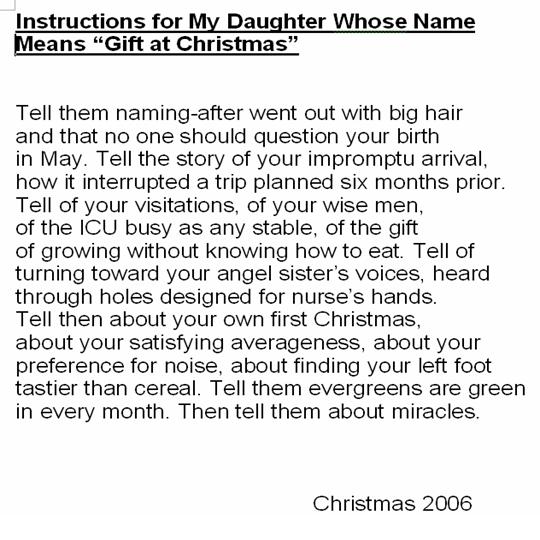
The best to you and your families, oh my 6 loyal readers, at this very special time of year.
Wednesday, December 13, 2006
Week Two, Book Five - Later
Two weeks between posts? Ugh. So many good excuses that I will not bore you with.
Fifth entry is coming, Meanwhile, entertain yourselves with this surprisingly good anthology of Winter Poems compiled by Bob and Margery at About.com.
Your patience is appreciated.
Fifth entry is coming, Meanwhile, entertain yourselves with this surprisingly good anthology of Winter Poems compiled by Bob and Margery at About.com.
Your patience is appreciated.
Friday, December 01, 2006
Five Books, The Fourth
I have a multilayered ulterior motive in recommending Coleman Barks’ Club – Granddaughter Poems. This work, inspired directly by the author's interactions with his granddaughter Briny has some fine moments, such as the book’s opening, No Finale, which starts
If I were dying, or if I were convinced
I were dying soon, say within a year, if
I were told so by doctors, I would write
a bunch of poems out of my nervousness
and my love for being here.
The line breaks that make this opening all about the narrator (note the prominence of the “I” in the first three lines - this is clearly conscious, as there is no "I" in Coleman Barks) contrast immediately with the observations and direct quotes of the young granddaughter, as in “In Opening Game Day Traffic”, where Briny explains football (spacing of the first line is off):
...You
pass the ball between your legs, you
go hurt somebody, then you start over.
I hate to sell it short with descriptions like “charming”, because there is craft here (especially in Briny’s drawings of imaginary composite animals), but “charming” is often what gets the casual reader across the threshold into a poem. And here is my mild deception: Once the casual reader is familiar with this small volume, she or he may spy the name Coleman Barks and find themselves purchasing Gourd Seed, or borrowing The Essential Rumi from the library. Then they’ll have, without noticing, slipped and fallen headlong into a world of poetry they’d have walked by without seeing not so long before.
Next up: Book Five and the Honorable Mentions. Which is not a bad name for a rock band. One composed of librarians and county fair judges, of course, but no one rocks like a librarian.
If I were dying, or if I were convinced
I were dying soon, say within a year, if
I were told so by doctors, I would write
a bunch of poems out of my nervousness
and my love for being here.
The line breaks that make this opening all about the narrator (note the prominence of the “I” in the first three lines - this is clearly conscious, as there is no "I" in Coleman Barks) contrast immediately with the observations and direct quotes of the young granddaughter, as in “In Opening Game Day Traffic”, where Briny explains football (spacing of the first line is off):
...You
pass the ball between your legs, you
go hurt somebody, then you start over.
I hate to sell it short with descriptions like “charming”, because there is craft here (especially in Briny’s drawings of imaginary composite animals), but “charming” is often what gets the casual reader across the threshold into a poem. And here is my mild deception: Once the casual reader is familiar with this small volume, she or he may spy the name Coleman Barks and find themselves purchasing Gourd Seed, or borrowing The Essential Rumi from the library. Then they’ll have, without noticing, slipped and fallen headlong into a world of poetry they’d have walked by without seeing not so long before.
Next up: Book Five and the Honorable Mentions. Which is not a bad name for a rock band. One composed of librarians and county fair judges, of course, but no one rocks like a librarian.
Friday, November 24, 2006
Interlude
I'm so full of my stuffing I can't bear the thought of turning my brain on, but just in case you overate less than I and are looking for a little something, here are two links that showed up in my email recently and which are work a look:
Josh Wallaert at the University of Minnesota has a new blog in which he posts entries from the first edition of Webster's American Dictionary (1828). I was skeptical of his claim to their being "found poems" until I read the entry for "badger":
Badger, n.
A quadruped of the genus Ursus, of a clumsy make, with short, thick legs, and long claws on the fore feet. It inhabits the north of Europe and Asia, burrows, is indolent and sleepy, feeds by night on vegetables, and is very fat.
Its skin is used for pistol furniture; its flesh makes good bacon, and its hair is used for brushes to soften the shades in painting. The American badger is called the ground hog, and is sometimes white.
Fun stuff. If you're interested at all in the evolution of language (and if you're a regular here, my guess is that you are), check out Webster's Daily.
Also. Martha Brockenbrough has a new column on playing with kids over at Cranium.com: "In The Name of Fun". First of all, everything Cranium does is bound to be cool, but Martha's spins are always entertaining and she's got a gift for capturing the parental epiphany.
From the first entry:
If you’re reading this, I’m guessing you have kids. That means you could be doing dishes right now. You could be picking up dirty socks, or maybe signing permission slips, driving to soccer practice, or encouraging someone — anyone? Please? — to practice good oral hygiene.
Honestly though, I hope you’re taking this moment for yourself, because that’s what I’m doing.
Bound to become part of my weekly checklist.
That's it. I can't think anymore. I wonder if there's any more apple-cranberry jam....
Josh Wallaert at the University of Minnesota has a new blog in which he posts entries from the first edition of Webster's American Dictionary (1828). I was skeptical of his claim to their being "found poems" until I read the entry for "badger":
Badger, n.
A quadruped of the genus Ursus, of a clumsy make, with short, thick legs, and long claws on the fore feet. It inhabits the north of Europe and Asia, burrows, is indolent and sleepy, feeds by night on vegetables, and is very fat.
Its skin is used for pistol furniture; its flesh makes good bacon, and its hair is used for brushes to soften the shades in painting. The American badger is called the ground hog, and is sometimes white.
Fun stuff. If you're interested at all in the evolution of language (and if you're a regular here, my guess is that you are), check out Webster's Daily.
Also. Martha Brockenbrough has a new column on playing with kids over at Cranium.com: "In The Name of Fun". First of all, everything Cranium does is bound to be cool, but Martha's spins are always entertaining and she's got a gift for capturing the parental epiphany.
From the first entry:
If you’re reading this, I’m guessing you have kids. That means you could be doing dishes right now. You could be picking up dirty socks, or maybe signing permission slips, driving to soccer practice, or encouraging someone — anyone? Please? — to practice good oral hygiene.
Honestly though, I hope you’re taking this moment for yourself, because that’s what I’m doing.
Bound to become part of my weekly checklist.
That's it. I can't think anymore. I wonder if there's any more apple-cranberry jam....
Monday, November 20, 2006
Five Books, Part III
Tina Kelley’s poems consistently contain two of the qualities that are essential to successful, memorable poetry: they apply language in a precise manner, conscious of both sound and definition, and they make extraordinary observations in unexpected places. Further, she is playful in both situation and voice, which showcases those essential qualities in novel, often fascinating ways. In The Gospel of Galore, her first book, she imagines a letter from God to humanity, considers labrador retrievers as both Gods and a school teacher, and projects herself as the blood in her lover’s veins and as a kite. Kelley’s passion for precision is incredible, and her deeply developed sense of wonder are simply unmatched; this uncommon combination makes her an essential read for people who are exploring poetry’s capabilities.
In “The Word Kite”, Kelley uses names from other languages to capture the way we sometimes describe things that are difficult to describe:
In Italian, it’s cervo volente, flying red deer. In French, flying stag.
In Germany, it’s the same word as dragon. In Japan, octopus.
The Spanish cometa suggests the stars, and fengzheng, in China,
is the wind’s stringed instrument. Kite for us is predatory bird,
from the Old English cyta, for which “no related word appears
in the cognate languages,” though we know now that kites
were once used by virgins, midwives and surviving twin sisters
to hang their laundry up to dry.
She routinely asks questions that are anything but routine, as in “I Love A Man Who Gave Blood Thirty Times”:
And everywhere I go, I think Do you have a pint of him, honey?
Does the sweet health and consideration running through him
run through you, too?
The Gospel of Galore contains also a number of poems based on bird names, birdsong, and almost-found poems from old Audobon guides, and makes magnificent connections, such as “Other Names”:
Remind me of the Scrabble words when I have too few vowels:
the strany, the tysty, wagell and wamp. Particularly the quandy,
the marrock willock scuttock, kelinky,
murre and gwilym, kiddaw and skiddaw.
Tina Kelley crafts poems to hang in the corners of rooms that most people would walk through without stopping, poems that create moments that become irreplaceable, once you become aware of them. Word on the street is that she has another book ready for a smart publisher to snap up. I'll be first in line with my preorder.
Next up: Something from outside New Jersey.
In “The Word Kite”, Kelley uses names from other languages to capture the way we sometimes describe things that are difficult to describe:
In Italian, it’s cervo volente, flying red deer. In French, flying stag.
In Germany, it’s the same word as dragon. In Japan, octopus.
The Spanish cometa suggests the stars, and fengzheng, in China,
is the wind’s stringed instrument. Kite for us is predatory bird,
from the Old English cyta, for which “no related word appears
in the cognate languages,” though we know now that kites
were once used by virgins, midwives and surviving twin sisters
to hang their laundry up to dry.
She routinely asks questions that are anything but routine, as in “I Love A Man Who Gave Blood Thirty Times”:
And everywhere I go, I think Do you have a pint of him, honey?
Does the sweet health and consideration running through him
run through you, too?
The Gospel of Galore contains also a number of poems based on bird names, birdsong, and almost-found poems from old Audobon guides, and makes magnificent connections, such as “Other Names”:
Remind me of the Scrabble words when I have too few vowels:
the strany, the tysty, wagell and wamp. Particularly the quandy,
the marrock willock scuttock, kelinky,
murre and gwilym, kiddaw and skiddaw.
Tina Kelley crafts poems to hang in the corners of rooms that most people would walk through without stopping, poems that create moments that become irreplaceable, once you become aware of them. Word on the street is that she has another book ready for a smart publisher to snap up. I'll be first in line with my preorder.
Next up: Something from outside New Jersey.
Thursday, November 09, 2006
Five Books of Poetry Everyone Should Read, Part Two
Bill Watterson once remarked (through his alter-ego Calvin) that “People who are nostalgic for childhood were obviously never children". Catherine Doty’s book Momentum proves that statement wrong. In her poems, Doty deals turns the fear and anxiety of childhood into funny and powerful moments without resorting to imposing her the filter and judgment of adult voice on her former self.
In “For May is the Month of Our Mother”, she recalls what she learned from breaking a statue of Mary:
… I learned then to use something right
or leave it alone. No, I didn’t. I learned twelve-inch Virgin,
polystyrene, luminous ivory, black beads in screw-off bottom
ran $4.95, or twenty weeks of allowance.
In “Curriculim Vitae”. she inverts the normal model for this summary of a life by listing all its mistakes, instead of its successes:
… All the attempts,
like the fish tanks of your childhood,
begun in eager greed and soon to fail,
twenty-five gallons of well-lit bouillabaisse.
This book is filled with characters she feared and loved, imitated and avoided, and they will be familiar to you whether or not you have in your past a neighbor who recorded her son’s BMs on a calendar in the kitchen. You’ll have to get the book for that one.
But for me, the real magic of this book is that it creates metaphorical moments without betraying its sentiment, applies skillful use of language without contriving the behavior or speech of the remembered characters it presents to us.
Momentum is a book I insist people read before they tell me they “don’t like poetry”. It has changed minds, believe me. Don’t make me come over there and read it to you.
Next in our series: Tina Kelley and The Gospel of Galore.
In “For May is the Month of Our Mother”, she recalls what she learned from breaking a statue of Mary:
… I learned then to use something right
or leave it alone. No, I didn’t. I learned twelve-inch Virgin,
polystyrene, luminous ivory, black beads in screw-off bottom
ran $4.95, or twenty weeks of allowance.
In “Curriculim Vitae”. she inverts the normal model for this summary of a life by listing all its mistakes, instead of its successes:
… All the attempts,
like the fish tanks of your childhood,
begun in eager greed and soon to fail,
twenty-five gallons of well-lit bouillabaisse.
This book is filled with characters she feared and loved, imitated and avoided, and they will be familiar to you whether or not you have in your past a neighbor who recorded her son’s BMs on a calendar in the kitchen. You’ll have to get the book for that one.
But for me, the real magic of this book is that it creates metaphorical moments without betraying its sentiment, applies skillful use of language without contriving the behavior or speech of the remembered characters it presents to us.
Momentum is a book I insist people read before they tell me they “don’t like poetry”. It has changed minds, believe me. Don’t make me come over there and read it to you.
Next in our series: Tina Kelley and The Gospel of Galore.
Saturday, November 04, 2006
A List that Reaches Out, Not In
I was checking out Wil Wheaton’s “Five Books Every Geek Should Read"* when something struck me: It’s been a theme among the bloggers I follow recently to talk about what’s important about “us” to “us”. Like geek books for geeks, poetry books for poets, modern philosophy books for modern philosophers, etc.
Maybe I’m unique, but rather than publishing possible credentials for membership in a club I’m already in, I’m more interested in being an ambassador of sorts for people outside the club. I find myself in this position naturally a lot anyway: I’m more deeply involved in the arts than many of my business and technical colleagues, but more aware of issues in business and technology than my artist friends; my personal politics are way to the left of most of my family, and way to the right of most of the people I encounter in the pursuit of poetry; I’m by profession and nature a developer of new products and new ideas, but I’m by hobby (inherited from my father) a student of the past and an occasionally voracious reader of history, etc., etc., etc.
All of which is a long way of saying: Hey, Wil Wheaton, as respected and linguistically gifted ubergeek, how about a list of 5 Books People Who Want to Know More About Geeks Should Read, That They’ll Find Enough Interesting Content in to Want to Finish, but Which Are Representative Enough of Geekdom to Reach Them and Hopefully Change Them a Little?
Granted, that’s a crappy title for a blog entry, but you know what I mean.
Let me put my money where my mouth is and give you “Five Books of Poetry Everyone Should Read”, with the idea that it will be a bibliography of reasonable length which I suggest you read before you attempt to credibly tell me that you “don’t like poetry”.
I want to roll this out one book at a time with enough exposition to be meaningful, and this entry is already 3 scroll-clicks too long, so the first selection is short with more to come later:
First up, the shortest collection in the bunch and therefore the least intimidating place to start, is BJ Ward’s 17 Love Poems with No Despair. The title is an obvious nod to Neruda, but the collection is a Whitman’s Sampler of love poems that have something for everyone. My favorite opening lines, from “Coffee”:
Honey, I hate mornings
like a dead leg hates a polka
Within the covers of 17 Love Poems..., you'll find both classic themes and references to members of the Justice League of America. If you love now or have loved once, have read Neruda or have never read Neruda, know who Zan and Jana are or didn't watch ABC on Saturday mornings in the seventies, you will find something to impress you in this slender volume. More on this book in the wrap up entry at the end of the list, which I promise to you, my six devoted readers, will be less than eight weeks from now (which my geek friends have already projected base on the average post density over the past few months, making certain allowances for impending holidays but my artist friends think is ridiculous because of the obvious passion contained in this entry....).
Next entry, with a more meaningful treatment: Cat Doty’s Momentum.
* A quick note: You can get to Wil Wheaton’s column from the WWdN link at right, but be aware that his column is hosted by a website that contains some content your business, family, and maternal filters will find questionable, so I’ll leave it to you to go read the original list if you like
Maybe I’m unique, but rather than publishing possible credentials for membership in a club I’m already in, I’m more interested in being an ambassador of sorts for people outside the club. I find myself in this position naturally a lot anyway: I’m more deeply involved in the arts than many of my business and technical colleagues, but more aware of issues in business and technology than my artist friends; my personal politics are way to the left of most of my family, and way to the right of most of the people I encounter in the pursuit of poetry; I’m by profession and nature a developer of new products and new ideas, but I’m by hobby (inherited from my father) a student of the past and an occasionally voracious reader of history, etc., etc., etc.
All of which is a long way of saying: Hey, Wil Wheaton, as respected and linguistically gifted ubergeek, how about a list of 5 Books People Who Want to Know More About Geeks Should Read, That They’ll Find Enough Interesting Content in to Want to Finish, but Which Are Representative Enough of Geekdom to Reach Them and Hopefully Change Them a Little?
Granted, that’s a crappy title for a blog entry, but you know what I mean.
Let me put my money where my mouth is and give you “Five Books of Poetry Everyone Should Read”, with the idea that it will be a bibliography of reasonable length which I suggest you read before you attempt to credibly tell me that you “don’t like poetry”.
I want to roll this out one book at a time with enough exposition to be meaningful, and this entry is already 3 scroll-clicks too long, so the first selection is short with more to come later:
First up, the shortest collection in the bunch and therefore the least intimidating place to start, is BJ Ward’s 17 Love Poems with No Despair. The title is an obvious nod to Neruda, but the collection is a Whitman’s Sampler of love poems that have something for everyone. My favorite opening lines, from “Coffee”:
Honey, I hate mornings
like a dead leg hates a polka
Within the covers of 17 Love Poems..., you'll find both classic themes and references to members of the Justice League of America. If you love now or have loved once, have read Neruda or have never read Neruda, know who Zan and Jana are or didn't watch ABC on Saturday mornings in the seventies, you will find something to impress you in this slender volume. More on this book in the wrap up entry at the end of the list, which I promise to you, my six devoted readers, will be less than eight weeks from now (which my geek friends have already projected base on the average post density over the past few months, making certain allowances for impending holidays but my artist friends think is ridiculous because of the obvious passion contained in this entry....).
Next entry, with a more meaningful treatment: Cat Doty’s Momentum.
* A quick note: You can get to Wil Wheaton’s column from the WWdN link at right, but be aware that his column is hosted by a website that contains some content your business, family, and maternal filters will find questionable, so I’ll leave it to you to go read the original list if you like
Monday, October 23, 2006
The Dark Unmarked Waters
Just read on Josh's blog that Deborah Tall has died. The journal she led, Seneca Review, was the first publication I remember reading and thinking: "Wow. I wish I wrote like that." Of course, this was before I'd learned to experiment with my own style but still, fifteen years later, I've never produced anything I thought fit or merited inclusion in that journal. It's a home for the lyric essay, which is a fascinating form for me, having been trained repeatedly in the classical and technical essay. This post takes its title from one of Deborah's poems.
Had another of those moments recently where I mined an unpleasant memory for a poem idea. I'm actually pleased with the final product, but my internal editor is all over me to burn the thing before [subject person who would not appreciate the publicity] finds out what I've written. As is usual, the "real" portion of the memory is the rough diamond at the center of a highly fictionalized setting, but I don't think [subject person] would consider that appropriate mitigation. It's the old question: how to reach the larger audience and not chase away the local one. Or is this a question that only I ask?
Had another of those moments recently where I mined an unpleasant memory for a poem idea. I'm actually pleased with the final product, but my internal editor is all over me to burn the thing before [subject person who would not appreciate the publicity] finds out what I've written. As is usual, the "real" portion of the memory is the rough diamond at the center of a highly fictionalized setting, but I don't think [subject person] would consider that appropriate mitigation. It's the old question: how to reach the larger audience and not chase away the local one. Or is this a question that only I ask?
Monday, October 16, 2006
Food For Thought
Just got word that Diane Lockward's second full-length book is out. You may have heard her read at this year's Dodge Festival. She's quite a generous spirit, good for poetry on a number of levels, and an old friend of the Spoken Word Series. And I'm not just saying that in case I run into her at our local Shop-Rite...
Visit Diane's website or the Wind Publications site for more about What Feeds Us. Here's a sample, but you'll have to visit the book's page for more...
An Average Day for an Average Liar
The average person tells thirteen lies each day.
—Dr. Georgia Witkin
One, on a day much like any other, I awake with alarm
clock blaring, turn to you, and say, "Your face
is no longer imprinted on my heart."
Two, I aim a dart to the groin, say I’ve taken a paramour.
Visit Diane's website or the Wind Publications site for more about What Feeds Us. Here's a sample, but you'll have to visit the book's page for more...
An Average Day for an Average Liar
The average person tells thirteen lies each day.
—Dr. Georgia Witkin
One, on a day much like any other, I awake with alarm
clock blaring, turn to you, and say, "Your face
is no longer imprinted on my heart."
Two, I aim a dart to the groin, say I’ve taken a paramour.
Thursday, October 12, 2006
Why?
A poet and blogger I respect a great deal has joined the blogosphere in a completely anonymous way and requested that the new blog reference in a recent email not be linked to the poet's name. The email included references to why the blog is important to have, and not important to link to a specific name. Interesting stuff. Can't share it with you, though.
But it makes me think out what this little space is for. Here are some reasons I keep Cosmic Liverwurst alive:
But it makes me think out what this little space is for. Here are some reasons I keep Cosmic Liverwurst alive:
- It forces me to consider my own writing from time to time, as I strive for weekly update at minimum.
- It provides an artistic reference to the artists I recruit to read in the Spoken Word Series in Hoboken - gives them a chance to know my aesthetics as another input into their decision to participate or not. This is the primary reason I'm not anonymous here.
- Since I carry the title of Artist in Residence at The Center for the Performing Arts at DeBaun Auditorium, I feel it appropriate to have a live, albeit slow-moving, contribution to the art I practice.
- My mom likes it.
This blog also allows me (in my own mind, anyway) to participate at some level in a world of artists far superior to myself, from whom I learn every time I log into Blogger. You'll find those artists listed to your right. They generally have actual writing projects and service to advertise, but they're on my list because they're insightful and interesting, and their writings contain qualities I aspire to have in my own.
If you're here to learn my personal politics, you'll be disappointed - they don't inform my writing much. Since my kids, my theater and music background, my technical education, and my 35-year roller-coaster relationship with Los Mets actually influence my writing a great deal, those will show up from time to time.
So that's why I'm here. In case you were wondering.
{cricket!}
{cricket!}
Tuesday, October 03, 2006
Getting Dodge-y
Yes, they eventually posted the Dodge schedule. Yes, I did get there. No, I haven't anywhere near enough time to properly do it justice. That will come in pieces as I find time to rediscover my notes.
- Anne Waldman: "Larger than Life" is an understatement. Truly thoughtful of questions during her "On Poetry" talk. Seemed genuinely pleased to hear that poetry continues at Stevens, where she once taught.
- Sekou Sundiata: This man has some pipes. Specifically and emphatically said: I'm not a spoken word artist, I'm a poet." and made clear the difference. Didn't get to hear him with his band, which is a great loss for me. The CD is terrific, though.
- Andrew Motion: Exudes humility like perspiration. Amplified by his London countryside accent, reads his formal verse in a way that creates the structure in your ear - a little stilted at the line breaks, but not enough to distract you from listening. If he wasn't genuinely grateful that I knew a little about his internet project before his reading, I'm the worst judge of people ever. Almost popped with excitement when talking about Bob Dylan.
- Coleman Barks: You can tell the grandfather poems from the Rumi, but you cannot distinguish the levels of joy in his presentation. Just when you think The Paul Winter Consort has become a little predictable, Barks turns to them and says "How about a little circus music?"
- Linda Pastan: Kept saying she'd "rather read poems than talk about making them", but spoke eloquently about the details of their construction. Two very interesting exercises: one she read a poem in third person, then in first person, and led a 6 minute discussion about which was better - the other, she read a Justice poem with a small stanza at the start, in the middle, and at the end to see where "it wanted to be". Great stuff.
- Jorie Graham: I could not physically write fast enough to keep up with everything she was saying that was noteworthy. Talked for a long time (it was a panel discussion), but not much of it was wasted.
Other notes:
- Too many terrific poets scheduled opposite each other at the ONE festival poets slot. I have generally loved the way the last several schedules have been laid out, but this didn't work for me. Mr. Haba, if you happen to be reading this, give us more opportunity to hear these "other" poets - some of them are more interesting than your features.
- It was brutally cold in the morning inside the big top and uncomfortably warm in the afternoon (in spots in the path of the stage lights aimed at the audience). This may be why no one enforced the "no coffee in the tent" rule in the mornings.
- Return to Waterloo Village seemed appreciated by most, and I have to say I did think things were laid out pretty well this year.
- You could get a near-raw hamburger and a vegan chili at the same stand. Three cheers for that!
- I took an hour off during the Saturday afternoon features. As much as I enjoy Lucille Clifton, I may have gotten more from that walk along the canal. You have to leave time for the words sink in, too.
It'll take me a month to sort through everything I want to process from my notebook. As the flotsam strikes me, so shall it appear here.
Saturday, September 16, 2006
Stuff and Fluff
Just got back from a whirlwind trip to Ireland and Scotland. I was chagrined to find myself on a completely different hotel floor from the rest of my party until I got off the elevator (Sorry - the LIFT)and was greeted by a bust of Yeats. Purpose for everything and all that. Turns out there was a najor figure from Irish history on ever floor - who better to greet an aspiring writer?
Missed a great week here, though - Two things I'd like to have been more on top of:
Missed a great week here, though - Two things I'd like to have been more on top of:
- George Witte presented from his The Apparationers in Rutherford. I was on a plane.
- BJ Ward's poem "Cuckoldom" from Poetry was featured on Poetry Daily. I didn't have internet access.
Less great was receiving the formal written let-down from Steel Toe's open reading period (though the news of the winners was long since out). Not that I was expecting it, but a thin SASE in your mailbox is always a little dispriting, no?
Dodge Festival schedule STILL isn't up, and I've heard that at least one of the featured readers doesn't know what day she's reding on yet. But I've also heard that The Poets of NJ will be reading on Saturday evening - Plan to be there if you haven't caught any of this group's road show yet.
Wednesday, September 06, 2006
Another Curmudgeon
My alumni magazine directed me to a recent entry to the online community. John Hargen is posting as The Scientific Curmudgeon on the Stevens website. A small but interesting body of work so far.
It's part of an encouraging effort called The Center for Science Writings. From the site: "The Center has two major missions: improving the communication skills of Stevens students and examining how books, essays, articles, and other forms of expression shape public perceptions of science. The Center is particularly interested in writings that explore the limits of science; the social implications of science; the relationship of science to the humanities, arts and religion; and the role of creativity and innovation in scientific progress."
The Scientific Curmudgeon is now on the list to your right. Check it out.
It's part of an encouraging effort called The Center for Science Writings. From the site: "The Center has two major missions: improving the communication skills of Stevens students and examining how books, essays, articles, and other forms of expression shape public perceptions of science. The Center is particularly interested in writings that explore the limits of science; the social implications of science; the relationship of science to the humanities, arts and religion; and the role of creativity and innovation in scientific progress."
The Scientific Curmudgeon is now on the list to your right. Check it out.
Wednesday, August 30, 2006
Waiting and Contemplating
The schedule for this year's Dodge festival is still not posted. Not that I should need more than 28 days to figure out how to spend 48 hours of my life, but the list of poets - especially the PFKAPAA (Poets Formerly Known as Poets Among Us) is just tremendous this year, and I know I need to run a nice optimization algorithm to get the right mix of fine poets whose work I know and fine poets whose work I've yet to meet.
Lord, I'm really geeky this week.
I'm actually looking forward to Dodge more than usual this year because I've written almost nothing since April, and I could use the time, inspiration, and bad cel phone reception to squeeze out some words.
Maybe even save a few to start repopulating this litte desert corner of the internet, too....
Lord, I'm really geeky this week.
I'm actually looking forward to Dodge more than usual this year because I've written almost nothing since April, and I could use the time, inspiration, and bad cel phone reception to squeeze out some words.
Maybe even save a few to start repopulating this litte desert corner of the internet, too....
Wednesday, August 16, 2006
Miscellany for a Wednesday
It's Charles Bukowski's birthday. Maybe we should all do today's writing drunk, naked and sweaty in commemoration. I've been meandering my way through Sifting Through the Madness for the Word, the Line, the Way: New Poems for months and to be honest, I find parts of it brutal - where the subject overwhelms what craft there is to the point where I have to put it down. It's like spotting micrograms of diamond in a pail of rotting meat.
***
On the other end of the spectrum, I've been spending lots of time with my contributor's copy of Silk Road. I'm just thrilled at being included in this inaugural volume alongside some of the writers whose works I've been studying and learning from. Among the poets you'll find there are Deborah Ager, Kelli Agodon, Steve Schroeder and Suzanne Frischkorn. From the Editors' note:
A series of collected writings on place is like a string of caravansaries along the ancient Silk Road. Each one offers a similar refuge from the immediacy of a dusty, perilous highway, yet no two are the same because of the mix of travelers who gather there.
What a great way to approach creating a magazine.
***
The 06-07 season of the Spoken Word Series has been posted at DeBaun.org. If artistic diversity is my primary objective in scheduling artists, I may have hit my peak in this, our 5th full year. And we're not done - I'm finalizing plans for a day of workshops in May and stewing up some longer term plans. I hope you NJ locals will keep an eye out. Or better, get on our mailing list.
***
The list of poets presenting at this year's Dodge Festival has been posted. It takes artistic diversity to a whole other level (and look for some lesser known but terrific talents in the bottom section of that list). It's interesting to think of this list and my own much smaller effort in the context of Deborah's recent comments on "KINDS" of poets, and to imagine the conscious and unconscious checklists in my head (and the heads of other event planners). "Diversity" requires criteria against which to check off "differences". Have to think about that some more.
***
On the other end of the spectrum, I've been spending lots of time with my contributor's copy of Silk Road. I'm just thrilled at being included in this inaugural volume alongside some of the writers whose works I've been studying and learning from. Among the poets you'll find there are Deborah Ager, Kelli Agodon, Steve Schroeder and Suzanne Frischkorn. From the Editors' note:
A series of collected writings on place is like a string of caravansaries along the ancient Silk Road. Each one offers a similar refuge from the immediacy of a dusty, perilous highway, yet no two are the same because of the mix of travelers who gather there.
What a great way to approach creating a magazine.
***
The 06-07 season of the Spoken Word Series has been posted at DeBaun.org. If artistic diversity is my primary objective in scheduling artists, I may have hit my peak in this, our 5th full year. And we're not done - I'm finalizing plans for a day of workshops in May and stewing up some longer term plans. I hope you NJ locals will keep an eye out. Or better, get on our mailing list.
***
The list of poets presenting at this year's Dodge Festival has been posted. It takes artistic diversity to a whole other level (and look for some lesser known but terrific talents in the bottom section of that list). It's interesting to think of this list and my own much smaller effort in the context of Deborah's recent comments on "KINDS" of poets, and to imagine the conscious and unconscious checklists in my head (and the heads of other event planners). "Diversity" requires criteria against which to check off "differences". Have to think about that some more.
Thursday, August 03, 2006
Here, gone, here
From the comings and goings files...
- Lost and Found Investigations has posted new comics this week, bringing its Gamefly-imposed hiatus to an apparent end. (Yay!)
- Kelli Agodon's blog has been subtracted the universe. A comment over at Jeannine's place leads me to think this was purposeful. Too bad - Kelli's was one of the truer-to-format "writer's blogs", with (I thought) the right mix of personal, projects, and poetry/prose.
- I just noticed that Kim Addonizio is blogging again, however.
- The Yankees did me the substantial favor of aquiring the two Phillies on my fantasy baseball team. Thanks, Brian Cashman! The Mets reacquired Roberto Hernandez, because Julio Franco wasn't doing enough to increase the average age of the team.
The next thing to go needs to be the HEAT!
Tuesday, August 01, 2006
James Weil (1929 – 2006)
By various electronic means, Ed Foster and Ron Sillman both bring us news today of the death of James Weil. For me to provide links here would imply a false familiarity with his work, but you can do a Google search on him and find a large number of references.
Among the accomplishments Ed included in his email obituary for Mr. Weil were these lines from "A Coney Island Life", which is on the Academy of American Poets' list of Great Poems to Teach:
Having lived a Coney Island life
on roller coaster ups and downs
and seen my helium hopes
break skyward without me,
now arms filled with dolls
I threw so much for
I take perhaps my last ride
on this planet-carousel
and ask
how many more times round
I have
to catch that brass-ring-sun
before the game is up.
Among the accomplishments Ed included in his email obituary for Mr. Weil were these lines from "A Coney Island Life", which is on the Academy of American Poets' list of Great Poems to Teach:
Having lived a Coney Island life
on roller coaster ups and downs
and seen my helium hopes
break skyward without me,
now arms filled with dolls
I threw so much for
I take perhaps my last ride
on this planet-carousel
and ask
how many more times round
I have
to catch that brass-ring-sun
before the game is up.
Friday, July 21, 2006
Feeding the Geek
Taking a small break from versification this week, and have been completely absorbed by The Physics of Superheroes by James Kakalios. It's a physics text of sorts, in that the science is solid and thoroughly explained, but it's also documentation of a love affair with comics. It asks and answers the question "Could this happen?" about many comics from the Golden and Silver eras, with examples of plausible and, well, miraculous physical happenings depicted in those glorious 4-color pages.
I'm not a huge comics fan (though I do enjoy a good Iron Man from time to time), but the enthusiasm Professor Kakalios shows for both his heroes and his equations is enough to carry me - and you - through his 400 pages quickly. He's an eloquent and talented writer.
And yes, I am a geek.
I'm not a huge comics fan (though I do enjoy a good Iron Man from time to time), but the enthusiasm Professor Kakalios shows for both his heroes and his equations is enough to carry me - and you - through his 400 pages quickly. He's an eloquent and talented writer.
And yes, I am a geek.
Monday, July 17, 2006
Reading and Sleeping
Has much been going on in the past month? Life continues to interfere with more regular posting; if you're looking for more regular (and more literarily astute) posting, check out the Frequented Blogs list. Here are a few miscellany from this corner of the world:
- Criticize his anthologies if you like, but Garrison Keillor continues to show good taste in selecting poems for The Writer's Almanac, this time rediscovering a gem from Meg Kearney's first book, An Unkindness of Ravens: "Creed".
- That, of course, follows the selection over the past month of two from Jeannine Gailey's Becoming the Villainess (click her blog below for details and current news).
- The DeBaun Series is coming together for next year, including what is shaping up to be a dynamite writing workshop day in May. Hope to be announcing detials by end-August.
- I did it again. I got some emergency expert guidance (and will be back to you for more, oh benevolent coach!) and submitted "To The Ones Who Must Be Loved" in an open reading period.
- What I'm reading currently: Only Here, Joe Salerno; Diary of a Cell, Jennifer Gresham; Never Before - Poems about first experience, edited by Laure-Anne Bosselaar. And all the writing mags - which I get more and more convinced just have nothing to say anymore.
- I did not make it into the New Jersey Writers Project, but am revamping my grammar school class concepts anyway - just in case any of you English teachers friends are checking in....
OK. That's all I'm awake enough to tell you about. I'm hoping for more awake time (for me and my dialup connection) soon!
Friday, June 23, 2006
Contrary to Popular Opinion...
...I have not, in fact, fallen from the face of the earth. However, I have had precious little time to focus on producing any new creative writings, and I'm just to darned private to tell you why. So speculate away; you get three guesses and the first two don't count.
But I have had some time to do some reading and listening. What reading I've been able to do has focused on a few places:
But I have had some time to do some reading and listening. What reading I've been able to do has focused on a few places:
- What Will Suffice, has a bunch of interesting commentaries by poets whose "ars poetica" poems were selected for inclusion in this pretty good anthology. Some of it loses me - I think the tendency to inflate good poems to find universality is a bit unchecked in this book, but it still is a nice collection.
- The latest 32 Poems is quite a strong issue. I've read it three times cover to cover and still find myself discovering things in it. Sandra Beasley's work is up at the website now - work a look and certainly enough for me to renew my subscription.
- I've rediscovered Discover. It's been a usual practice to grab a copy whenever I have time in an airport, but now, as a subsriber, I'm reinfusing myself with the sense of wonder this magazine has about just about everything. Even if you're not a science geek, you can benefit from at wonder, I promise.
As for listening, my ears have been focused mostly on the soundtrack from Barnum because my kids have fallen in love with the show. It's reminded me of all those great parts I had on my list of "Roles I'd Love to Play" back when I trod the boards frequently: John Adams in 1776, PT Barnum in Barnum, and other assorted blowhards.
Ah, for time for it all....
Subscribe to:
Posts (Atom)