OK. I have come to accept that the "Poetry" section in most commercial bookstores is going to contain the works of Jewel, Shakespeare, Maya Angelou, and two local authors. But I also accept that - for the most part - contemporary poetry is a limited-appeal art form and a bit of an acquired taste. As a pledge to the fraternity of the word, I feel comfortable admitting this aloud.
But parenting? Is there really an acquired taste for being a good parent? An attentive spouse and caregiver? My local paper recently ran a microreview - a positive microreview - of something called "Dad's Own Housekeeping Book" (Link deliberately omitted). Author David Bowers is a stay-at-home Dad and in general seems to be a creator of useful books, and I hope he won't take this personally, but:
Oh, please.
I'm sure it's filled with useful advice (to be fair, I'm reacting to the review, not the book), but how many more books do we need that assume male parents haven't progressed past Ricky Ricardo? The publisher's description of the book (via BN.com) opens with "Just because you’re born with a “Y” chromosome doesn’t excuse you from cleaning the bathroom, especially in this day and age when time’s at a premium and partners have to be, well, partners." Excuse me, but which of us knuckle-dragging cavemen in the 45 and under category hasn't been living this since we first dropped to one knee?
Maybe my ire is misdirected. What I'm really aggravated about is when friends anticipating their first blessed event turn to me for resources (knowing my first approach to just about anything is to acquire baseline knowledge and the right vocabulary), and I have just the one suggestion: Armin Brott. Don't get me wrong - Brott's books are pretty good, and I learned much from each of them (except for some of the deliberate redundancies of Father for Life). But are these really the only books available that don't assume that we (fathers) are stupid, reluctant, incompetent, depressed, belligerent, or some appalling combination of these? Maybe I'm missing the forest here, but for every "Be Prepared: A Practical Handbook for New Dads", I see 6 "Keeping the Baby Alive till Your Wife Gets Home: The Tough New 'how-to' for 21st Century Dads". I mean, even the (presumably) well-intentioned anthology Fatherhood displays a dismal lack of awareness by including Plath's "Daddy". I'm not looking for pollyanish, sunshine-and-saccharine treatments, just ones that don't think me an imbecile, a jerk, or a monster. Isn't there market for a book about caring, positive, literate fathering experience?
Are there good books out there I just haven't found? Or is this my call to arms? Or, more accurately, to pencils?
Wednesday, July 25, 2007


Thursday, July 19, 2007
RIP Sekou Sundiata
I am very surprised at the degree to which reading of Sekou Sundiata'a passing struck me just now, and I'm trying to understand it. I was introduced to his work at the first Dodge festival I attended, and I had a chance last year to sit in on a couple of his smaller events. People have been referring to him as a "performance poet", and he certainly was that - in his craft discussion, he mentioned that he tended to want to produce a CD, not a book, when he was compiling his poems. But when I asked him what might be different about writing for the ear as opposed to the page (which is how I interpreted his comment), he gently pushed back on my assumption. He clearly wanted his work to be an experience in print or in person - an event no matter how it was encountered - he just seemed to think of the CD as the way he would present the work first.
He had a quiet but forceful presence at the microphone, the kind that for me that makes clear the distinction between confidence and arrogance. Arrogance says "I have had these experiences and I know things better than you and I will tell you them now. Sit down and listen." Confidence says "I have had these experiences and I'm going to talk for a while now. You might want to listen." His presence was augmented by a great set of pipes - the kind of effortless bass that baritones with aspirations of C like me can't help but envy.
I've been looking for links to audio files of some of what he presented in his Dodge appearances so I can talk more about how he adjusted his work in real time, and how the crowd began to create our own rhythms in response to his, but I can't find them. Maybe later.
In the meantime, here are a few links. If you never heard him speak, find some audio below and give a listen. You won't be disappointed. I'm going to go stick Longstoryshort in the player and close my eyes.
Some links:
- Wikipedia's (already updated) entry
- A Fresh Air interview with Terry Gross
- His TV appearances.
- An AAP article.
- His CD Longstoryshort with some audio samples.
Sunday, July 15, 2007
Expanding Your Sources
I came to my current marginlly serious approach to writing by a circuitous path. While I've always played with words (my earliest "serious" effort being a novella penned in the fourth grade about a villanous plot to make Mars invisible to the Earth for nebulous and never-detailed nefarious purposes). But I was always more active as both participant and practitioner in other art forms. I've been a chorus and band performer in since first grade, played the accordion since the 4th (more bands, but as a serious solo for the first time, acted in and directed plays and conducted musicals since high school, and devoured books of all genres for as long as I can remember - including those 4 glorious summer of commuting into Manhattan, where I averaged 2 books a week (one I particularly remember was Ed Koch's Mayor - not to date myself or anything...).
My point is this: my poetry today is heavily influenced by sources other than poetry. If you surf the body of my work, you'll of course find weak echoes of Stevens, Frost and Williams, and some more contemprary influences as well. But you might also detect the influence of Loesser's lyrics, any number of prose authors of any period (Twain, Bradbury and Zelazny, to form one non-obvious group), and one I'm often surprised to find myself turning toward, Woody Allen.
If you only know Allen from his movies (or worse, from his more recent, more average movies), you are avoiding the company of brilliance. He has a new book of essays out, his first since 1980, which I'm going to pounce on this week.
...UPDATE BEGINS HERE...
Having always been enjoyed books, plays, and movies in that order, I first came upon Allen in a copy of Side Effects stolen out of my Uncle Frank's bedroom when I was 13. That copy has since been stolen from me, which makes a sort of sense. But I still have my Without Feathers, which has any number of examples of how all great writing has elements that poets can learn from.
Excellent poems are often built around phrasing which is both unexpected and perfect. As in this line, opening "The Early Essays (On Seeing a Tree in Summer)": "Of all the wonders of nature, a tree in summer is perhaps the most remarkable, with the possible exception of seeing a moose sing "Embraceable You" in spats".
What I love about that line is how it starts in ordinaryness (banality, even), and wrenches you to someplace completely different and unanticipated. We can debate whether it's funny (I know, Mother, I know), but there's no debating its originality and craft.
Another example: Allen's names are designed to dive through the ear and create tangible and complete characters by the end of the sentences in which they are introduced. Names like "Sir Osgood Mulford Twelge" and "Kaiser Lupowitz" seem to come with headshots attached.
The point is that Allen is brilliant at dropping you someplace you could not have anticipated. It may not be taking the top of your head off, but remember what Mr. Allen had to say about another of Ms. Dickinson's quotes: "How wrong Emily Dickinson was! Hope is not "the thing with feathers". The thing with feathers has turned out to be my nephew. I must take him to that specialist in Zurich."
NOTE: All quotes are from Woody Allen's Without Feathers, 1975 edition. Also stolen from my Uncle Frank.
Sunday, July 08, 2007
I don't know how long they've been around, but Writer's Digest has a number of pretty active blogs now. Seems the poetry one is pretty new, with posts from Nancy Breen and Robert Lee Brewer from the WD Books cast list. I discovered Poetic Asides through a comment made over at Jeannine's place and visited with some trepidation. I gave up on WD a little over a year ago, when it became clear to me that their opinion of meaningful poetry content wasn't aligning with mine (also when Nancy Kress's contributions became less frequent).
It's early, of course (though relative posting rates being what they are, Poetic Asides will have reached the word count of this humble establishment before summer's end), but I think it shows some promise. I think anyone who frequents one or more of the poet's blogs at right will find the content a little light at first (the concept of the spam prompt, for example, are quite old to established poet-bloggers), but remember these blogs aren't for the established "blogosphere", they're for WD aficionados learning what blogs are and are not, what they are capable of and who they can reach.
Which leads me to a question. Many of us began the discovery our voices through relentless imitation. Some of those imitations must have, at times, found a way to an audience (publication, workshop, friend-of-a-friend), and that audience may not have recognized the imitation. For example, a good hunk of my early work aspires to be After Apple-picking or Birches. But a good hunk of my "immediate audience", having a knowledge of Frost that ended at the edge of the woods, therefore learned of the original through my works. Is that bad? Does it mean my work is less meaningful? Less useful? Sure, to one "schooled in the art" my work brought nothing new, but for some people, my work was the key to deeper knowledge of Frost. And to me, those same poems were the apprentice work that helped me hone my sense of rhythm, of sound, of line, etc. that have become something of my own voice.
So: Imitation of the past greats: good or bad? Useful? If so, to whom? Does it deserve positive, negative, or no attention from those who discover it? Enthusiastically joining the blog party without deep, knowledge of what earlier-arriving guests brought with them: good or bad? Useful? If so, to whom? Does it deserve positive, negative, or no attention from those who discover it?
My answer: Poetic Asides may bring new readers the long way around to the places Ron Silliman et al have been working in for years. It will definitely add a new voice, even while it searches through what came before looking for a place to settle in.
(Quick aside, poets only): first submission in almost 2 years went out yesterday. Got any luck you feel like sharing?
(Another quick aside, SF fans only): If you haven't already, go read the July Asimov's - Nancy Kress's novella is terrific.
(Final quick aside: computer nerds only): Any idea why Blogger is resisting accepting a title for this post?
Wednesday, July 04, 2007
Independence!
Independence from a tyrannical June, that is. A difficult month for a number of reasons which, for tradition's sake, I will not detail here. So. Draw a little picket fence (which is what we used do to between frames of a really bad line of bowling to indicate a fresh start - when we kept score with pencils, that is. Remember those terrific overhead scoring "systems" where you wrote with a nice soft pencil on an acetate and projected it overhead? But I digress...) and let's start this blog new.
Spent Independence Day at the Grover Cleveland Birthplace for their annual 4th of July Ice Cream Social. They really do a nice job - aside from the freezer for the ice cream and the guy on playing Mala Femmena on the synthesizer, they provide you the experience of a party they way it would have been when Cleveland was a boy. My kids rolled hoops, played marbles, enjoyed the game o graces, and dressed up in time-appropriate garb. A delightful afternoon overall.
During my hiatus (which clearly began long before I declared it here), it's occurred to me that I may be a sort of Ed Sullivan as regards the poetry world. After 20 years on and off and 6 years of serious pursuit, I'm confident to say that - even if my career someday shows me to be a B+ practitioner of the art myself - I have a good ear and sense of the craft, have realized some terrific luck recruiting some really fine poets to read in my series in Hoboken, have had some success "discovering" artists in some way. Case in point: the pairing of poet John J. Trause with painter Michael Filan in our Visible Word event. When the fruit of your ideas is good enough to get picked up by objective third parties, you gain a little confidence. And I am just as pleased to see my idea flourish in recognition for other artists as I am to have my own words recognized; in my mind this is one of the things that distinguishes managers and mentors. If you will: Confidence in the skills, independence from the ego.
Speaking of which, I won't have time this year for the annual watching of William Daniels' wonderful portrayal of John Adams in 1776. Good thing I have it memorized.
Tuesday, June 05, 2007
This Here Little Unintentional Hiatus
Well, just in case anyone is still dropping in here from time to time, let the notion that I'll be posting meaningfully any time soon be gone from your head. June is shaping up to make May look like the slothful Sunday at the heart of a long weekend.
The corner deli ("Your source for Cosmic Liverwurst since 2003") will reopen on July 4th, which hopefully will signify my independence from some current time-consuming activities in addition to portending a sleepless evening for my kids and the delicious overnight smell of sulfur.
Among the things you have waiting for you upon our return:
- Tidbits from the Celebration of NJ Journals
- Upcoming publication news
- Details on an exciting Spoken Word Series 07-08
- Complaints about Bobby Abreu's batting average
Thursday, May 17, 2007
New Wordsey
At this Sunday's Celebration of NJ Literary Journals (plus a few neighbors), 24 poets will represent 12 magazines. And those so represented and representing will be:
For US 1 Worksheets: Wanda Praisner, Nancy Scott
For Exit 13: Adele Kenny, John Larkin
For Mad Poets Review: Autumn Konopka, Rachel Bunting
For Heliotrope: Cindy Savett, Michael T. Young
For Journal of New Jersey Poets: Sandra Duguid, Alison Nguyen
For Lips: Stanley Barkan, Jim Gwyn
For New York Quarterly: Peter Arcese, Ira Joe Fisher
For Painted Bride Quarterly: Nicole Hefner, Sanjana Nair
For Tiferet: Priscilla Orr, Edwin Romond
For Home Planet News: Roberta Gould, Robert Milby
For Edison Literary Review: Madeline Tiger, David Vincenti
For Paterson Literary Review: Svea Barrett, Joe Weil
And yes, it's THAT Ira Joe Fisher.
More links if I get a chance, which means probably not.
But come anyway!
Friday, May 11, 2007
In which we get to the point
Shanna Compton has a very good essay up at PoetryFoundation.org.
The severalth annual Celebration of NJ Journals is coming up soon.
The talented and generous Maria Gillan has a new book out.
The next season of Spoken Word Series will be announced next Friday. Smaller? Yes. More power per unit poet? Geeky, but guaranteed.
This weekend is Mother's Day. Go here for ideas, but skip the Plath.
Back to regularity soon.
Friday, April 20, 2007
In Which We Offer a Random Assortment of Things Which Have Occurred To Us But Which We Have Not Had Time To Trim To A Length Shorter Than This Title.
As usual, many good excuses for my absence. As usual, I will keep them to myself. Stuff:
- I hereby declare May to be NaProPoMo (National Procrastinating Poets' Month). Not that I'm procrastinating per se, but that's when I'll get some time to execute my poem-a-day thing. Look at it this way: I'm challenging myself to complete one more poem than all the folks who actually did their thing on time.
- Even though I haven't really done anything with PoWriMo yet, I did say I would get a draft up "soon" (geologically speaking). Well, here:
(Sorry, Deleted)
- Just in case you're interested to know what I do with all that time I'm not writing poems (when I'm not spending it with my family, of course), let me mention that I'll be presenting in the poster session at the Project Management Institute of New Jersey's symposium on Sustainable Project Management on May 7. I'll have a great handout describing a simple tool you can use to assess the sustainability of an individual's contribution to your PM talent pool. Be sure and say hi when you stop by, all you project-managing poets, you.
- No, I haven't given up on my chess thesis. But I have been playing a lot of chess against the computer, and I remain convinced my position will hold water once I articulate it. Whenever that turns out to be.
- Recently heard from the always-impactful Meg Kearney that the Solstice Summer Writers’ Conference is still accepting applications. Poetry instructors are Naomi Ayala, Kurt Brown, Cornelius Eady, A. Van Jordan. Go sign up now.
That's my 8 minutes of on-line time for tonight. More to come, approximately soonish.
Saturday, March 24, 2007
All out of Sprynch
Spring/Synch, get it? Snow all over my yard, but it's spring, and that's a great analogy for how I'm managing my time right now?
Yeah, that's about how organized my writings are at the moment. Which is why I haven't posted my chess/poetry thesis again. Tom's comments deserve a response that has been decently proofread.
Anyway, this doesn't mean good things aren't happening.
Yeah, that's about how organized my writings are at the moment. Which is why I haven't posted my chess/poetry thesis again. Tom's comments deserve a response that has been decently proofread.
Anyway, this doesn't mean good things aren't happening.
- Check out the end of the 06-07 season of the Spoken Word Series.
- Take a look at this year's writing workshop at The Center for the Performing Arts at DeBaun Auditorium and the three awesome instructors we have for you.
- Set aside May 20 for what may be the best annual poetry event in New Jersey (and I'm not just saying that because Dodge and the Warren County are biennial or because I'm actually performing in this one)
I've also got my manuscript distilled to pithy chapbook form for spring deadlines (and am understanding its weaknesses more now), I have the 07-08 season of the series in Hoboken just about booked, and have actually transcribed my "notebook" (a tape recorder I usually do my composing on) for the first time in 6 months. So there's stuff, just not organized enough to tell you about today. I'm even feeling up to posting a draft next time. Just to see how good Jeannine's mood really is (Just kidding!).
See you next weekend.
Friday, March 16, 2007
I guess she knows the old man's a poet?
So we're sitting in the living room doing a Mad Lib with one of the kids scribing. We go around and around with the nouns and the numbers until she asks her mother for an adverb. Mommy hesitates for the slightest of instants, and the little one jumps in with "That's OK. Daddy can do that one."
Needless to say, Mommy came up with an adverb.
And now if you'll excuse me, I'm off for some upside-down hog with snuggled cream.
Needless to say, Mommy came up with an adverb.
And now if you'll excuse me, I'm off for some upside-down hog with snuggled cream.
Tuesday, March 06, 2007
I haven't wandered off...
... but I haven't had time for much reprocessing, and Tom's got me thumbing the chess books I've never actually read. I will get back to my parallels between chess and poetry - I still think they're there, but I want to reformulate my explanation, but in the meantime, please amuse yourselves with this terrific post over at Defective Yeti on the revitalizing of cliches.
The post was made sweeter for me when I saw David Lamotte's name - David, who does not live near me, was one of the first unexpected audience members to follow a link or an add to a Spoken Word Series event in Hoboken. He's a gifted songwriter, and he read a lyric of his "The Water's Gonna Win" as a poem in our open mic period, and it was good stuff.
The small world at work. Back soon.
Friday, February 23, 2007
The exchange before midpoem
Well, Tom's got me reprocessing this theory before I've even exchanged a pawn for a participle, but let's continue.
In chess, the transition from opening to midgame is marked by an exchange of pieces, intitiated by the sacrifice of a piece for the purpose of clearing out and ultimately assuming a controlling posture toward (though not necessary controlling position in) the middle of the board. It is marked by the beginning of development of more powerful pieces for use in midgame.
Before we get to the development of the powerful pieces, let's discuss the transition, the exchange. How is this akin to writing poems? My contention is that more successful poems tend to operate from a vulnerable position - confessional exposure being the most obvious and most overused. If you're willing to think ahead with me and anticipate that a good poem has to leave itself open in anticipation of a surprise somewhere in it (like a well-played chess game will at some point deviate from mere parroting of the great players), then the first transition of that poem is the conscious direction that creates the opportunity for surprise. The sacrifice of a bishop to radically and blatantly disrupt the center defenses may be similar to the driving home of the poem's idea through a repetition of word and image.
Or, maybe, the transition is the deliberate clearing of the space around the poem's opening that makes taking it in a new direction possible. On the chess board, this could be exchange of pawns and knights that leaves the middle empty for the queen to take over. In the poem, this is discarding of the details not central to the poem's thesis that leave the metaphor available for detail and embellishment.
Just like the meaning of a chess move can only be interpreted in the context of the style of the player, the meaning of a poetry development can only be interpreted in the context of the style of the poet. Similarly, a single poet's/player's style can change from poem/game to poem/game.
Next up: me bouncing off your comments.
Following that: Midpoem.
Sunday, February 18, 2007
Poetry Like Chess: The Opening
(Disclaimer: By objective standards, I qualify as "advanced amateur" in both poetry and chess)
Accept for this discussion that a chess game develops in a series of known phases: The opening, the midgame and the endgame, with definable transitions between each phase pair. I know some will resist this idea, but this is really not a bad analog for a poem. Poems require compelling openings, precise and developing middles, and impactful (or at least calculated) endings.
Though poetry has the advantage over chess in number of potential openings, it is greatly similar in one way: a wildly unconventional opening portends either genius or the beginning of an unpredictable uneven ride.
Let us take "opening" in this case to mean "stage setting". On offense or defense in chess, a good player is thinking several moves ahead, positioning pieces not for where they need to be now, but where they need to be in the future. And anticipating where the opponent expects them to be and meeting that expectation in one of two ways: Either by presenting the opponent with something different, something surprising but still part of her plan, or by accepting the opponent's expectation, but with a level of preparedness that leaves no square of the board unaccounted for in its depth of planning.
Is this all that different than writing a poem? I know we want to believe that we follow the poem to where it wants to lead us, but I think this isn't entirely dissimilar from playing off a good opponent across the chess board. You have a plan, and you execute that plan, adjusting it continuously as you receive input and opposition. In the case of a poem, we often provide the input and opposition internally, maybe subconsciously, but we are reacting in real time to our own words as they develop on the page before us - the point at which they stop being our property and start belonging to the poem. It is that point at which they are most like the moves of our opponent on the chess board; even if we have anticipated their move perfectly, we are still reacting to it - choosing to keep with our plan or depart from it.
Some chess openings are accepted convention (Ruy Lopez, Ponziani), some are more radical than others, and some require more skills (particularly those that develop the queen early). Again, here, this isn't all that different from the writing process: We can choose to employ standard, or favorite, or accepted openings, or ones that are challenge the reader (the opponent?) to play along with us. A good chess player will decide by the 4th move if the opponent has the skills to make the game competitive. How many times have you decided by the 4th line of a poem that it was not crafted with sufficient skill to be meaningful or useful to you? How many of your own poems have you tolerated past a weak 4th line, ignoring your own awareness that it was weak?
Understand I'm not saying that an unconventional opening, or an aggressive or challenging one is a bad thing - merely that it requires greater skill to pull off effectively. And that discarding convention merely as an act of anarchy is a sure way to lose the reader, and make the challenge of completing the poem very, very difficult.
If I can figure a way to do so meaningfully, next up will be examples. Down the road a piece is: Transition one: The first sacrifice.
Wednesday, January 31, 2007
Spam, Amy Holman, and Ruy Lopez
(wherein we celebrate Ms. Holman's return to the blogging world with a sincere but ridiculous title).
(1) Re: Spam, let me say that I have received my favorite bit of unsolicited kilobytes in quite some time. Apparently, an underintelligent bot, presumably through entries like this, has flagged me as a Dodge enthusiast.
Dear blog author:
They do promise they will not "send this message (any) more than twice... intentionally". For the record, this is a Ford house, sir. At least until the next recall.
(2) Re: Amy Holman, a comment below and a fresh post over at Literadog lead me to believe that Amy is over computer issues and back to her infrequent but in-depth commentary on publications publishing. Her most recent commentary (on The Potmac Review) shows why we should value the opinion of this author and teacher so highly: she speaks with passion and intelligence on just about all literary fronts.
And (3) Re: Ruy Lopez, consider this, the opening gamibt (if you will) of my comparison between playing chcess and writing a poem: There are many ways to open a chess game. Most are conventional, and will take you to conventional gameplay if you let them. Some are unconventional, and will take you to game situations which can be fascinating or brutal - or both.
Get where I'm going, yet?
(1) Re: Spam, let me say that I have received my favorite bit of unsolicited kilobytes in quite some time. Apparently, an underintelligent bot, presumably through entries like this, has flagged me as a Dodge enthusiast.
Dear blog author:
We recently came across your site, cosmicliverwurst.blogspot.com, while searching for bloggers who blog about Dodge issues.
A small group of us have started a new site called http://www.dodge-bloggers.com">Dodge Bloggers . Our intent is to bring Dodge bloggers closer together, and make a positive contribution to the Internet community.
They do promise they will not "send this message (any) more than twice... intentionally". For the record, this is a Ford house, sir. At least until the next recall.
(2) Re: Amy Holman, a comment below and a fresh post over at Literadog lead me to believe that Amy is over computer issues and back to her infrequent but in-depth commentary on publications publishing. Her most recent commentary (on The Potmac Review) shows why we should value the opinion of this author and teacher so highly: she speaks with passion and intelligence on just about all literary fronts.
And (3) Re: Ruy Lopez, consider this, the opening gamibt (if you will) of my comparison between playing chcess and writing a poem: There are many ways to open a chess game. Most are conventional, and will take you to conventional gameplay if you let them. Some are unconventional, and will take you to game situations which can be fascinating or brutal - or both.
Get where I'm going, yet?
Thursday, January 25, 2007
Book Five: Anthologus Majorus
So I've been trying to decide on an anthology to end my little series of recommendations that people NOT intimate with the art of poetry should try. I keep coming back to Poetry 180, not necessarily because it's a great collection (it's pretty good), but because it seems to be the book most consistent with my purpose: To expose people who "like poetry but don't always get it" (the excuse I hear most often) to good work of a style or set of styles that they can appreciate at two levels: the first, sheer entertainment; the second, the emergence of the details of craft.
A poem like Gouge, Adze, Rasp, Hammer is first an interesting read, next a good springboard to talk about concretness of language. Cartoon Physics, Part 1 is a poem almost anyone can inhabit, but it's also a great vehicle to talk about how unique connection and observation is at the center of all good poems. The exposure to form is purposeful and obvious (to a poet), but it is not intimidating or didactic. It's not the reason most people stop reading poetry as high school sophomores.
180 More has better poems, I think, but they're smirkier. There are more inside jokes, more poems for poets to share with each other. The uninitiated can go from 180 to More, but I don't see More hooking them in the same way.
Looking back over my list, I'm satisfied that my recommendations are what I set out for them to be - good poems in collections that hang together well that kick open doors and encourage people to walk through them. I hope you approve.
Next up: had a short exchange with Jeff about (how I perceive) a similarity in attacking technical work and poetic work. I think that to say the two are somewhat dissimilar is fair. But to say that the two attacks share neither strategy nor tactics does disservice to both writing process and engineering innovation. I think I can sway you.
However, I don't think you, oh my 6 loyal readers, are disposed to that argument just yet. So next up is a transition point: Why writing good poetry is like playing chess well.
Anyone want to try to get in front of me on this one?
Saturday, January 06, 2007
Excuses, Shmexcuses...
Brief summary:
- Holiday houseguests
- unexpected project(s)
- a four-day Christmas (typical)
- unexpected project(s) for the Mrs.
- 60% of the house sick with something (at least one double pink-eye sinus-infection whammy)
- expected project(s)
- Essential Love, 180 More, a pile of BAPs, et al. in a pile waiting for me to finish my little project.
I mean, really.
I'm online about 8 minutes a day right now, so if you're waiting for something from me, well... sorry. As a peace offering, here's a recent discovery that you'll enjoy if you share my interest in the writing process: http://wordswimmer.blogspot.com/.
Be back soon.
Monday, December 18, 2006
Interlude 2: A Note For Christmas
While I'm determined to select an anthology for Book 5, I also know there's no way I'll get to that and do it justice this week. Therefore, we take another interlude in which I offer you my annual Christmas poem. Past years' installments ("The Donkey Tells the Story", and "Prayer Before Starting to Assemble the Rugged Tykes(tm) Free-Standing Play Kitchen With RealGlow(tm) Microwave Action", for example) are available for the price of one holiday greeting.
{Sorry - this poem has been removed. Please email me if you're interested in seeing it}
The best to you and your families, oh my 6 loyal readers, at this very special time of year.
{Sorry - this poem has been removed. Please email me if you're interested in seeing it}
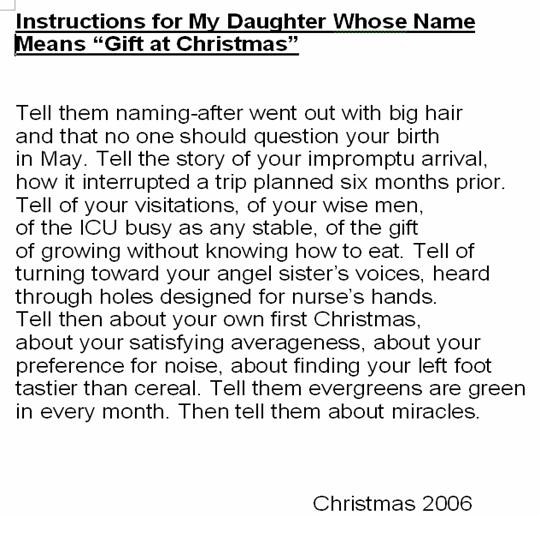
The best to you and your families, oh my 6 loyal readers, at this very special time of year.
Wednesday, December 13, 2006
Week Two, Book Five - Later
Two weeks between posts? Ugh. So many good excuses that I will not bore you with.
Fifth entry is coming, Meanwhile, entertain yourselves with this surprisingly good anthology of Winter Poems compiled by Bob and Margery at About.com.
Your patience is appreciated.
Fifth entry is coming, Meanwhile, entertain yourselves with this surprisingly good anthology of Winter Poems compiled by Bob and Margery at About.com.
Your patience is appreciated.
Friday, December 01, 2006
Five Books, The Fourth
I have a multilayered ulterior motive in recommending Coleman Barks’ Club – Granddaughter Poems. This work, inspired directly by the author's interactions with his granddaughter Briny has some fine moments, such as the book’s opening, No Finale, which starts
If I were dying, or if I were convinced
I were dying soon, say within a year, if
I were told so by doctors, I would write
a bunch of poems out of my nervousness
and my love for being here.
The line breaks that make this opening all about the narrator (note the prominence of the “I” in the first three lines - this is clearly conscious, as there is no "I" in Coleman Barks) contrast immediately with the observations and direct quotes of the young granddaughter, as in “In Opening Game Day Traffic”, where Briny explains football (spacing of the first line is off):
...You
pass the ball between your legs, you
go hurt somebody, then you start over.
I hate to sell it short with descriptions like “charming”, because there is craft here (especially in Briny’s drawings of imaginary composite animals), but “charming” is often what gets the casual reader across the threshold into a poem. And here is my mild deception: Once the casual reader is familiar with this small volume, she or he may spy the name Coleman Barks and find themselves purchasing Gourd Seed, or borrowing The Essential Rumi from the library. Then they’ll have, without noticing, slipped and fallen headlong into a world of poetry they’d have walked by without seeing not so long before.
Next up: Book Five and the Honorable Mentions. Which is not a bad name for a rock band. One composed of librarians and county fair judges, of course, but no one rocks like a librarian.
Subscribe to:
Posts (Atom)