At this Sunday's Celebration of NJ Literary Journals (plus a few neighbors), 24 poets will represent 12 magazines. And those so represented and representing will be:
For US 1 Worksheets: Wanda Praisner, Nancy Scott
For Exit 13: Adele Kenny, John Larkin
For Mad Poets Review: Autumn Konopka, Rachel Bunting
For Heliotrope: Cindy Savett, Michael T. Young
For Journal of New Jersey Poets: Sandra Duguid, Alison Nguyen
For Lips: Stanley Barkan, Jim Gwyn
For New York Quarterly: Peter Arcese, Ira Joe Fisher
For Painted Bride Quarterly: Nicole Hefner, Sanjana Nair
For Tiferet: Priscilla Orr, Edwin Romond
For Home Planet News: Roberta Gould, Robert Milby
For Edison Literary Review: Madeline Tiger, David Vincenti
For Paterson Literary Review: Svea Barrett, Joe Weil
And yes, it's THAT Ira Joe Fisher.
More links if I get a chance, which means probably not.
But come anyway!
Thursday, May 17, 2007


Friday, May 11, 2007
In which we get to the point
Shanna Compton has a very good essay up at PoetryFoundation.org.
The severalth annual Celebration of NJ Journals is coming up soon.
The talented and generous Maria Gillan has a new book out.
The next season of Spoken Word Series will be announced next Friday. Smaller? Yes. More power per unit poet? Geeky, but guaranteed.
This weekend is Mother's Day. Go here for ideas, but skip the Plath.
Back to regularity soon.
The severalth annual Celebration of NJ Journals is coming up soon.
The talented and generous Maria Gillan has a new book out.
The next season of Spoken Word Series will be announced next Friday. Smaller? Yes. More power per unit poet? Geeky, but guaranteed.
This weekend is Mother's Day. Go here for ideas, but skip the Plath.
Back to regularity soon.
Friday, April 20, 2007
In Which We Offer a Random Assortment of Things Which Have Occurred To Us But Which We Have Not Had Time To Trim To A Length Shorter Than This Title.
As usual, many good excuses for my absence. As usual, I will keep them to myself. Stuff:
- I hereby declare May to be NaProPoMo (National Procrastinating Poets' Month). Not that I'm procrastinating per se, but that's when I'll get some time to execute my poem-a-day thing. Look at it this way: I'm challenging myself to complete one more poem than all the folks who actually did their thing on time.
- Even though I haven't really done anything with PoWriMo yet, I did say I would get a draft up "soon" (geologically speaking). Well, here:
(Sorry, Deleted)
- Just in case you're interested to know what I do with all that time I'm not writing poems (when I'm not spending it with my family, of course), let me mention that I'll be presenting in the poster session at the Project Management Institute of New Jersey's symposium on Sustainable Project Management on May 7. I'll have a great handout describing a simple tool you can use to assess the sustainability of an individual's contribution to your PM talent pool. Be sure and say hi when you stop by, all you project-managing poets, you.
- No, I haven't given up on my chess thesis. But I have been playing a lot of chess against the computer, and I remain convinced my position will hold water once I articulate it. Whenever that turns out to be.
- Recently heard from the always-impactful Meg Kearney that the Solstice Summer Writers’ Conference is still accepting applications. Poetry instructors are Naomi Ayala, Kurt Brown, Cornelius Eady, A. Van Jordan. Go sign up now.
That's my 8 minutes of on-line time for tonight. More to come, approximately soonish.
Saturday, March 24, 2007
All out of Sprynch
Spring/Synch, get it? Snow all over my yard, but it's spring, and that's a great analogy for how I'm managing my time right now?
Yeah, that's about how organized my writings are at the moment. Which is why I haven't posted my chess/poetry thesis again. Tom's comments deserve a response that has been decently proofread.
Anyway, this doesn't mean good things aren't happening.
Yeah, that's about how organized my writings are at the moment. Which is why I haven't posted my chess/poetry thesis again. Tom's comments deserve a response that has been decently proofread.
Anyway, this doesn't mean good things aren't happening.
- Check out the end of the 06-07 season of the Spoken Word Series.
- Take a look at this year's writing workshop at The Center for the Performing Arts at DeBaun Auditorium and the three awesome instructors we have for you.
- Set aside May 20 for what may be the best annual poetry event in New Jersey (and I'm not just saying that because Dodge and the Warren County are biennial or because I'm actually performing in this one)
I've also got my manuscript distilled to pithy chapbook form for spring deadlines (and am understanding its weaknesses more now), I have the 07-08 season of the series in Hoboken just about booked, and have actually transcribed my "notebook" (a tape recorder I usually do my composing on) for the first time in 6 months. So there's stuff, just not organized enough to tell you about today. I'm even feeling up to posting a draft next time. Just to see how good Jeannine's mood really is (Just kidding!).
See you next weekend.
Friday, March 16, 2007
I guess she knows the old man's a poet?
So we're sitting in the living room doing a Mad Lib with one of the kids scribing. We go around and around with the nouns and the numbers until she asks her mother for an adverb. Mommy hesitates for the slightest of instants, and the little one jumps in with "That's OK. Daddy can do that one."
Needless to say, Mommy came up with an adverb.
And now if you'll excuse me, I'm off for some upside-down hog with snuggled cream.
Needless to say, Mommy came up with an adverb.
And now if you'll excuse me, I'm off for some upside-down hog with snuggled cream.
Tuesday, March 06, 2007
I haven't wandered off...
... but I haven't had time for much reprocessing, and Tom's got me thumbing the chess books I've never actually read. I will get back to my parallels between chess and poetry - I still think they're there, but I want to reformulate my explanation, but in the meantime, please amuse yourselves with this terrific post over at Defective Yeti on the revitalizing of cliches.
The post was made sweeter for me when I saw David Lamotte's name - David, who does not live near me, was one of the first unexpected audience members to follow a link or an add to a Spoken Word Series event in Hoboken. He's a gifted songwriter, and he read a lyric of his "The Water's Gonna Win" as a poem in our open mic period, and it was good stuff.
The small world at work. Back soon.
The post was made sweeter for me when I saw David Lamotte's name - David, who does not live near me, was one of the first unexpected audience members to follow a link or an add to a Spoken Word Series event in Hoboken. He's a gifted songwriter, and he read a lyric of his "The Water's Gonna Win" as a poem in our open mic period, and it was good stuff.
The small world at work. Back soon.
Friday, February 23, 2007
The exchange before midpoem
Well, Tom's got me reprocessing this theory before I've even exchanged a pawn for a participle, but let's continue.
In chess, the transition from opening to midgame is marked by an exchange of pieces, intitiated by the sacrifice of a piece for the purpose of clearing out and ultimately assuming a controlling posture toward (though not necessary controlling position in) the middle of the board. It is marked by the beginning of development of more powerful pieces for use in midgame.
Before we get to the development of the powerful pieces, let's discuss the transition, the exchange. How is this akin to writing poems? My contention is that more successful poems tend to operate from a vulnerable position - confessional exposure being the most obvious and most overused. If you're willing to think ahead with me and anticipate that a good poem has to leave itself open in anticipation of a surprise somewhere in it (like a well-played chess game will at some point deviate from mere parroting of the great players), then the first transition of that poem is the conscious direction that creates the opportunity for surprise. The sacrifice of a bishop to radically and blatantly disrupt the center defenses may be similar to the driving home of the poem's idea through a repetition of word and image.
Or, maybe, the transition is the deliberate clearing of the space around the poem's opening that makes taking it in a new direction possible. On the chess board, this could be exchange of pawns and knights that leaves the middle empty for the queen to take over. In the poem, this is discarding of the details not central to the poem's thesis that leave the metaphor available for detail and embellishment.
Just like the meaning of a chess move can only be interpreted in the context of the style of the player, the meaning of a poetry development can only be interpreted in the context of the style of the poet. Similarly, a single poet's/player's style can change from poem/game to poem/game.
Next up: me bouncing off your comments.
Following that: Midpoem.
In chess, the transition from opening to midgame is marked by an exchange of pieces, intitiated by the sacrifice of a piece for the purpose of clearing out and ultimately assuming a controlling posture toward (though not necessary controlling position in) the middle of the board. It is marked by the beginning of development of more powerful pieces for use in midgame.
Before we get to the development of the powerful pieces, let's discuss the transition, the exchange. How is this akin to writing poems? My contention is that more successful poems tend to operate from a vulnerable position - confessional exposure being the most obvious and most overused. If you're willing to think ahead with me and anticipate that a good poem has to leave itself open in anticipation of a surprise somewhere in it (like a well-played chess game will at some point deviate from mere parroting of the great players), then the first transition of that poem is the conscious direction that creates the opportunity for surprise. The sacrifice of a bishop to radically and blatantly disrupt the center defenses may be similar to the driving home of the poem's idea through a repetition of word and image.
Or, maybe, the transition is the deliberate clearing of the space around the poem's opening that makes taking it in a new direction possible. On the chess board, this could be exchange of pawns and knights that leaves the middle empty for the queen to take over. In the poem, this is discarding of the details not central to the poem's thesis that leave the metaphor available for detail and embellishment.
Just like the meaning of a chess move can only be interpreted in the context of the style of the player, the meaning of a poetry development can only be interpreted in the context of the style of the poet. Similarly, a single poet's/player's style can change from poem/game to poem/game.
Next up: me bouncing off your comments.
Following that: Midpoem.
Sunday, February 18, 2007
Poetry Like Chess: The Opening
(Disclaimer: By objective standards, I qualify as "advanced amateur" in both poetry and chess)
Accept for this discussion that a chess game develops in a series of known phases: The opening, the midgame and the endgame, with definable transitions between each phase pair. I know some will resist this idea, but this is really not a bad analog for a poem. Poems require compelling openings, precise and developing middles, and impactful (or at least calculated) endings.
Though poetry has the advantage over chess in number of potential openings, it is greatly similar in one way: a wildly unconventional opening portends either genius or the beginning of an unpredictable uneven ride.
Let us take "opening" in this case to mean "stage setting". On offense or defense in chess, a good player is thinking several moves ahead, positioning pieces not for where they need to be now, but where they need to be in the future. And anticipating where the opponent expects them to be and meeting that expectation in one of two ways: Either by presenting the opponent with something different, something surprising but still part of her plan, or by accepting the opponent's expectation, but with a level of preparedness that leaves no square of the board unaccounted for in its depth of planning.
Is this all that different than writing a poem? I know we want to believe that we follow the poem to where it wants to lead us, but I think this isn't entirely dissimilar from playing off a good opponent across the chess board. You have a plan, and you execute that plan, adjusting it continuously as you receive input and opposition. In the case of a poem, we often provide the input and opposition internally, maybe subconsciously, but we are reacting in real time to our own words as they develop on the page before us - the point at which they stop being our property and start belonging to the poem. It is that point at which they are most like the moves of our opponent on the chess board; even if we have anticipated their move perfectly, we are still reacting to it - choosing to keep with our plan or depart from it.
Some chess openings are accepted convention (Ruy Lopez, Ponziani), some are more radical than others, and some require more skills (particularly those that develop the queen early). Again, here, this isn't all that different from the writing process: We can choose to employ standard, or favorite, or accepted openings, or ones that are challenge the reader (the opponent?) to play along with us. A good chess player will decide by the 4th move if the opponent has the skills to make the game competitive. How many times have you decided by the 4th line of a poem that it was not crafted with sufficient skill to be meaningful or useful to you? How many of your own poems have you tolerated past a weak 4th line, ignoring your own awareness that it was weak?
Understand I'm not saying that an unconventional opening, or an aggressive or challenging one is a bad thing - merely that it requires greater skill to pull off effectively. And that discarding convention merely as an act of anarchy is a sure way to lose the reader, and make the challenge of completing the poem very, very difficult.
If I can figure a way to do so meaningfully, next up will be examples. Down the road a piece is: Transition one: The first sacrifice.
Accept for this discussion that a chess game develops in a series of known phases: The opening, the midgame and the endgame, with definable transitions between each phase pair. I know some will resist this idea, but this is really not a bad analog for a poem. Poems require compelling openings, precise and developing middles, and impactful (or at least calculated) endings.
Though poetry has the advantage over chess in number of potential openings, it is greatly similar in one way: a wildly unconventional opening portends either genius or the beginning of an unpredictable uneven ride.
Let us take "opening" in this case to mean "stage setting". On offense or defense in chess, a good player is thinking several moves ahead, positioning pieces not for where they need to be now, but where they need to be in the future. And anticipating where the opponent expects them to be and meeting that expectation in one of two ways: Either by presenting the opponent with something different, something surprising but still part of her plan, or by accepting the opponent's expectation, but with a level of preparedness that leaves no square of the board unaccounted for in its depth of planning.
Is this all that different than writing a poem? I know we want to believe that we follow the poem to where it wants to lead us, but I think this isn't entirely dissimilar from playing off a good opponent across the chess board. You have a plan, and you execute that plan, adjusting it continuously as you receive input and opposition. In the case of a poem, we often provide the input and opposition internally, maybe subconsciously, but we are reacting in real time to our own words as they develop on the page before us - the point at which they stop being our property and start belonging to the poem. It is that point at which they are most like the moves of our opponent on the chess board; even if we have anticipated their move perfectly, we are still reacting to it - choosing to keep with our plan or depart from it.
Some chess openings are accepted convention (Ruy Lopez, Ponziani), some are more radical than others, and some require more skills (particularly those that develop the queen early). Again, here, this isn't all that different from the writing process: We can choose to employ standard, or favorite, or accepted openings, or ones that are challenge the reader (the opponent?) to play along with us. A good chess player will decide by the 4th move if the opponent has the skills to make the game competitive. How many times have you decided by the 4th line of a poem that it was not crafted with sufficient skill to be meaningful or useful to you? How many of your own poems have you tolerated past a weak 4th line, ignoring your own awareness that it was weak?
Understand I'm not saying that an unconventional opening, or an aggressive or challenging one is a bad thing - merely that it requires greater skill to pull off effectively. And that discarding convention merely as an act of anarchy is a sure way to lose the reader, and make the challenge of completing the poem very, very difficult.
If I can figure a way to do so meaningfully, next up will be examples. Down the road a piece is: Transition one: The first sacrifice.
Wednesday, January 31, 2007
Spam, Amy Holman, and Ruy Lopez
(wherein we celebrate Ms. Holman's return to the blogging world with a sincere but ridiculous title).
(1) Re: Spam, let me say that I have received my favorite bit of unsolicited kilobytes in quite some time. Apparently, an underintelligent bot, presumably through entries like this, has flagged me as a Dodge enthusiast.
Dear blog author:
They do promise they will not "send this message (any) more than twice... intentionally". For the record, this is a Ford house, sir. At least until the next recall.
(2) Re: Amy Holman, a comment below and a fresh post over at Literadog lead me to believe that Amy is over computer issues and back to her infrequent but in-depth commentary on publications publishing. Her most recent commentary (on The Potmac Review) shows why we should value the opinion of this author and teacher so highly: she speaks with passion and intelligence on just about all literary fronts.
And (3) Re: Ruy Lopez, consider this, the opening gamibt (if you will) of my comparison between playing chcess and writing a poem: There are many ways to open a chess game. Most are conventional, and will take you to conventional gameplay if you let them. Some are unconventional, and will take you to game situations which can be fascinating or brutal - or both.
Get where I'm going, yet?
(1) Re: Spam, let me say that I have received my favorite bit of unsolicited kilobytes in quite some time. Apparently, an underintelligent bot, presumably through entries like this, has flagged me as a Dodge enthusiast.
Dear blog author:
We recently came across your site, cosmicliverwurst.blogspot.com, while searching for bloggers who blog about Dodge issues.
A small group of us have started a new site called http://www.dodge-bloggers.com">Dodge Bloggers . Our intent is to bring Dodge bloggers closer together, and make a positive contribution to the Internet community.
They do promise they will not "send this message (any) more than twice... intentionally". For the record, this is a Ford house, sir. At least until the next recall.
(2) Re: Amy Holman, a comment below and a fresh post over at Literadog lead me to believe that Amy is over computer issues and back to her infrequent but in-depth commentary on publications publishing. Her most recent commentary (on The Potmac Review) shows why we should value the opinion of this author and teacher so highly: she speaks with passion and intelligence on just about all literary fronts.
And (3) Re: Ruy Lopez, consider this, the opening gamibt (if you will) of my comparison between playing chcess and writing a poem: There are many ways to open a chess game. Most are conventional, and will take you to conventional gameplay if you let them. Some are unconventional, and will take you to game situations which can be fascinating or brutal - or both.
Get where I'm going, yet?
Thursday, January 25, 2007
Book Five: Anthologus Majorus
So I've been trying to decide on an anthology to end my little series of recommendations that people NOT intimate with the art of poetry should try. I keep coming back to Poetry 180, not necessarily because it's a great collection (it's pretty good), but because it seems to be the book most consistent with my purpose: To expose people who "like poetry but don't always get it" (the excuse I hear most often) to good work of a style or set of styles that they can appreciate at two levels: the first, sheer entertainment; the second, the emergence of the details of craft.
A poem like Gouge, Adze, Rasp, Hammer is first an interesting read, next a good springboard to talk about concretness of language. Cartoon Physics, Part 1 is a poem almost anyone can inhabit, but it's also a great vehicle to talk about how unique connection and observation is at the center of all good poems. The exposure to form is purposeful and obvious (to a poet), but it is not intimidating or didactic. It's not the reason most people stop reading poetry as high school sophomores.
180 More has better poems, I think, but they're smirkier. There are more inside jokes, more poems for poets to share with each other. The uninitiated can go from 180 to More, but I don't see More hooking them in the same way.
Looking back over my list, I'm satisfied that my recommendations are what I set out for them to be - good poems in collections that hang together well that kick open doors and encourage people to walk through them. I hope you approve.
Next up: had a short exchange with Jeff about (how I perceive) a similarity in attacking technical work and poetic work. I think that to say the two are somewhat dissimilar is fair. But to say that the two attacks share neither strategy nor tactics does disservice to both writing process and engineering innovation. I think I can sway you.
However, I don't think you, oh my 6 loyal readers, are disposed to that argument just yet. So next up is a transition point: Why writing good poetry is like playing chess well.
Anyone want to try to get in front of me on this one?
A poem like Gouge, Adze, Rasp, Hammer is first an interesting read, next a good springboard to talk about concretness of language. Cartoon Physics, Part 1 is a poem almost anyone can inhabit, but it's also a great vehicle to talk about how unique connection and observation is at the center of all good poems. The exposure to form is purposeful and obvious (to a poet), but it is not intimidating or didactic. It's not the reason most people stop reading poetry as high school sophomores.
180 More has better poems, I think, but they're smirkier. There are more inside jokes, more poems for poets to share with each other. The uninitiated can go from 180 to More, but I don't see More hooking them in the same way.
Looking back over my list, I'm satisfied that my recommendations are what I set out for them to be - good poems in collections that hang together well that kick open doors and encourage people to walk through them. I hope you approve.
Next up: had a short exchange with Jeff about (how I perceive) a similarity in attacking technical work and poetic work. I think that to say the two are somewhat dissimilar is fair. But to say that the two attacks share neither strategy nor tactics does disservice to both writing process and engineering innovation. I think I can sway you.
However, I don't think you, oh my 6 loyal readers, are disposed to that argument just yet. So next up is a transition point: Why writing good poetry is like playing chess well.
Anyone want to try to get in front of me on this one?
Saturday, January 06, 2007
Excuses, Shmexcuses...
Brief summary:
- Holiday houseguests
- unexpected project(s)
- a four-day Christmas (typical)
- unexpected project(s) for the Mrs.
- 60% of the house sick with something (at least one double pink-eye sinus-infection whammy)
- expected project(s)
- Essential Love, 180 More, a pile of BAPs, et al. in a pile waiting for me to finish my little project.
I mean, really.
I'm online about 8 minutes a day right now, so if you're waiting for something from me, well... sorry. As a peace offering, here's a recent discovery that you'll enjoy if you share my interest in the writing process: http://wordswimmer.blogspot.com/.
Be back soon.
Monday, December 18, 2006
Interlude 2: A Note For Christmas
While I'm determined to select an anthology for Book 5, I also know there's no way I'll get to that and do it justice this week. Therefore, we take another interlude in which I offer you my annual Christmas poem. Past years' installments ("The Donkey Tells the Story", and "Prayer Before Starting to Assemble the Rugged Tykes(tm) Free-Standing Play Kitchen With RealGlow(tm) Microwave Action", for example) are available for the price of one holiday greeting.
{Sorry - this poem has been removed. Please email me if you're interested in seeing it}
The best to you and your families, oh my 6 loyal readers, at this very special time of year.
{Sorry - this poem has been removed. Please email me if you're interested in seeing it}
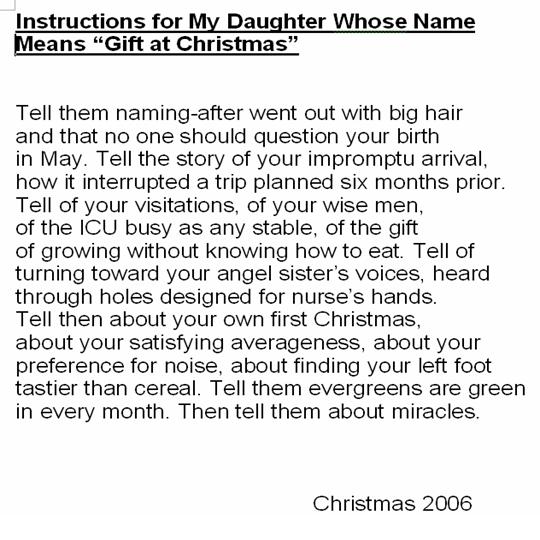
The best to you and your families, oh my 6 loyal readers, at this very special time of year.
Wednesday, December 13, 2006
Week Two, Book Five - Later
Two weeks between posts? Ugh. So many good excuses that I will not bore you with.
Fifth entry is coming, Meanwhile, entertain yourselves with this surprisingly good anthology of Winter Poems compiled by Bob and Margery at About.com.
Your patience is appreciated.
Fifth entry is coming, Meanwhile, entertain yourselves with this surprisingly good anthology of Winter Poems compiled by Bob and Margery at About.com.
Your patience is appreciated.
Friday, December 01, 2006
Five Books, The Fourth
I have a multilayered ulterior motive in recommending Coleman Barks’ Club – Granddaughter Poems. This work, inspired directly by the author's interactions with his granddaughter Briny has some fine moments, such as the book’s opening, No Finale, which starts
If I were dying, or if I were convinced
I were dying soon, say within a year, if
I were told so by doctors, I would write
a bunch of poems out of my nervousness
and my love for being here.
The line breaks that make this opening all about the narrator (note the prominence of the “I” in the first three lines - this is clearly conscious, as there is no "I" in Coleman Barks) contrast immediately with the observations and direct quotes of the young granddaughter, as in “In Opening Game Day Traffic”, where Briny explains football (spacing of the first line is off):
...You
pass the ball between your legs, you
go hurt somebody, then you start over.
I hate to sell it short with descriptions like “charming”, because there is craft here (especially in Briny’s drawings of imaginary composite animals), but “charming” is often what gets the casual reader across the threshold into a poem. And here is my mild deception: Once the casual reader is familiar with this small volume, she or he may spy the name Coleman Barks and find themselves purchasing Gourd Seed, or borrowing The Essential Rumi from the library. Then they’ll have, without noticing, slipped and fallen headlong into a world of poetry they’d have walked by without seeing not so long before.
Next up: Book Five and the Honorable Mentions. Which is not a bad name for a rock band. One composed of librarians and county fair judges, of course, but no one rocks like a librarian.
If I were dying, or if I were convinced
I were dying soon, say within a year, if
I were told so by doctors, I would write
a bunch of poems out of my nervousness
and my love for being here.
The line breaks that make this opening all about the narrator (note the prominence of the “I” in the first three lines - this is clearly conscious, as there is no "I" in Coleman Barks) contrast immediately with the observations and direct quotes of the young granddaughter, as in “In Opening Game Day Traffic”, where Briny explains football (spacing of the first line is off):
...You
pass the ball between your legs, you
go hurt somebody, then you start over.
I hate to sell it short with descriptions like “charming”, because there is craft here (especially in Briny’s drawings of imaginary composite animals), but “charming” is often what gets the casual reader across the threshold into a poem. And here is my mild deception: Once the casual reader is familiar with this small volume, she or he may spy the name Coleman Barks and find themselves purchasing Gourd Seed, or borrowing The Essential Rumi from the library. Then they’ll have, without noticing, slipped and fallen headlong into a world of poetry they’d have walked by without seeing not so long before.
Next up: Book Five and the Honorable Mentions. Which is not a bad name for a rock band. One composed of librarians and county fair judges, of course, but no one rocks like a librarian.
Friday, November 24, 2006
Interlude
I'm so full of my stuffing I can't bear the thought of turning my brain on, but just in case you overate less than I and are looking for a little something, here are two links that showed up in my email recently and which are work a look:
Josh Wallaert at the University of Minnesota has a new blog in which he posts entries from the first edition of Webster's American Dictionary (1828). I was skeptical of his claim to their being "found poems" until I read the entry for "badger":
Badger, n.
A quadruped of the genus Ursus, of a clumsy make, with short, thick legs, and long claws on the fore feet. It inhabits the north of Europe and Asia, burrows, is indolent and sleepy, feeds by night on vegetables, and is very fat.
Its skin is used for pistol furniture; its flesh makes good bacon, and its hair is used for brushes to soften the shades in painting. The American badger is called the ground hog, and is sometimes white.
Fun stuff. If you're interested at all in the evolution of language (and if you're a regular here, my guess is that you are), check out Webster's Daily.
Also. Martha Brockenbrough has a new column on playing with kids over at Cranium.com: "In The Name of Fun". First of all, everything Cranium does is bound to be cool, but Martha's spins are always entertaining and she's got a gift for capturing the parental epiphany.
From the first entry:
If you’re reading this, I’m guessing you have kids. That means you could be doing dishes right now. You could be picking up dirty socks, or maybe signing permission slips, driving to soccer practice, or encouraging someone — anyone? Please? — to practice good oral hygiene.
Honestly though, I hope you’re taking this moment for yourself, because that’s what I’m doing.
Bound to become part of my weekly checklist.
That's it. I can't think anymore. I wonder if there's any more apple-cranberry jam....
Josh Wallaert at the University of Minnesota has a new blog in which he posts entries from the first edition of Webster's American Dictionary (1828). I was skeptical of his claim to their being "found poems" until I read the entry for "badger":
Badger, n.
A quadruped of the genus Ursus, of a clumsy make, with short, thick legs, and long claws on the fore feet. It inhabits the north of Europe and Asia, burrows, is indolent and sleepy, feeds by night on vegetables, and is very fat.
Its skin is used for pistol furniture; its flesh makes good bacon, and its hair is used for brushes to soften the shades in painting. The American badger is called the ground hog, and is sometimes white.
Fun stuff. If you're interested at all in the evolution of language (and if you're a regular here, my guess is that you are), check out Webster's Daily.
Also. Martha Brockenbrough has a new column on playing with kids over at Cranium.com: "In The Name of Fun". First of all, everything Cranium does is bound to be cool, but Martha's spins are always entertaining and she's got a gift for capturing the parental epiphany.
From the first entry:
If you’re reading this, I’m guessing you have kids. That means you could be doing dishes right now. You could be picking up dirty socks, or maybe signing permission slips, driving to soccer practice, or encouraging someone — anyone? Please? — to practice good oral hygiene.
Honestly though, I hope you’re taking this moment for yourself, because that’s what I’m doing.
Bound to become part of my weekly checklist.
That's it. I can't think anymore. I wonder if there's any more apple-cranberry jam....
Monday, November 20, 2006
Five Books, Part III
Tina Kelley’s poems consistently contain two of the qualities that are essential to successful, memorable poetry: they apply language in a precise manner, conscious of both sound and definition, and they make extraordinary observations in unexpected places. Further, she is playful in both situation and voice, which showcases those essential qualities in novel, often fascinating ways. In The Gospel of Galore, her first book, she imagines a letter from God to humanity, considers labrador retrievers as both Gods and a school teacher, and projects herself as the blood in her lover’s veins and as a kite. Kelley’s passion for precision is incredible, and her deeply developed sense of wonder are simply unmatched; this uncommon combination makes her an essential read for people who are exploring poetry’s capabilities.
In “The Word Kite”, Kelley uses names from other languages to capture the way we sometimes describe things that are difficult to describe:
In Italian, it’s cervo volente, flying red deer. In French, flying stag.
In Germany, it’s the same word as dragon. In Japan, octopus.
The Spanish cometa suggests the stars, and fengzheng, in China,
is the wind’s stringed instrument. Kite for us is predatory bird,
from the Old English cyta, for which “no related word appears
in the cognate languages,” though we know now that kites
were once used by virgins, midwives and surviving twin sisters
to hang their laundry up to dry.
She routinely asks questions that are anything but routine, as in “I Love A Man Who Gave Blood Thirty Times”:
And everywhere I go, I think Do you have a pint of him, honey?
Does the sweet health and consideration running through him
run through you, too?
The Gospel of Galore contains also a number of poems based on bird names, birdsong, and almost-found poems from old Audobon guides, and makes magnificent connections, such as “Other Names”:
Remind me of the Scrabble words when I have too few vowels:
the strany, the tysty, wagell and wamp. Particularly the quandy,
the marrock willock scuttock, kelinky,
murre and gwilym, kiddaw and skiddaw.
Tina Kelley crafts poems to hang in the corners of rooms that most people would walk through without stopping, poems that create moments that become irreplaceable, once you become aware of them. Word on the street is that she has another book ready for a smart publisher to snap up. I'll be first in line with my preorder.
Next up: Something from outside New Jersey.
In “The Word Kite”, Kelley uses names from other languages to capture the way we sometimes describe things that are difficult to describe:
In Italian, it’s cervo volente, flying red deer. In French, flying stag.
In Germany, it’s the same word as dragon. In Japan, octopus.
The Spanish cometa suggests the stars, and fengzheng, in China,
is the wind’s stringed instrument. Kite for us is predatory bird,
from the Old English cyta, for which “no related word appears
in the cognate languages,” though we know now that kites
were once used by virgins, midwives and surviving twin sisters
to hang their laundry up to dry.
She routinely asks questions that are anything but routine, as in “I Love A Man Who Gave Blood Thirty Times”:
And everywhere I go, I think Do you have a pint of him, honey?
Does the sweet health and consideration running through him
run through you, too?
The Gospel of Galore contains also a number of poems based on bird names, birdsong, and almost-found poems from old Audobon guides, and makes magnificent connections, such as “Other Names”:
Remind me of the Scrabble words when I have too few vowels:
the strany, the tysty, wagell and wamp. Particularly the quandy,
the marrock willock scuttock, kelinky,
murre and gwilym, kiddaw and skiddaw.
Tina Kelley crafts poems to hang in the corners of rooms that most people would walk through without stopping, poems that create moments that become irreplaceable, once you become aware of them. Word on the street is that she has another book ready for a smart publisher to snap up. I'll be first in line with my preorder.
Next up: Something from outside New Jersey.
Thursday, November 09, 2006
Five Books of Poetry Everyone Should Read, Part Two
Bill Watterson once remarked (through his alter-ego Calvin) that “People who are nostalgic for childhood were obviously never children". Catherine Doty’s book Momentum proves that statement wrong. In her poems, Doty deals turns the fear and anxiety of childhood into funny and powerful moments without resorting to imposing her the filter and judgment of adult voice on her former self.
In “For May is the Month of Our Mother”, she recalls what she learned from breaking a statue of Mary:
… I learned then to use something right
or leave it alone. No, I didn’t. I learned twelve-inch Virgin,
polystyrene, luminous ivory, black beads in screw-off bottom
ran $4.95, or twenty weeks of allowance.
In “Curriculim Vitae”. she inverts the normal model for this summary of a life by listing all its mistakes, instead of its successes:
… All the attempts,
like the fish tanks of your childhood,
begun in eager greed and soon to fail,
twenty-five gallons of well-lit bouillabaisse.
This book is filled with characters she feared and loved, imitated and avoided, and they will be familiar to you whether or not you have in your past a neighbor who recorded her son’s BMs on a calendar in the kitchen. You’ll have to get the book for that one.
But for me, the real magic of this book is that it creates metaphorical moments without betraying its sentiment, applies skillful use of language without contriving the behavior or speech of the remembered characters it presents to us.
Momentum is a book I insist people read before they tell me they “don’t like poetry”. It has changed minds, believe me. Don’t make me come over there and read it to you.
Next in our series: Tina Kelley and The Gospel of Galore.
In “For May is the Month of Our Mother”, she recalls what she learned from breaking a statue of Mary:
… I learned then to use something right
or leave it alone. No, I didn’t. I learned twelve-inch Virgin,
polystyrene, luminous ivory, black beads in screw-off bottom
ran $4.95, or twenty weeks of allowance.
In “Curriculim Vitae”. she inverts the normal model for this summary of a life by listing all its mistakes, instead of its successes:
… All the attempts,
like the fish tanks of your childhood,
begun in eager greed and soon to fail,
twenty-five gallons of well-lit bouillabaisse.
This book is filled with characters she feared and loved, imitated and avoided, and they will be familiar to you whether or not you have in your past a neighbor who recorded her son’s BMs on a calendar in the kitchen. You’ll have to get the book for that one.
But for me, the real magic of this book is that it creates metaphorical moments without betraying its sentiment, applies skillful use of language without contriving the behavior or speech of the remembered characters it presents to us.
Momentum is a book I insist people read before they tell me they “don’t like poetry”. It has changed minds, believe me. Don’t make me come over there and read it to you.
Next in our series: Tina Kelley and The Gospel of Galore.
Saturday, November 04, 2006
A List that Reaches Out, Not In
I was checking out Wil Wheaton’s “Five Books Every Geek Should Read"* when something struck me: It’s been a theme among the bloggers I follow recently to talk about what’s important about “us” to “us”. Like geek books for geeks, poetry books for poets, modern philosophy books for modern philosophers, etc.
Maybe I’m unique, but rather than publishing possible credentials for membership in a club I’m already in, I’m more interested in being an ambassador of sorts for people outside the club. I find myself in this position naturally a lot anyway: I’m more deeply involved in the arts than many of my business and technical colleagues, but more aware of issues in business and technology than my artist friends; my personal politics are way to the left of most of my family, and way to the right of most of the people I encounter in the pursuit of poetry; I’m by profession and nature a developer of new products and new ideas, but I’m by hobby (inherited from my father) a student of the past and an occasionally voracious reader of history, etc., etc., etc.
All of which is a long way of saying: Hey, Wil Wheaton, as respected and linguistically gifted ubergeek, how about a list of 5 Books People Who Want to Know More About Geeks Should Read, That They’ll Find Enough Interesting Content in to Want to Finish, but Which Are Representative Enough of Geekdom to Reach Them and Hopefully Change Them a Little?
Granted, that’s a crappy title for a blog entry, but you know what I mean.
Let me put my money where my mouth is and give you “Five Books of Poetry Everyone Should Read”, with the idea that it will be a bibliography of reasonable length which I suggest you read before you attempt to credibly tell me that you “don’t like poetry”.
I want to roll this out one book at a time with enough exposition to be meaningful, and this entry is already 3 scroll-clicks too long, so the first selection is short with more to come later:
First up, the shortest collection in the bunch and therefore the least intimidating place to start, is BJ Ward’s 17 Love Poems with No Despair. The title is an obvious nod to Neruda, but the collection is a Whitman’s Sampler of love poems that have something for everyone. My favorite opening lines, from “Coffee”:
Honey, I hate mornings
like a dead leg hates a polka
Within the covers of 17 Love Poems..., you'll find both classic themes and references to members of the Justice League of America. If you love now or have loved once, have read Neruda or have never read Neruda, know who Zan and Jana are or didn't watch ABC on Saturday mornings in the seventies, you will find something to impress you in this slender volume. More on this book in the wrap up entry at the end of the list, which I promise to you, my six devoted readers, will be less than eight weeks from now (which my geek friends have already projected base on the average post density over the past few months, making certain allowances for impending holidays but my artist friends think is ridiculous because of the obvious passion contained in this entry....).
Next entry, with a more meaningful treatment: Cat Doty’s Momentum.
* A quick note: You can get to Wil Wheaton’s column from the WWdN link at right, but be aware that his column is hosted by a website that contains some content your business, family, and maternal filters will find questionable, so I’ll leave it to you to go read the original list if you like
Maybe I’m unique, but rather than publishing possible credentials for membership in a club I’m already in, I’m more interested in being an ambassador of sorts for people outside the club. I find myself in this position naturally a lot anyway: I’m more deeply involved in the arts than many of my business and technical colleagues, but more aware of issues in business and technology than my artist friends; my personal politics are way to the left of most of my family, and way to the right of most of the people I encounter in the pursuit of poetry; I’m by profession and nature a developer of new products and new ideas, but I’m by hobby (inherited from my father) a student of the past and an occasionally voracious reader of history, etc., etc., etc.
All of which is a long way of saying: Hey, Wil Wheaton, as respected and linguistically gifted ubergeek, how about a list of 5 Books People Who Want to Know More About Geeks Should Read, That They’ll Find Enough Interesting Content in to Want to Finish, but Which Are Representative Enough of Geekdom to Reach Them and Hopefully Change Them a Little?
Granted, that’s a crappy title for a blog entry, but you know what I mean.
Let me put my money where my mouth is and give you “Five Books of Poetry Everyone Should Read”, with the idea that it will be a bibliography of reasonable length which I suggest you read before you attempt to credibly tell me that you “don’t like poetry”.
I want to roll this out one book at a time with enough exposition to be meaningful, and this entry is already 3 scroll-clicks too long, so the first selection is short with more to come later:
First up, the shortest collection in the bunch and therefore the least intimidating place to start, is BJ Ward’s 17 Love Poems with No Despair. The title is an obvious nod to Neruda, but the collection is a Whitman’s Sampler of love poems that have something for everyone. My favorite opening lines, from “Coffee”:
Honey, I hate mornings
like a dead leg hates a polka
Within the covers of 17 Love Poems..., you'll find both classic themes and references to members of the Justice League of America. If you love now or have loved once, have read Neruda or have never read Neruda, know who Zan and Jana are or didn't watch ABC on Saturday mornings in the seventies, you will find something to impress you in this slender volume. More on this book in the wrap up entry at the end of the list, which I promise to you, my six devoted readers, will be less than eight weeks from now (which my geek friends have already projected base on the average post density over the past few months, making certain allowances for impending holidays but my artist friends think is ridiculous because of the obvious passion contained in this entry....).
Next entry, with a more meaningful treatment: Cat Doty’s Momentum.
* A quick note: You can get to Wil Wheaton’s column from the WWdN link at right, but be aware that his column is hosted by a website that contains some content your business, family, and maternal filters will find questionable, so I’ll leave it to you to go read the original list if you like
Monday, October 23, 2006
The Dark Unmarked Waters
Just read on Josh's blog that Deborah Tall has died. The journal she led, Seneca Review, was the first publication I remember reading and thinking: "Wow. I wish I wrote like that." Of course, this was before I'd learned to experiment with my own style but still, fifteen years later, I've never produced anything I thought fit or merited inclusion in that journal. It's a home for the lyric essay, which is a fascinating form for me, having been trained repeatedly in the classical and technical essay. This post takes its title from one of Deborah's poems.
Had another of those moments recently where I mined an unpleasant memory for a poem idea. I'm actually pleased with the final product, but my internal editor is all over me to burn the thing before [subject person who would not appreciate the publicity] finds out what I've written. As is usual, the "real" portion of the memory is the rough diamond at the center of a highly fictionalized setting, but I don't think [subject person] would consider that appropriate mitigation. It's the old question: how to reach the larger audience and not chase away the local one. Or is this a question that only I ask?
Had another of those moments recently where I mined an unpleasant memory for a poem idea. I'm actually pleased with the final product, but my internal editor is all over me to burn the thing before [subject person who would not appreciate the publicity] finds out what I've written. As is usual, the "real" portion of the memory is the rough diamond at the center of a highly fictionalized setting, but I don't think [subject person] would consider that appropriate mitigation. It's the old question: how to reach the larger audience and not chase away the local one. Or is this a question that only I ask?
Monday, October 16, 2006
Food For Thought
Just got word that Diane Lockward's second full-length book is out. You may have heard her read at this year's Dodge Festival. She's quite a generous spirit, good for poetry on a number of levels, and an old friend of the Spoken Word Series. And I'm not just saying that in case I run into her at our local Shop-Rite...
Visit Diane's website or the Wind Publications site for more about What Feeds Us. Here's a sample, but you'll have to visit the book's page for more...
An Average Day for an Average Liar
The average person tells thirteen lies each day.
—Dr. Georgia Witkin
One, on a day much like any other, I awake with alarm
clock blaring, turn to you, and say, "Your face
is no longer imprinted on my heart."
Two, I aim a dart to the groin, say I’ve taken a paramour.
Visit Diane's website or the Wind Publications site for more about What Feeds Us. Here's a sample, but you'll have to visit the book's page for more...
An Average Day for an Average Liar
The average person tells thirteen lies each day.
—Dr. Georgia Witkin
One, on a day much like any other, I awake with alarm
clock blaring, turn to you, and say, "Your face
is no longer imprinted on my heart."
Two, I aim a dart to the groin, say I’ve taken a paramour.
Subscribe to:
Posts (Atom)